Inflammation in Chronic Disease
Phase 1
In recognition of the key role that inflammation plays in multiple chronic diseases, CIHR launched the Inflammation in Chronic Disease initiative aimed at understanding commonalities and differences between these chronic diseases with respect to the role that inflammation plays in their development, progression and complications. The vision of CIHR's Inflammation in Chronic Disease initiative, which was developed at the 2011 Inflammation in Chronic Disease Consensus Conference, was to establish new interdisciplinary teams that bring together groups of researchers who could undertake innovative research in the field of chronic inflammation. The Inflammation in Chronic Disease initiative also encompasses two other CIHR research initiatives, the Canadian Microbiome Initiative and the Transplantation Research Initiative.
Overview

Inflammation is the body’s immediate response to damage of its tissues and cells by pathogens, harmful stimuli, or physical injury. The inflammatory process is characterized by redness, swelling, an increase in temperature, loss of normal bodily function and pain. Nonetheless, inflammation is crucial to health. Without it, wounds and infections would never heal.
Inflammation can be either acute or chronic. Acute inflammation is the body’s initial response to harmful stimuli and involves increased movement of plasma and immune cells from the blood into injured tissues, followed by a cascade of biochemical reactions that promote the inflammatory response. It is a complex response that involves many players, including the local circulatory system, the immune system, various cells within the injured tissue, and in certain cases, the microbiome (the microorganisms existing in a particular part of the body). However, in prolonged, or chronic, inflammation, there is a shift in the type of cells present at the site of inflammation, and the simultaneous destruction and restoration of the tissue. Inflammation is also responsible for transplant rejection, which is a major obstacle in organ transplant procedures.
To date, researchers have made considerable progress in understanding the cellular and molecular events that are involved in the acute inflammatory response. However, the events that lead to localized or systemic chronic inflammation, such as chronic infections and autoimmune diseases, are only partly understood. There is an urgent need to set forward a national research initiative on Inflammation in Chronic Disease. Our aging society is facing a growing burden of chronic disease and a greater need for complex treatment approaches, resulting in increased health care costs and human suffering.
Key Research Needs

Existing research has already confirmed that an inflammatory response can be controlled at multiple levels, but there is still a lot to be learned about how inflammation is regulated. This is due in part to the complexity of the inflammatory response and the multitude of components and factors involved. However, there appear to be some common principles across different inflammatory diseases, and these commonalities may prove to be fundamental to inflammation itself. Researchers must explore these common principles further to help fill in the gaps in our understanding of the response.
Through the Inflammation in Chronic Disease initiative, CIHR will support research teams that look beyond individual diseases and conditions. By helping identify a unifying theory to explain chronic inflammatory states, these teams will lay the foundation for the development of interventions to reduce and alleviate diseases associated with inflammation.
Objectives
The goal of this initiative is to develop a unified, transformative Canadian strategy on inflammation. This initiative will support health research to accelerate the discovery and validation of common biomarkers, therapeutic targets, and inflammatory mechanisms among chronic diseases. The ultimate goal of this research will be to prevent and/or treat chronic disease by reducing inflammation and pain through novel interventions. The six major objectives of this initiative include:
- Understanding the mechanisms underlying tissue inflammation across chronic diseases, including following organ transplantation.
- Identifying biomarkers common to inflammatory diseases and potential therapeutic targets and treatments, including microbiota.
- Developing imaging strategies to detect and monitor the progression of inflammation and pain, and their responsiveness to treatment.
- Identifying interventions and effective programs for prevention of chronic disease and the pain associated with chronic disease.
- Providing an opportunity for the transplantation community to come together in a national research program that will lead to an increase in the quantity and quality of donor organs and improved long-term outcomes for transplant patients. Learn more about the Transplantation Research Initiative.
- Strengthening Canada’s role as a leader in the International Human Microbiome Consortium and providing valuable insights into the relationship between the microbiome, inflammation and a number of chronic diseases. Learn more about the Canadian Microbiome Initiative.
Desired Impacts
This initiative will make use of significant Canadian strengths in areas such as inflammation, biomarkers, pain, imaging, physical activity, transplantation and microbiome research. Additionally, the initiative will address the global objective of connecting research groups working in different chronic disease areas. In doing so, the initiative will help advance the research on common pathways and interventions in chronic disease, ultimately contributing to a unified Canadian chronic disease strategy. The initiative will achieve this through a variety of funding opportunities with a multi-disciplinary, multi-disease and multi-sectoral focus.
Phase 2
Building on previous investments, CIHR has now launched the Health Challenges in Chronic Inflammation – Phase 2 (HCCI2) initiative.
Overview of HCCI2
The HCCI2 Initiative, a $13.5M CIHR investment, aims to move beyond the current research silos and bring together the Canadian inflammation research community to collectively leverage the expertise of multiple disciplines, pillars of research, Institutes and partners. It will support a collaborative strategy on inflammation and will stimulate innovative health research approaches and translation of knowledge on shared pathways to prevent or reduce inflammation in chronic disease. This strategic investment aims to improve the health outcomes of Canadians, throughout their life cycle, in an equitable way that considers biological, social and individual characteristics, including but not limited to sex, gender, ethnicity and socioeconomic status.
The initiative will promote the integration of the following principles:
- Inter-disciplinary
- Translational
- Patient engagement
- Life trajectory
- Sex-, Gender- and Equity- responsive
HCCI2 builds on previous investments, notably Phase 1 of Health Challenges in Chronic Inflammation, that have identified promising molecular and cellular candidates as well as biological, environmental, social and behavioral pathways that are shared across chronic conditions and are almost at the stage of being targeted in an intervention trial.
HCCI2 will support the next phase of inflammation research in Canada through two distinct components:
- Preparation to Trial in Inflammation for Chronic Conditions; and
- Intervention Trial in Inflammation for Chronic Conditions
The purpose of HCCI2 is to support a collaborative and interdisciplinary strategy on inflammation in Canada to accelerate the development of new solutions and/or the repurposing and optimization of existing solutions for the prevention, diagnosis, prediction of treatment response, and management of inflammation in chronic conditions. This multi-institute initiative will accelerate the clinical translation of solutions that target shared pathways of inflammation in chronic conditions.
The CIHR Health Challenges in Chronic Inflammation – Phase 2 initiative is led by the Institute of Infection and Immunity in collaboration with the CIHR Institutes of Aging, Circulatory and Respiratory Health, Gender and Health, Musculoskeletal Health and Arthritis, Nutrition, Metabolism and Diabetes and the CIHR HIV/AIDS and STBBI Research Initiative.
HCCI2 Strategic Funding Opportunities
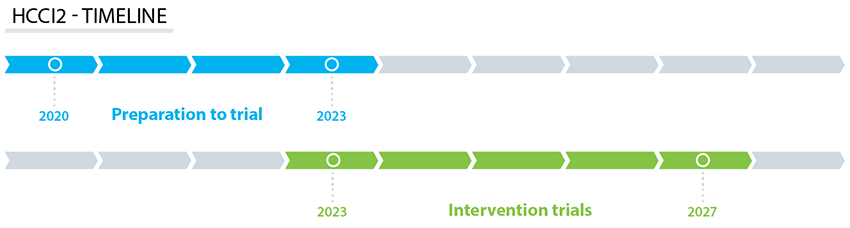
HCCI2 Timeline – long description
HCCI2 will support the next phase of inflammation research through two distinct components: The first component “Preparation to Trial in Inflammation for Chronic Conditions” will be launched in 2020 and will fund successful research projects until late 2023. The second component “Intervention Trial in Inflammation for Chronic Conditions” will provide funding from early 2023 until late 2027. Note that the timelines are estimates and subject to change.
Preparation to Trial in Inflammation for Chronic Conditions
The overall goal of the Team Grants: Preparation to Trial in Inflammation for Chronic Conditions is to support the identification and validation of shared mechanistic pathways of inflammation underlying two or more chronic conditions to inform the future development and/or implementation of an intervention trial for the prevention, diagnosis or management of inflammation aimed at improving the quality of life for those living with or at risk of developing chronic conditions.
The objectives of this funding opportunity are:
- To promote the application of new and existing knowledge on shared pathways that drive inflammation in chronic conditions to be targeted in subsequent human intervention trials;
- To promote a precision medicine approach that equitably delivers the benefit of interventions and improves health outcomes for all individuals; and
- To promote a high quality, inter-disciplinary training and mentoring environment to prepare the next generation of leaders in inflammation research
More information can be found on the funding opportunity page for the Team Grants: Preparation to Trial in Inflammation for Chronic Conditions competition.
Intervention Trial in Inflammation for Chronic Conditions
The overall goal of the Team Grants: Intervention Trial in Inflammation for Chronic Conditions is to support intervention trials that will lead to the repurposing or development of interventions for prevention, diagnosis, prediction of treatment response, and management of inflammation in chronic conditions, and/or the optimization of such interventions across life stages, sex, gender and other intersecting conditions. It is expected that this targeted research investment will lead to improved availabilities of solutions for inflammation in chronic disease and catalyze changes in clinical practice and policy.
The objectives of this funding opportunity are to:
- Utilize knowledge on shared inflammation pathways in intervention trials in humans with the objective of improving prevention or management of inflammation in people living with or at risk of developing chronic conditions.
- Equitably improve health outcomes for population subgroups that have been underrepresented in research (e.g., women, LGBTQIA/2S populations, racialized Canadians, Indigenous Peoples, pregnant people) and those across life stages (e.g., children, older adults) through proven effective evidence-based interventions to address the health effects of inflammation.
- Accelerate the mobilization of knowledge and translation of research outcomes into proven and effective solutions and interventions to benefit multiple chronic conditions through early engagement, sustained and meaningful collaboration with PWLE, KUs, inflammation researchers and researchers from other disciplines.
- Foster a high-quality, interdisciplinary training and mentoring environment to increase capacity and prepare a diverse next generation of leaders to address inflammation in chronic conditions.
More information can be found on the funding opportunity page for the Team Grants: Intervention Trial in Inflammation for Chronic Conditions competition.
Funding results
Notice
The information is provided in the language in which it was submitted by the researcher.
Team Grant: Preparation to Trial: Inflammation for Chronic Conditions
| Name | Institution | Project title |
|---|---|---|
 Levings, Megan K Dijke, Ilona E West, Lori J |
University of British Columbia | Allogeneic thymus-derived Tregs to prevent chronic inflammation in transplantation |
 Muruve, Daniel A Kubes, Paul Senger, Donna L |
University of Calgary | Therapeutic Targeting a Shared Inflammation Pathway in the Lung and Kidney |
 Rayner, Katey | Ottawa Heart Institute Research Corporation (Ontario) | Targeting RIPK1 in Immunometabolism and Cardiovascular Diseases (TRIC) |
 Schultz, Kirk R |
University of British Columbia | Regulatory Natural Killer Cell Treatment in Chronic Graft-versus-Host Disease and Solid Organ Transplantation Chronic Rejection |
 Swardfager, Walter L Lanctôt, Krista L |
Sunnybrook Research Institute (Toronto, Ontario) | Pro-Resolving Inflammatory Mediators in Neurovascular Gains in Aerobic Training (PRIMiNG-AT) |
Team Grant: Preparation to Trial in Inflammation for Chronic Conditions - CIHR HIV/AIDS Research Initiative
| Name | Institution | Project title |
|---|---|---|
 Costiniuk, Cecilia T Di Marzo, Vincenzo Jenabian, Mohammad-Ali |
Research Institute of the McGill University Health Centre | Role of the Endocannabinoid System (ECS) in HIV-associated chronic inflammation and comorbidities |
 Mckinnon, Lyle R Arsenio, Janilyn Murooka, Thomas T |
University of Manitoba | Subsets of subsets: investigating Th17 pathways in inflammatory bowel disease and HIV |
Team Grant: Intervention Trial in Inflammation for Chronic Conditions
| Name | Institution | Project title |
|---|---|---|
 Levings, Megan K Schultz, Kirk R Ahmad, Imran Dijke, Ilona E Hay, Kevin A Lad, Deepesh P West, Lori J |
University of British Columbia | Allogeneic regulatory T cell therapy to prevent graft versus host disease |
 James, Matthew T Levin, Adeera Pannu, Neesh I |
University of Calgary | Prevention of Nephrotoxin-induced Acute Kidney Injury with Cilastatin (PONTIAC) Trial |
 Katsanos, Aristeidis Shoamanesh, Ashkan |
McMaster University | Colchicine for the prevention of vascular events after an acute intracerebral hemorrhage (CoVasc-ICH) |
Team Grants: Intervention Trial in Inflammation for Chronic Conditions – CIHR HIV/AIDS Research Initiative
| Name | Institution | Project title |
|---|---|---|
 Durand, Madeleine Margolese, Shari L Finzi, Andrés |
Centre hospitalier de l'Université de Montréal (CHUM) | The RESTART Trial: Reducing Systemic inflammation for people on AntiRetroviral Therapy |
Team Grants: Intervention Trial in Inflammation for Chronic Conditions – Knowledge Mobilization Hub
| Name | Institution | Project title |
|---|---|---|
 Gongal, Patricia Levings, Megan K West, Lori J |
University of Alberta | A Knowledge Mobilization Hub for the Canadian Inflammation Research Community |
Funding
Closed Competitions
| Funding opportunity | Competition | Funding decision |
|---|---|---|
Team Grant: Intervention Trial in Inflammation for Chronic Conditions – Evidence to Impact |
202403ITI | View |
| 202303LII | View | |
| Team Grant: Preparation to Trial: Inflammation for Chronic Conditions | 202101ICC | View |
| 202101CC1 | View | |
| Team Grant: Health Challenges in Chronic Inflammation Initiative | 201310THC | View |
| Other: Transplantation Research | 201212TFU | View |
| Emerging Team Grant: Canadian Microbiome Initiative | 201005CMF | View |
| Catalyst Grant: Human Microbiome | 200808CHM | View |
Contact information
Telephone: 613-954-1968
Toll Free: 1-888-603-4178
support-soutien@cihr-irsc.gc.ca
- Date modified: