Quarterly Financial Report for the Quarter Ended June 30, 2026
Table of contents
- Introduction
- Highlights of fiscal quarter and fiscal year-to-date results
- Risk and uncertainties
- Significant changes related to personnel, operations and programs
- Annex A - Statement of Authorities (unaudited)
- Annex B - Departmental budgetary expenditures by Standard Object (unaudited)
1. Introduction
This quarterly financial report has been prepared by management as required by section 65.1 of the Financial Administration Act and in the form and manner prescribed by the Treasury Board. This quarterly report should be read in conjunction with the Main Estimates and Supplementary Estimates. It has not been subject to an external audit or review, nor has it been subject to the approval of the Audit Committee.
1.1 Authority, mandate and programs
The Canadian Institutes of Health Research (CIHR) is the Government of Canada's health research funding agency. It was created in June 2000 by the Canadian Institutes of Health Research Act with a mandate “to excel, according to internationally accepted standards of scientific excellence, in the creation of new knowledge and its translation into improved health for Canadians, more effective health services and products and a strengthened Canadian health care system.”
CIHR invests in high quality health research and health research personnel to help create and apply new knowledge that can improve health outcomes for Canadians, lead to innovative products and services that improve Canada's health care system, and create high quality employment and commercial opportunities.
Further details on CIHR’s mandate and program activities can be found in Part II of the Main Estimates and the Departmental Plan.
1.2 Basis of presentation
This quarterly report has been prepared using an expenditure basis of accounting. The accompanying Statement of Authorities includes CIHR’s spending authorities granted by Parliament, and those used by the organization consistent with the Main Estimates and Supplementary Estimates (as applicable). This report has been prepared using a special-purpose financial reporting framework designed to meet financial information needs with respect to the use of spending authorities.
The authority of Parliament is required before monies can be spent by the Government of Canada. Approvals are given in the form of annually approved limits through appropriation acts, or through legislation in the form of statutory spending authority for specific purposes.
CIHR uses the full accrual method of accounting to prepare and present its annual departmental financial statements that are part of the departmental results reporting process. However, the spending authorities voted by Parliament remain on an expenditure basis.
2. Highlights of fiscal quarter and fiscal year-to-date results
This section highlights the significant items that contributed to the change in resources available for the fiscal year, and the actual year-to-date expenditures compared with the previous fiscal year.
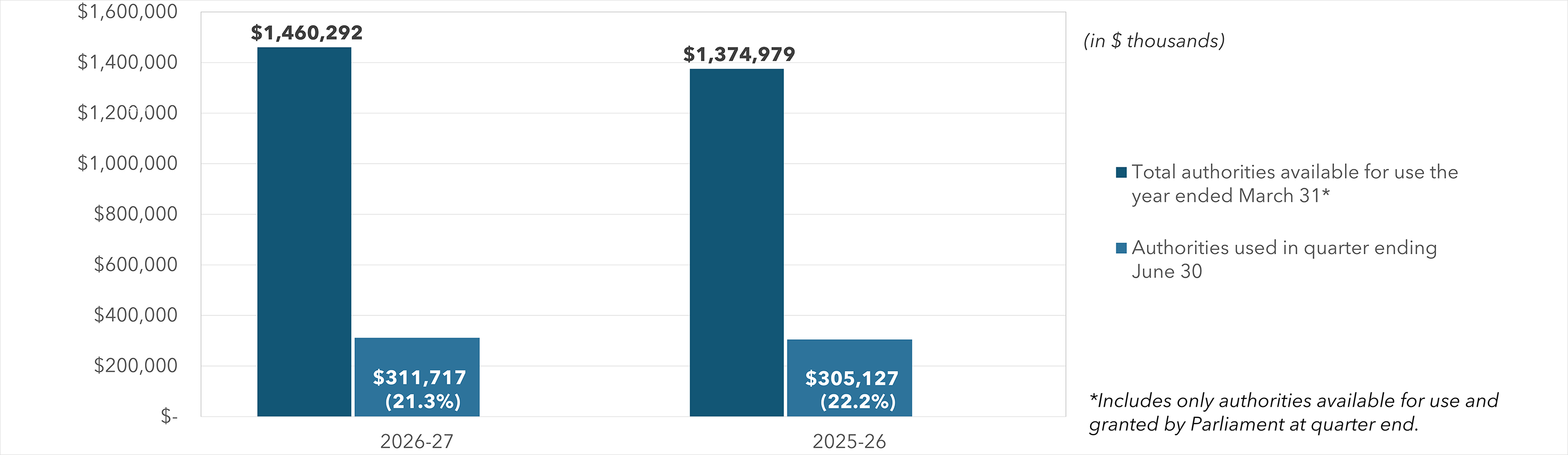
The following graph provides a comparison of budgetary authorities available for the full fiscal year and quarterly budgetary expenditures for the fiscal years 2026-27 and 2025-26.
Long Description
| 2026-27 | 2025-26 | |
|---|---|---|
| Total authorities available for use the year ended March 31Footnote * | $1,460,292 | $1,374,979 |
| Authorities used in quarter ending June 30 | $311,717 | $305,127 |
2.1 Significant changes to budgetary authorities
Total budgetary authorities available for use increased by $85.3 million (6.2%) from the previous fiscal year.
Budgetary authorities available for use
(in $ thousands)
| 2026-27 | 2025-26 | $ change | % change | |
|---|---|---|---|---|
| Vote 1 - Operating Expenditures | 75,062 | 76,463 | (1,401) | (1.8%) |
| Vote 5 - Grants | 1,374,824 | 1,288,833 | 85,991 | 6.7% |
| Statutory Authorities (employee benefits plan) |
10,406 | 9,683 | 723 | 7.5% |
| Total | 1,460,292 | 1,374,979 | 85,313 | 6.2% |
The following table provides a detailed explanation of changes to CIHR’s authorities by Vote.
| Changes to voted and statutory authorities (2026–27 compared with 2025-26) | Vote 1 Operating |
Vote 5 Grants |
Statutory AuthoritiesFootnote * |
Total |
|---|---|---|---|---|
| Canada Research Training Awards Suite | 242 | 43,091 | 64 | 43,397 |
| Increased support for core research grants | 104 | 40,613 | 12 | 40,729 |
| Net effect of CIHR’s participation in tri-agency programs in collaboration with the Natural Sciences and Engineering Research Council (NSERC) and the Social Sciences and Humanities Research Council (SSHRC) | - | 31,108 | - | 31,108 |
| Support research to understand the harms and benefits of cannabis use in different contexts | 26 | 7,750 | (8) | 7,768 |
| Indigenous Innovation and Leadership in Research Network Grants | - | 1,905 | - | 1,905 |
| Launch of new Youth Mental Health Fund | (164) | 1,932 | (33) | 1,735 |
| Indigenous Health Research Capacity | - | 1,250 | - | 1,250 |
| Canadian Genomics Strategy | 16 | 820 | 4 | 840 |
| EBP Adjustment | - | - | 705 | 705 |
| Black Scholarships & Fellows | 13 | 347 | 3 | 363 |
| Various low-dollar adjustments and vote transfer | (41) | (83) | (2) | (126) |
| Dementia and Brain Health in Aging | 20 | (830) | 7 | (803) |
| Net transfers from other government departments for specific programs and initiatives | 13 | (934) | - | (921) |
| Long-Term Health Impacts of COVID-19 | 20 | (1,128) | 5 | (1,103) |
| Funding to Develop a National Strategy for Drugs for Rare Diseases | 20 | (1,500) | 5 | (1,475) |
| Canada Research Chairs | - | (2,419) | - | (2,419) |
| Diabetes Prevention, Research, Surveillance | (152) | (3,790) | (39) | (3,981) |
| Funding to support graduate students and postdoctoral researchers | - | (12,411) | - | (12,411) |
| Comprehensive Expenditure Review | (1,518) | (19,730) | - | (21,248) |
| Total | (1,401) | 85,991 | 723 | 85,313 |
2.2 Significant changes to authorities used
The following table provides a comparison of cumulative spending by vote for the current and previous fiscal years.
Q1 expenditures
(in $ thousands)
| 2026-27 | 2025-26 | $ change | % change | |
|---|---|---|---|---|
| Vote 1 – Operating Expenditures | 13,981 | 17,028 | (3,047) | (17.9%) |
| Vote 5 – Grants | 295,134 | 285,678 | 9,456 | 3.3% |
| Statutory Authorities (employee benefits plan) |
2,602 | 2,421 | 181 | 7.5% |
| Total | 311,717 | 305,127 | 6,590 | 2.2% |
Through the first quarter of 2026–27, CIHR began to implement the various reduction measures associated with the Government of Canada’s Comprehensive Expenditure Review. These measures, which impact both Operating and Grants votes, are being phased in over time, requiring the Agency to adjust planned expenditures and activities to achieve the identified reductions while continuing to support delivery of its mandate.
Vote 1 – Operating Expenditures
Total expenditures in the first quarter decreased by $3.0 million (-17.9%). The following table provides a comparison by standard object and a brief explanation for material variances.
Q1 expenditures
(in $ thousands)
| Standard object | 2026-27 | 2025-26 | $ change | Variance analysis |
|---|---|---|---|---|
| Personnel | 12,345 | 15,024 | (2,679) | Decrease is attributable to the reduction in workforce following the implementation of CIHR’s Organizational Review. |
| Transportation and communications | 178 | 91 | 87 | Increase driven by an increase in internet costs (associated with move to new office space part way through the previous year), as well as an increase in travel driven by an in person advisory committee meeting and additional international travel in support of external partnerships and global collaboration. |
| Information | 98 | 219 | (121) | Decrease is due to a timing difference in payment for an online database subscription. |
| Professional and special services | 553 | 516 | 37 | Not material. |
| Rentals | 796 | 1,167 | (371) | Decrease is due to a delay in billing from another government department for annual costs of shared information systems. |
| Repair and maintenance | 9 | 2 | 7 | Not material. |
| Utilities, materials and supplies | 2 | 2 | - | Not material. |
| Acquisition of machinery and equipment | 1 | 8 | (7) | Not material. |
| Other subsidies and payments | (1) | (1) | - | Not material. |
| Total | 13,981 | 17,028 | (3,047) | |
| Percentage of authorities used | 18.6% | 22.3% |
Vote 5 – Grants
Grant authorities used through the first quarter of 2026-27 increased by $9.5 million (3.3%) compared to the prior fiscal year. The percentage of grant authorities used is consistent with the prior year (21.5% and 22.2% respectively), as grants are typically paid out in monthly installments throughout the year.
Overall spending as of June 30, 2026 is consistent with management expectations.
Statutory Authorities
Actual spending for statutory authorities in the first quarter of 2026-27 is 25.0% of the total available authorities for use for the year, which is consistent with CIHR management expectations given that this expenditure is distributed equally throughout the fiscal year.
3. Risks and uncertainties
Over the past year, CIHR has undergone significant organizational change as a result of the Comprehensive Expenditure Review and the implementation of its own Organizational Review. These initiatives have led to notable changes to the Agency’s organizational structure, including reductions in executive and full-time equivalent positions, as well as the realignment of roles, responsibilities, and accountabilities across the organization, including those related to the identification and mitigation of corporate risks.
In response, CIHR is currently refreshing its Corporate Risk Profile to ensure it accurately reflects the Agency’s current organizational structure, strategic priorities, and evolving risk landscape. In parallel, CIHR is updating its Corporate Risk Register to support the ongoing identification, assessment, monitoring, and reporting of enterprise risks. The Risk Register will support a consistent and structured approach to documenting corporate risks, including risk ratings, mitigation measures, key risk indicators, assigned risk owners, and reporting updates. This will enhance accountability, transparency, and enterprise-wide risk oversight.
CIHR will continue to adapt its risk management practices as organizational change is implemented, ensuring that risk governance remains aligned with the Agency’s operational context and strategic objectives.
4. Significant changes related to personnel, operations and programs
4.1 Personnel
On May 27, 2026, CIHR announced the appointment of Dr. Keith Fowke as the next Scientific Director of the CIHR Institute of Infection and Immunity for a term of four years, starting July 1, 2026.
As a result of CIHR’s Organizational Review, the following positions the following executive positions were impacted:
| Position | Impact |
|---|---|
| Executive Vice-President | Discontinued |
| Associate Vice-President, Research Programs - Strategy | Discontinued |
| Associate Vice-President, Governance and External Relations | Discontinued |
| Vice-President, Research, Learning Health Systems | Portfolio realigned and renamed to Vice-President, Strategic Science and External Relations |
| Vice-President, Corporate Services and Transformation | New position and portfolio realignment |
4.2 Operations
CIHR continues to operate within the broader federal fiscal restraint environment, including the implementation of the Government of Canada’s Comprehensive Expenditure Review (CER), which resulted in a required 2% reduction to the Agency’s reference levels across both operating and grant funding. While the impact on CIHR’s operating budget has been limited, the reduction to grant funding represents a broader adjustment to the resources available to support the Canadian health research community. CIHR has begun implementing various measures to manage these reductions while maintaining effective delivery of its programs and operational commitments.
In parallel, CIHR is undertaking a Resource Alignment Review to ensure operating resources are aligned with its restructured organization, current priorities, and evolving needs. This forward-looking review will help position the Agency with an efficient and sustainable operating model that supports effective delivery in the current environment and enables CIHR to remain responsive to future priorities.
4.3 Programs
Through Budget 2025, CIHR received $416.8M over 12 years in new funding for the International Research Talent Recruitment program, including:
- $340M over 12 years, starting in 2026-27, to launch an accelerated research Chairs initiative to recruit exceptional international researchers to Canadian universities;
- $38.4M over 11 years, starting in 2027-28, to support universities’ recruitment of international assistant professors, as appropriate; and
- $38.4M over 3 years, starting in 2026-27, to enable top international doctoral students and post-doctoral fellows to relocate to Canada.
Approval by Senior Officials
Approved by:
[original signed by]
Paul C. Hébert, MD, MHSc, FRCPC, FCAHS
President
[original signed by]
Jimmy Fecteau, MBA, CPA
Chief Financial Officer
Ottawa, Canada
August 28, 2026
Annex A - Statement of Authorities (unaudited)
For the quarter ended June 30, 2026
Fiscal year 2026-27
(in thousands of dollars)
| Total available for use for the year ending March 31, 2027Footnote * | Used during the quarter ended June 30, 2026 | Year to date used at quarter-end | |
|---|---|---|---|
| Vote 1 – Operating expenditures | 75,062 | 13,981 | 13,981 |
| Vote 5 - Grants | 1,374,824 | 295,134 | 295,134 |
| Contributions to employee benefit plans (Budgetary statutory authorities) | 10,406 | 2,602 | 2,602 |
| Total budgetary authorities | 1,460,292 | 311,717 | 311,717 |
|
|||
Fiscal year 2025-26
(in thousands of dollars)
| Total available for use for the year ending March 31, 2026Footnote * | Used during the quarter ended June 30, 2025 | Year to date used at quarter-end | |
|---|---|---|---|
| Vote 1 – Operating expenditures | 76,463 | 17,028 | 17,028 |
| Vote 5 - Grants | 1,288,833 | 285,678 | 285,678 |
| Contributions to employee benefit plans (Budgetary statutory authorities) | 9,683 | 2,421 | 2,421 |
| Total budgetary authorities | 1,374,979 | 305,127 | 305,127 |
|
|||
Annex B - Departmental budgetary expenditures by Standard Object (unaudited)
For the quarter ended June 30, 2026
Fiscal year 2026-27
(in thousands of dollars)
| Expenditures | Planned expenditures for the year ending March 31, 2027Footnote * | Expended during the quarter ended June 30, 2026 | Year to date used at quarter-end |
|---|---|---|---|
| Personnel | 72,666 | 14,948 | 14,948 |
| Transportation and communications | 1,526 | 178 | 178 |
| Information | 715 | 98 | 98 |
| Professional and special services | 5,687 | 553 | 553 |
| Rentals | 3,914 | 795 | 795 |
| Repair and maintenance | 617 | 9 | 9 |
| Utilities, materials and supplies | 42 | 2 | 2 |
| Acquisition of machinery and equipment | 301 | 1 | 1 |
| Transfer payments | 1,374,824 | 295,134 | 295,134 |
| Other subsidies and payments | - | (1) | (1) |
| Total budgetary expenditures | 1,460,292 | 311,717 | 311,717 |
|
|||
Fiscal year 2025-26
(in thousands of dollars)
| Expenditures | Planned expenditures for the year ending March 31, 2026Footnote * | Expended during the quarter ended June 30, 2025 | Year to date used at quarter-end |
|---|---|---|---|
| Personnel | 73,009 | 17,445 | 17,445 |
| Transportation and communications | 843 | 91 | 91 |
| Information | 751 | 219 | 219 |
| Professional and special services | 5,305 | 516 | 516 |
| Rentals | 4,707 | 1,167 | 1,167 |
| Repair and maintenance | 735 | 2 | 2 |
| Utilities, materials and supplies | 46 | 2 | 2 |
| Acquisition of machinery and equipment | 496 | 8 | 8 |
| Transfer payments | 1,288,833 | 285,678 | 285,678 |
| Other subsidies and payments | 254 | (1) | (1) |
| Total budgetary expenditures | 1,374,979 | 305,127 | 305,127 |
|
|||
- Date modified: