What We Heard Report: End of Grant Knowledge Mobilization Event Summary
Addressing Infectious and Congenital Syphilis in Canada
Related
Event Description
On January 28 and 29, 2026, the Canadian Institutes of Health Research (CIHR), in partnership with the Public Health Agency of Canada and Indigenous Services Canada, hosted a virtual end-of-grant Knowledge Mobilization Event. The event brought together funded research teams from the Operating Grant: Addressing Infectious and Congenital Syphilis in Canada funding opportunity, along with policymakers, community leaders, and other knowledge users.
The goals of the event were to inform public health action, advance equity, and support the integration of innovative approaches into Canada's response to infectious and congenital syphilis. This was achieved by disseminating research findings, supporting evidence-informed decision-making, identifying evidence gaps and emerging priorities, and highlighting opportunities to strengthen future community-led initiatives, research, and collaborative public health responses.
Research teams were invited to contribute to the event design, including its objectives, format, and thematic focus, and to extend invitations to knowledge users and decision makers who would benefit from learning about their work.
218 participants attended the event across the two days. Approximately 69% of the participants were from federal, provincial or territorial health agencies, 13% were from community organizations, and 14% were from academic institutions. The chart below provides the geographical distribution of the participants:
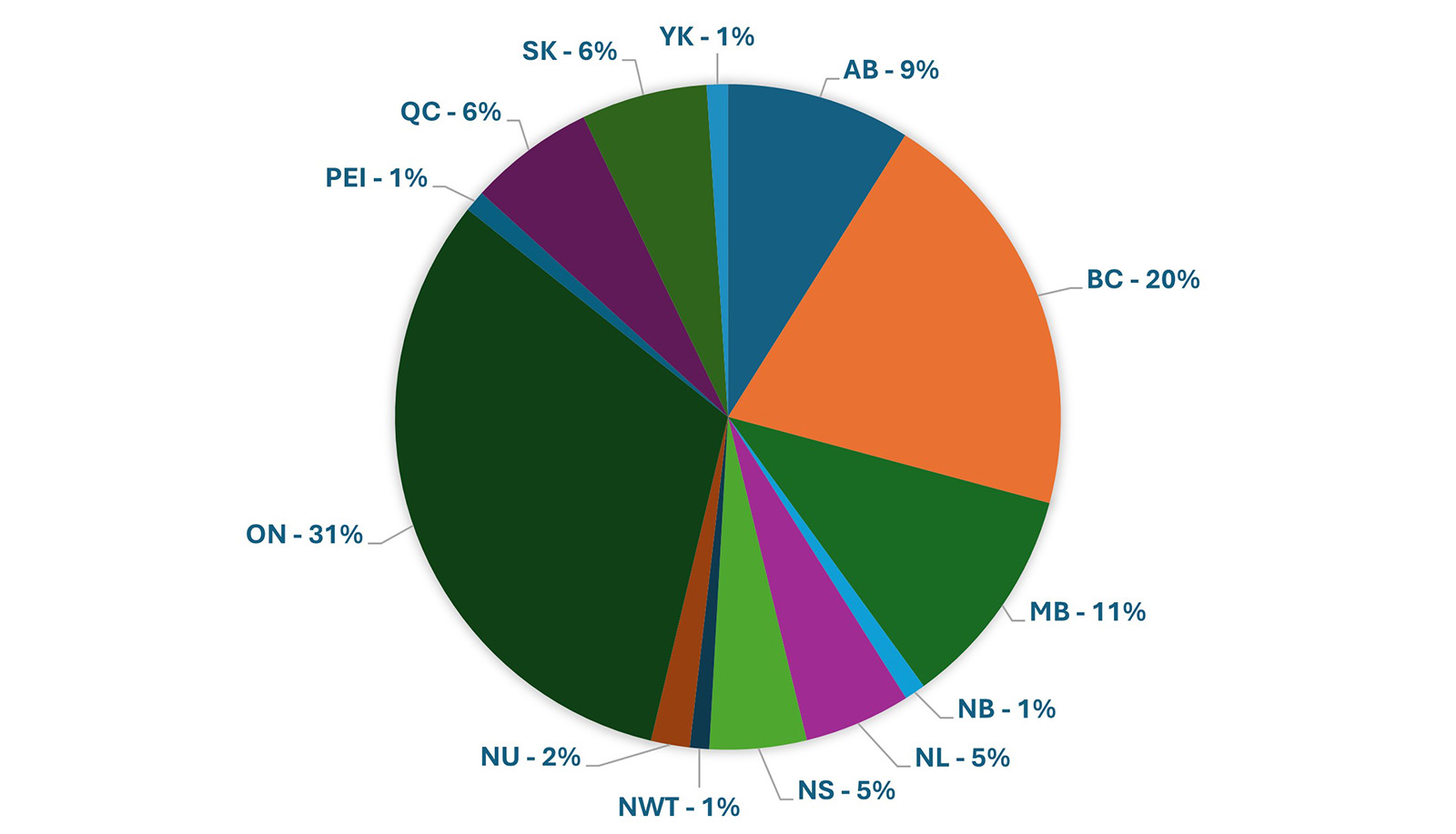
Long description
Geographical Distribution of Participants:
- Ontario: 31%
- Quebec: 6%
- Saskatchewan: 6%
- Yukon: 1%
- Alberta: 9%
- British Columbia: 20%
- Manitoba: 11%
- New Brunswick: 1%
- Newfoundland and Labrador: 5%
- Nova Scotia: 5%
- Northwest Territories: 1%
- Nunavut: 2%
The meeting was chaired by Dr. Charu Kaushic, Scientific Director of the CIHR Institute of Infection and Immunity. The event opened with a welcome and prayer from Grandmother Irene Compton, followed by remarks from Steven Sternthal, Director General of the Centre for Communicable Diseases and Infection Control at PHAC and Dr. Chelsea Gabel, Scientific Director of the CIHR Institute of Indigenous Peoples's Health. A keynote session provided an overview of current syphilis trends in Canada, along with perspectives on global health, public health systems and health equityFootnote 1.
Throughout the event, the seven funded teams presented key findings and lessons learned from their research projects. On Day 1, breakout sessions enabled participants to explore themes related to Indigenous-led prevention, improved testing and treatment access for underserved populations, and strengthened surveillance and clinical careFootnote 2. On Day 2, a workshop on applying research to practice allowed participants to engage in four thematic groups: prevention and public health strategies; access to care and health equity; policy and systems change; and knowledge mobilization and community engagementFootnote 3. The event concluded with a discussion on sustaining research impact across jurisdictions and contextsFootnote 4, followed by a closing prayer from Grandmother Irene Compton.
Key themes and messages
Through presentations and discussions, participants reinforced that effective tools and interventions to prevent infectious and congenital syphilis are well established. The central focus moving forward is supporting their implementation, integration and sustainability across diverse health system contexts.
-
Community-Led and Culturally Grounded Approaches
Participants emphasized that community-led and culturally grounded approaches, particularly Indigenous-led initiatives, are essential for effective syphilis prevention, testing, and care. These approaches foster trust, ensure relevance, and support long-term sustainability. Participants emphasized that Indigenous-led models grounded in kinship, land-based practices, ceremony and community knowledge play a foundational role in strengthening effective and equitable syphilis prevention systems.
-
Equity and Trauma-Informed Care
A strong cross cutting theme was the importance of centering equity in syphilis response efforts. Participants highlighted the need for trauma informed, stigma aware, and relationship based models of care that address structural and social barriers impacting access to testing, treatment, and prenatal care. Participants noted the value of evaluation approaches that capture relational outcomes, such as trust, cultural safety and community confidence, alongside traditional clinical indicators.
-
Expanding and Supporting the Community Health Workforce
The event underscored the critical role of diverse providers, including peer workers, Indigenous health navigators, nurses, outreach teams, pharmacists, and Elders, in reaching populations facing barriers to traditional healthcare services. Ensuring these providers are supported, valued, and meaningfully integrated into care delivery was identified as a priority.
-
Low Barrier and Innovative Testing and Treatment Models
Participants showcased effective innovations such as point of care testing, dual HIV/syphilis tests, mobile and community based outreach, self testing options, and integrated emergency department screening. These models were shown to improve access, reduce delays in diagnosis and treatment, and increase engagement among underserved populations. Several presentations highlighted the potential of integrating rapid testing into prenatal and low-barrier clinical settings to support earlier diagnosis and treatment during pregnancy, contributing to improved maternal and infant outcomes.
-
Strengthening Data and Surveillance Systems
The need for timely, consistent, and actionable surveillance data emerged as a key message. Improved data systems, including real time reporting, cross jurisdictional collaboration, and culturally appropriate data governance, were identified as essential for monitoring trends, evaluating interventions, and supporting public health decision making. Participants underscored that data are most impactful when paired with lived experience, storytelling and early engagement with decision-makers to support policy translation.
-
Policy and Systems-Level Solutions
Participants highlighted that sustainable progress requires supportive policies and system level changes. Key areas identified included enabling regulatory environments, fostering cross sector collaboration, integrating services more effectively, and ensuring communities have a meaningful role in shaping policies and programs. Participants also noted that systems level change takes time, and that research can drive innovation by generating proof of concept to inform future policy and program design.
-
Creative and Accessible Knowledge Mobilization
Teams emphasized the value of creative, accessible, and culturally relevant knowledge mobilization approaches and strategies, such as arts based materials, community workshops, peer led education, and digital tools, to support engagement and broaden the reach of research findings.
-
Partnership, Collaboration, and Shared Responsibility
A major cross cutting theme was the importance of strong partnerships among communities, researchers, clinicians, public health agencies, and policymakers. Participants highlighted shared responsibility, co creation, and meaningful collaboration as cornerstones of successful syphilis prevention and care efforts.
-
Need for Sustained and Flexible Funding
Teams noted that sustained, flexible funding is essential to support ongoing community needs, sustain long term partnerships, maintain effective outreach and testing programs, and build on emerging innovations. Long term investment was identified as critical for maintaining momentum and supporting community centered approaches.
Next steps
Insights from the event will inform ongoing public health planning and collaborative efforts related to infectious and congenital syphilis in Canada, while also helping to identify future priorities for research, community engagement, and knowledge mobilization.
For more information
For additional information, please contact the HIV/AIDS and STBBI Research Initiative at hivaids-vihsida@cihr-irsc.gc.ca or support-soutien@cihr-irsc.gc.ca.
Canada's research response to HIV/AIDS and STBBI is propelled by the CIHR HIV/AIDS and STBBI Research Initiative. With strategic and scientific leadership from the CIHR Institute of Infection and Immunity, the Research Initiative invests approximately $21 million per year to support researchers and trainees through research funding aligned with priorities identified in the 2022-2027 CIHR HIV/AIDS and STBBI Strategic Plan. These priorities advance the actions identified in the Pan-Canadian STBBI Framework (Reducing the Health Impact of Sexually Transmitted and Blood-Borne Infections in Canada by 2030: A Pan-Canadian STBBI Framework for Action) and Government of Canada's Action Plan on STBBI (Government of Canada's sexually transmitted and blood-borne infections (STBBI) action plan 2024-2030). The CIHR HIV/AIDS and STBBI Research Initiative is guided by CIHR HIV/AIDS and STBBI Research Advisory Committee (CHASRAC), which is comprised of members from diverse areas of expertise, and includes academic researchers from a range of disciplines, people with lived/living experience, and representatives from community organizations.
- Date modified: