Quarterly Financial Report for the Quarter Ended December 31, 2025
Table of contents
- Introduction
- Highlights of fiscal quarter and fiscal year-to-date results
- Risk and uncertainties
- Significant changes related to personnel, operations and programs
- Annex A - Statement of Authorities (unaudited)
- Annex B - Departmental budgetary expenditures by Standard Object (unaudited)
1. Introduction
This quarterly financial report has been prepared by management as required by section 65.1 of the Financial Administration Act and in the form and manner prescribed by the Treasury Board. This quarterly report should be read in conjunction with the Main Estimates and Supplementary Estimates. It has not been subject to an external audit or review, nor has it been subject to the approval of the Audit Committee.
1.1 Authority, mandate and programs
The Canadian Institutes of Health Research (CIHR) is the Government of Canada's health research funding agency. It was created in June 2000 by the Canadian Institutes of Health Research Act with a mandate “to excel, according to internationally accepted standards of scientific excellence, in the creation of new knowledge and its translation into improved health for Canadians, more effective health services and products and a strengthened Canadian health care system.”
CIHR invests in high quality health research and health research personnel to help create and apply new knowledge that can improve health outcomes for Canadians, lead to innovative products and services that improve Canada's health care system, and create high quality employment and commercial opportunities.
Further details on CIHR’s mandate and program activities can be found in Part II of the Main Estimates and the Departmental Plan.
1.2 Basis of presentation
This quarterly report has been prepared using an expenditure basis of accounting. The accompanying Statement of Authorities includes CIHR’s spending authorities granted by Parliament, and those used by the organization consistent with the Main Estimates and Supplementary Estimates (as applicable). This report has been prepared using a special-purpose financial reporting framework designed to meet financial information needs with respect to the use of spending authorities.
The authority of Parliament is required before monies can be spent by the Government of Canada. Approvals are given in the form of annually approved limits through appropriation acts, or through legislation in the form of statutory spending authority for specific purposes.
When Parliament is dissolved for the purposes of a general election, section 30 of the Financial Administration Act authorizes the Governor General, under certain conditions, to issue a special warrant authorizing the Government to withdraw funds from the Consolidated Revenue Fund. A special warrant is deemed to be an appropriation for the fiscal year in which it is issued.
CIHR uses the full accrual method of accounting to prepare and present its annual departmental financial statements that are part of the departmental results reporting process. However, the spending authorities voted by Parliament remain on an expenditure basis.
2. Highlights of fiscal quarter and fiscal year-to-date results
This section highlights the significant items that contributed to the change in resources available for the fiscal year, and the actual year-to-date expenditures compared with the previous fiscal year.
The following graph provides a comparison of budgetary authorities available for the full fiscal year and quarterly budgetary expenditures for the fiscal years 2025-26 and 2024-25.
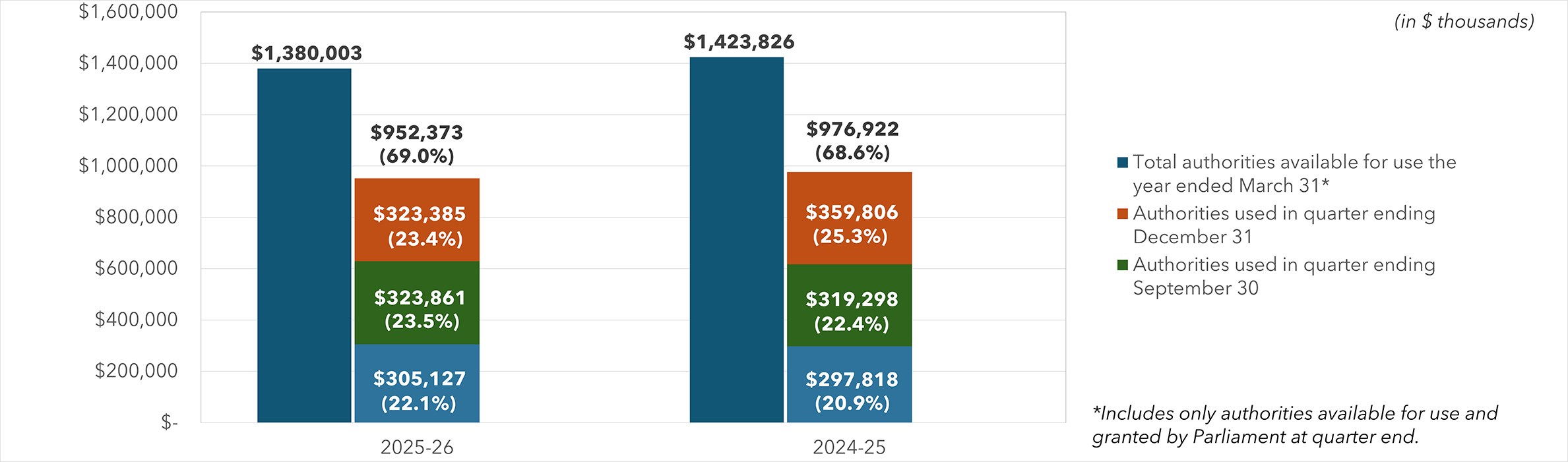
Long Description
| 2025-26 | 2024-25 | 2025-26 % | 2024-25 % | |
|---|---|---|---|---|
| Total authorities available for use the year ended March 31Footnote * | $1,380,003 | $1,423,826 | ||
| Authorities used as at June 30 | $305,127 | $297,818 | 22.1% | 20.9% |
| Authorities used as at September 30 | $323,861 | $319,298 | 23.5% | 22.4% |
| Authorities used as at December 31 | $323,385 | $359,806 | 23.4% | 25.3% |
| Authorities used to date | $952,373 | $976,922 | 69.0% | 68.6% |
2.1 Significant changes to budgetary authorities
Total budgetary authorities available for use decreased by $43.8 million (-3.1%) from the previous fiscal year.
Budgetary authorities available for use
(in $ thousands)
| 2025-26 | 2024-25 | $ change | % change | |
|---|---|---|---|---|
| Vote 1 – Operating Expenditures | 78,030 | 77,957 | 73 | 0.1% |
| Vote 5 – Grants | 1,292,290 | 1,336,871 | (44,581) | (3.3%) |
| Statutory Authorities (employee benefits plan) | 9,683 | 8,998 | 685 | 7.6% |
| Total | 1,380,003 | 1,423,826 | (43,823) | (3.1%) |
The following table provides a detailed explanation of changes to CIHR’s authorities by Vote.
Changes to voted and statutory authorities (2025–26 compared with 2024-25)
(in $ thousands)
| Vote 1 Operating |
Vote 5 Grants |
Statutory AuthoritiesFootnote * |
Total | |
|---|---|---|---|---|
| Increased support for core research grants | 855 | 22,116 | 125 | 23,096 |
| Net effect of CIHR’s participation in tri-agency programs in collaboration with the Natural Sciences and Engineering Research Council (NSERC) and the Social Sciences and Humanities Research Council (SSHRC) | - | 4,226 | - | 4,226 |
| Youth Mental Health Fund | 449 | 1,932 | 95 | 2,476 |
| Support research to understand the harms and benefits of cannabis use in different contexts | 751 | 1,500 | 169 | 2,420 |
| Canada Research Training Awards Suite | 1,232 | - | 261 | 1,493 |
| Canadian Genomics Strategy | 332 | 1,036 | 85 | 1,453 |
| EBP Adjustments | - | - | 1,343 | 1,343 |
| Indigenous Health Research Capacity | - | 1,250 | - | 1,250 |
| Change in Operating Budget Carry Forward | 867 | - | - | 867 |
| National Women's Health Research Initiative | (232) | 1,000 | (57) | 711 |
| Black Scholarships and Fellows | 10 | 347 | 3 | 360 |
| Increased support of graduate students and postdoctoral researchers | (458) | 866 | (75) | 333 |
| Various low-dollar adjustments and vote transfers | 159 | (87) | 34 | 106 |
| National strategy for drugs for rare diseases | (387) | - | (99) | (486) |
| Building a world-class health data systems for Canadians | (172) | (4,454) | 13 | (4,613) |
| Net transfers from other government departments for specific programs and initiatives | 114 | (7,317) | - | (7,203) |
| Endowment to the Gairdner Foundation | - | (10,000) | - | (10,000) |
| Clinical Trials Fund | (3,447) | (56,996) | (1,212) | (61,655) |
| Total | 73 | (44,581) | 685 | (43,823) |
2.2 Significant changes to authorities used
The following table provides a comparison of cumulative spending by vote for the current and previous fiscal years (in $ thousands).
| Q3 expenditures 2025-26 | Q3 expenditures 2024-25 | Q3 expenditures $ change | Q3 expenditures % change | Cumulative (YTD) expenditures 2025-26 | Cumulative (YTD) expenditures 2024-25 | Cumulative (YTD) expenditures $ change | Cumulative (YTD) expenditures % change | |
|---|---|---|---|---|---|---|---|---|
| Vote 1 – Operating Expenditures | 16,248 | 19,039 | (2,791) | (14.7%) | 50,295 | 53,483 | (3,188) | (6.0%) |
| Vote 5 – Grants | 304,716 | 338,566 | (33,850) | (10.0%) | 894,816 | 916,832 | (22,016) | (2.4%) |
| Statutory Authorities (employee benefits plan) | 2,421 | 2,201 | 220 | 10.0% | 7,262 | 6,607 | 655 | 9.9% |
| Total | 323,385 | 359,806 | (36,421) | (10.1%) | 952,373 | 976,922 | (24,549) | (2.5%) |
Through the third quarter of 2025-26, CIHR continued to align its financial planning with the federal government's Refocusing Government Spending initiative, which aims to reallocate expenditures for professional services, travel, operations, and transfer payments in support of other government priorities.
Vote 1 – Operating Expenditures
(in $ thousands)
Total expenditures used through the third quarter decreased by $3.2 million (-6.0%). The following table provides a comparison by standard object and a brief explanation for material year-to-date variances.
| Standard object | Q3 expenditures 2025-26 | Q3 expenditures 2024-25 | Q3 expenditures $ change | Cumulative (YTD) expenditure 2025-26 | Cumulative (YTD) expenditure 2024-25 | Cumulative (YTD) expenditure $ change | Variance analysis (YTD) |
|---|---|---|---|---|---|---|---|
| Personnel | 14,875 | 17,395 | (2,520) | 45,262 | 47,813 | (2,551) | Personnel costs decreased compared to the prior year, reflecting an organizational review undertaken to strengthen alignment between the organization’s structure, mandate, and strategic priorities, resulting in a 13% reduction in headcount. |
| Transportation and communications | 121 | 90 | 31 | 392 | 295 | 97 | Increase due to earlier billing in current year by another government department for annual costs of shared services. |
| Information | (14) | 113 | (127) | 293 | 502 | (209) | Decrease due to a delay in billing from another government department for annual costs of shared information systems, as well as the timing of payments for access to several academic journals. |
| Professional and special services | 797 | 617 | 180 | 2,039 | 1,621 | 418 |
Overall increase due to:
|
| Rentals | 355 | 675 | (320) | 2,038 | 2,687 | (649) |
Overall decrease due to:
|
| Repair and maintenance | 61 | 32 | 29 | 96 | 88 | 8 | Not significant |
| Utilities, materials and supplies | 22 | 11 | 11 | 34 | 15 | 19 | Not significant |
| Acquisition of machinery and equipment | 32 | 107 | (75) | 78 | 250 | (172) | Acquisition of new information technology infrastructure equipment in the prior year in preparation for CIHR’s move of office location. |
| Other subsidies and payments | (1) | (1) | 0 | 63 | 212 | (149) | Non-repeating payments related to settlement of legal matters. |
| Total | 16,248 | 19,039 | (2,791) | 50,295 | 53,483 | (3,188) | |
| Percentage of authorities used | 20.8% | 24.4% | 64.5% | 68.6% |
Vote 5 – Grants
Grant authorities used through the third quarter of 2025-26 decreased by $22.0 million (-2.4%) compared to the prior fiscal year. The percentage of grant authorities used is consistent with the prior year (69.2% and 68.6% respectively), as grants are typically paid out in monthly installments throughout the year. The small overall decrease reflects reduced budgetary authorities available outlined in Section 2.1.
Overall spending as of December 31, 2025 is consistent with management expectations.
Statutory Authorities
Actual spending for statutory authorities through the third quarter of 2025-26 is 75.0% of the total available authorities for use for the year, which is consistent with CIHR management expectations given that this expenditure is distributed equally throughout the fiscal year.
3. Risks and uncertainties
CIHR is funded through voted parliamentary spending authorities and statutory authorities for operating expenditures and transfer payments. As a result, its operations are impacted by any changes to funding approved through Parliament. Delivering programs and services may depend on several risk factors such as economic fluctuations, technological and scientific development, evolving government priorities, and central agency or government-wide initiatives.
CIHR is committed to a disciplined, risk management process in its daily operations. In 2023–24, CIHR developed a new Corporate Risk Profile (CRP) through a cross-organizational consultation process led by an external consultant firm to identify risks for the Agency. The CRP was most recently updated in June 2025 and enables CIHR to proactively monitor and manage risks throughout the year, supporting the effective delivery of its mandate. In 2025–26, CIHR is participating in a new government-wide Risk and Compliance Process, launched by the Treasury Board Secretariat, through which new risks will be identified and existing ones reassessed.
Current key risks and their mitigation response are as follows.
Risk 1 – Corporate Prioritization
There is a risk that CIHR’s current corporate prioritization process may not allow for sufficient oversight and controls to ensure new Agency priorities are sufficiently resourced (e.g., infrastructure, staff, funding), and that existing priorities are resourced properly.
Mitigation/response:
- An annual integrated planning process was established to support effective operational planning and execution. In 2025–26, the process was streamlined by simplifying templates and steps, with a focus on collecting key data to inform decision-making.
- Operational planning is led by senior leadership, who set budget envelopes and operational priorities. CIHR management then identifies the projects and initiatives that can be delivered within those parameters.
- Quarterly reviews enable ongoing monitoring of progress, risks, and resource pressures, allowing for timely course corrections and the management of emerging priorities.
- Anticipated development of a new internal governance structure to enhance horizontal discussions and strengthen decision-making related to priority-setting, resource allocation, and overall integrated planning.
Risk 2 – CIHR/Institutes’ Authorities, Roles, and Responsibilities
There is a risk that the lack of a clear governance framework within CIHR and between CIHR and the Institutes, including the authorities, roles, and responsibilities, may cause an important misalignment in terms of who is accountable for what, and how decisions are made, leading to potential reputational damage to CIHR as well as inefficient decision making and use of limited resources.
Mitigation/response:
- Development of an updated Institutes Model to clarify the authorities, roles, and responsibilities of both the Institutes and CIHR.
- Development of a policy that articulates the role, responsibilities, and unique value of the Institutes, ensuring alignment with the CIHR Act and reinforcing their strategic role within the health research ecosystem, supporting more effective governance and shared accountability.
- Existing processes reviewed to ensure management decisions and business activities comply with Agency policy requirements.
- Development of a communications program to ensure all stakeholders involved in the research funding approval process understand and comply with policy requirements and approval protocols.
Risk 3 – Cybersecurity
There is a risk that CIHR’s current Information Management/Information Technology (IM/IT) infrastructure (e.g., systems, software) and support framework (e.g., strategies, policies, procedures, expertise) may allow for significant cybersecurity incidents affecting confidentiality, integrity, and availability of services (core and/or critical).
Mitigation/response:
- IM/IT processes are being reviewed and updated to ensure the integration of comprehensive data management and protection controls.
- Access controls are regularly reviewed to ensure stakeholders receive system and information access strictly on an as-needed basis and in accordance with their authorized security classification.
- The Chief Information Officer has been empowered and adequately resourced to lead the assessment, planning, and execution of all monitoring and management activities related to CIHR’s IM/IT systems.
- CIHR’s Information Management Policy is circulated at least annually to ensure all personnel understand their responsibilities to safeguard IM/IT systems and the information they contain.
- A training and awareness program is being developed to enhance data management, literacy, and protection across the organization.
Risk 4 – Research Funding Partnerships
CIHR and its research funding partners can have different and sometimes conflicting mandates and accountabilities (e.g., taxpayers, boards, donors), which can create policy and process misalignment and tension within the partnership. There are risks of inconsistent interpretation and application of Central Agency policies by CIHR and conflicting or misaligned policies and/or delivery requirements between CIHR and its partners. This could affect CIHR's reputation and potentially lead to an uneven application of the research funding delivery process.
Mitigation/response:
- Launch of a Partnership Framework in August 2024 that provides clarity and guidance on CIHR’s engagement with domestic partners.
- Provision of training sessions to staff and Institutes to support greater promulgation of the Partnership Framework.
- Development of a high-level onboarding guide for new partners to explain what collaborating with CIHR looks like.
- Potential issues and risks are proactively identified early in negotiations using the Partnership Assessment Checklist. A defined process is in place to escalate and resolve partnership issues and/or risks as they arise with those accountable.
- Ensure funding conditions do not frustrate the program objectives, while allowing for nuanced policy interpretation that enables flexibility but maintains compliance.
- Ensure that each funding partner’s requirements are clearly outlined in an agreement or Memorandum of Understanding (MOU), and work towards greater efficiency in obtaining signatures in advance of the launch of Funding Opportunities.
- Ensure that partner and organizational requirements are clearly communicated to applicants in the Funding Opportunity and inform partners in advance that no changes can be made to content or requirements once it is launched.
4. Significant changes related to personnel, operations and programs
On November 24, 2025, CIHR announced the appointment of Dr. Mary Jung as the next Scientific Director of CIHR Institute of Nutrition, Metabolism and Diabetes.
Organizational review
CIHR continues to undergo an organizational review aimed at advancing its strategic science agenda and optimizing resource allocation. The first phase of implementation is currently in progress, involving changes to the leadership structure and workforce to minimize overlap and more effectively align resources with key organizational priorities.
Budget 2025
Budget 2025 includes several proposals directly related to CIHR:
- $1 billion over 13 years, starting in 2025-26, to CIHR, NSERC, and SSHRC to launch an accelerated research Chairs initiative to recruit exceptional international researchers to Canadian universities.
- $133.6 million over three years, starting in 2026-27, to CIHR, NSERC, and SSHRC to enable top international doctoral students and post-doctoral fellows to relocate to Canada.
- Up to $120 million over 12 years, starting in 2026-27, to the granting councils to support universities’ recruitment of international assistant professors, as appropriate.
Budget 2025 also notes that the Government of Canada will examine whether Canada’s research ecosystem requires further support to retain talent, and work to implement the capstone research organization, as announced in Budget 2024. It is expected that the process to establish the capstone organization will take some time, and CIHR will continue its business as usual for the foreseeable future. In the meantime, CIHR will continue to work closely with Health Canada, Innovation, Science and Economic Development Canada, and our Tri-Council partners to discuss and identify the next steps.
Budget 2025’s Comprehensive Expenditure Review set reduction targets for CIHR and the other granting councils at 2%; a measure intended to protect the councils’ important role in advancing the government’s growth agenda. CIHR continues to revise its spending plans for 2026-27 in accordance with guidance from the Treasury Board Secretariat and Department of Finance.
Approval by Senior Officials
Approved by:
[original signed by]
Paul C. Hébert, MD, MHSc, FRCPC, FCAHS
President
[original signed by]
Jimmy Fecteau, MBA, CPA
Chief Financial Officer
Ottawa, Canada
February 27, 2026
Annex A - Statement of Authorities (unaudited)
For the quarter ended December 31, 2025
2025-26
(in thousands of dollars)
| Total available for use for the year ending March 31, 2026Footnote * | Used during the quarter ended December 31, 2025 | Year to date used at quarter-end | |
|---|---|---|---|
| Vote 1 – Operating expenditures | 78,030 | 16,248 | 50,295 |
| Vote 5 - Grants | 1,292,290 | 304,716 | 894,816 |
| Contributions to employee benefit plans (Budgetary statutory authorities) | 9,683 | 2,421 | 7,262 |
| Total budgetary authorities | 1,380,003 | 323,385 | 952,373 |
|
|||
2024-25
(in thousands of dollars)
| Total available for use for the year ending March 31, 2025Footnote * | Used during the quarter ended December 31, 2024 | Year to date used at quarter-end | |
|---|---|---|---|
| Vote 1 – Operating expenditures | 77,957 | 19,039 | 53,483 |
| Vote 5 - Grants | 1,336,871 | 338,566 | 916,832 |
| Contributions to employee benefit plans (Budgetary statutory authorities) | 8,998 | 2,201 | 6,607 |
| Total budgetary authorities | 1,423,826 | 359,806 | 976,922 |
|
|||
Annex B - Departmental budgetary expenditures by Standard Object (unaudited)
For the quarter ended December 31, 2025
2025-26
(in thousands of dollars)
| Planned expenditures for the year ending March 31, 2026Footnote * | Expended during the quarter ended December 31, 2025 | Year to date used at quarter-end | |
|---|---|---|---|
| Expenditures: | |||
| Personnel | 74,121 | 17,296 | 52,524 |
| Transportation and communications | 881 | 121 | 392 |
| Information | 780 | (14) | 293 |
| Professional and special services | 5,523 | 797 | 2,039 |
| Rentals | 4,840 | 355 | 2,038 |
| Repairs and maintenance | 748 | 61 | 96 |
| Utilities, materials and supplies | 48 | 22 | 34 |
| Acquisition of machinery and equipment | 514 | 32 | 78 |
| Transfer payments | 1,292,290 | 304,716 | 894,816 |
| Other subsidies and payments | 258 | (1) | 63 |
| Total budgetary expenditures | 1,380,003 | 323,385 | 952,373 |
|
|||
2024-25
(in thousands of dollars)
| Planned expenditures for the year ending March 31, 2025Footnote * | Expended during the quarter ended December 31, 2024 | Year to date used at quarter-end | |
|---|---|---|---|
| Expenditures: | |||
| Personnel | 73,878 | 19,593 | 54,420 |
| Transportation and communications | 799 | 90 | 295 |
| Information | 663 | 114 | 502 |
| Professional and special services | 6,623 | 618 | 1,621 |
| Rentals | 4,529 | 676 | 2,687 |
| Repairs and maintenance | 174 | 32 | 88 |
| Utilities, materials and supplies | 29 | 11 | 15 |
| Acquisition of machinery and equipment | 260 | 107 | 250 |
| Transfer payments | 1,336,871 | 338,566 | 916,832 |
| Other subsidies and payments | 0 | (1) | 212 |
| Total budgetary expenditures | 1,423,826 | 359,806 | 976,922 |
|
|||
- Date modified: