Knowledge Mobilization: Learning
Internal KM Resources
Interested in learning more about KM at CIHR? Check out our Institutes' KM-related webpages.
- Institutes
External KM Resources
Interested in learning more about KM practice and science? A compilation of external KM resources is coming soon. Please reach out to the KM team at CIHR (km-mc@cihr-irsc.gc.ca) if there is a resource you wish to suggest.
Canadian KM Leadership: The Knowledge to Action Framework
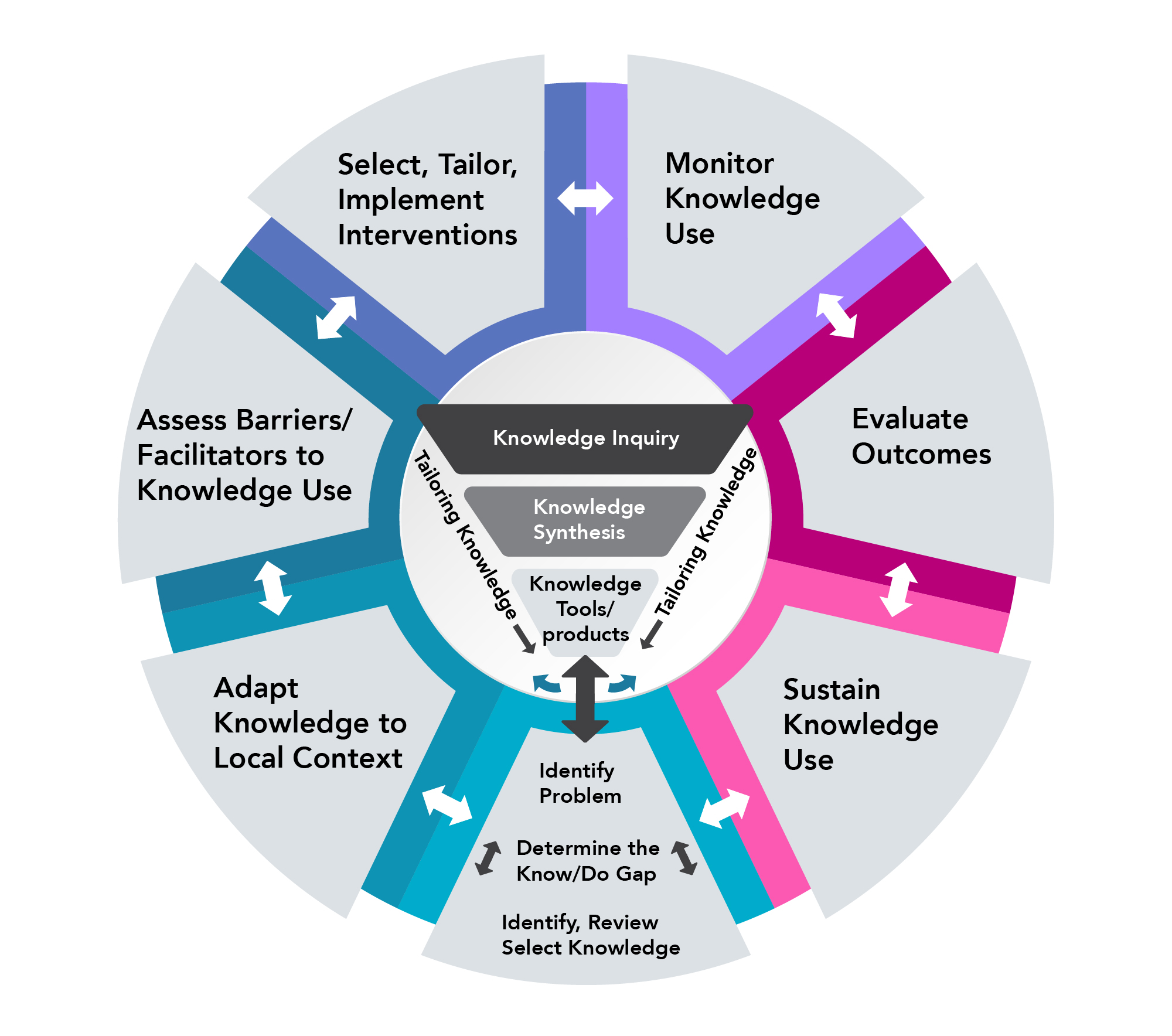
In the early 2000s, CIHR adopted the Knowledge to Action Framework (see figure belowFootnote 1) and subsequently used this Canadian innovation to ground its KM strategies.
The Knowledge to Action Framework conceptualizes the relationship between knowledge creation and action, with each concept comprised of ideal phases or categories. A knowledge creation "funnel" conveys the idea that knowledge needs to be increasingly distilled before it is ready for application. The action part of the process can be thought of as a cycle leading to implementation or application of knowledge. In contrast to the knowledge funnel, the action cycle represents the activities that may be needed for knowledge application.
Long description
This figure illustrates the knowledge to action process. The knowledge creation funnel at the centre of the image consists of three phases which appear in the following order from the top of the funnel, which is the widest, to the bottom, which is the narrowest: Knowledge Inquiry, Knowledge Synthesis, and Knowledge Tools/Products. The term "Tailoring Knowledge" appears along the right-hand length of the funnel. Arrows are circling the funnel to illustrate that the knowledge creation phases can influence the action phases at several points along the circle.
The action cycle surrounding the funnel consists of seven phases, connected with bidirectional arrows: At the bottom of the cycle is: Identify Problem, Determine the Know/Do Gap and Identify, Review, Select Knowledge. In clockwise order, the remaining phases are: Adapt Knowledge to Local Context; Assess Barriers/Facilitators to Knowledge Use; Select, Tailor, Implement Interventions; Monitor Knowledge Use; Evaluate Outcomes; and Sustain Knowledge Use.
- Date modified: