Project Grant: Building a sustainable future for curiosity-driven research
On this page
- At a glance
- What we have heard so far
- How to participate and what happens next
- Introduction
- Challenge 1: Reduce application pressure
- Challenge 2: Strengthening peer review
- Challenge 3: Improving program design
- What happens next
- Annex 1: Environmental Scan
- Annex 2: Restrictive interventions not being pursued
- Annex 3: Figures and Tables
At a glance
Peer review is the foundation of CIHR's funding system and the health research ecosystem in Canada. It enables CIHR to identify and support health research of the highest quality by engaging appropriate expertise, applying rigorous judgement and ensuring the fair assessment of applications. The peer review system that underpins the Project Grant program is under increasing strain and faces three main challenges:
-
1. Application volume is outpacing funding and review capacity
The number of grant applications has grown by almost 60% since Spring 2022 while available funding has remained stable. Over the same period, mean requested budgets have increased by 18%. As a result, success rates are declining, while the burden on applicants, reviewers, institutions and CIHR is increasing. A growing proportion of time and effort is being invested in writing, submitting and reviewing scientifically excellent applications that cannot be funded within the available budget. Canada is not alone: research funding organizations in Canada and internationally are also contending with rising application pressure on peer review systems.
-
2. The peer review process is under growing strain
Members of the research community have raised concerns about aspects of the peer review process, including the consistency of assessments, the quality of feedback, and the effectiveness of virtual deliberations to support robust and calibrated discussions. At the same time, growth in application volume has increased demand on the peer review system and required increasingly intensive reviewer recruitment efforts. Together, these pressures are making it more difficult to maintain confidence in peer review, which relies on a sufficient supply of qualified, trained and engaged reviewers and underpins the research community's trust in funding decisions.
-
3. The program must serve increasingly diverse research needs
The Project Grant program is expected to serve a highly diverse health research community and accommodate applications that vary considerably in scope, methodology, risk profile, and timelines. These issues raise important questions about the extent to which the current system is equipped to meet the needs of the full range of health research communities served by CIHR.
Together, these challenges create a cycle in which applicants, reviewers, institutions, and CIHR invest increasing time and effort for diminishing returns. Left unaddressed, these pressures risk eroding the quality, efficiency, effectiveness and long-term sustainability of the health research ecosystem.
What we have heard so far
Since January 2026, CIHR has engaged more than 2,000 participants through advisory bodies, networks, institutions, peer review groups and national engagement sessions. There is strong agreement that the system is under real strain, but there is little consensus on how to respond. Feedback to date shows broad support for addressing application pressure and strengthening peer review. However, there are differing views about specific interventions CIHR should take to address these challenges and concerns about potential impacts on fairness, access, and support for the highest-quality, most impactful research.
How CIHR is approaching this discussion
Any future changes to the Project Grant program should strengthen the core principles that underpin peer review as described in Table 1.
| Principle | Description |
|---|---|
Expertise |
Applications are assessed by individuals with appropriate scientific, methodological, clinical, policy, community and/or lived-experience knowledge. |
| Research Quality | Peer review strengthens the quality, rigor, and impact of health research through expert assessment and constructive feedback. |
| Fairness | Applications are assessed consistently, objectively and without bias. |
| Transparency | Evaluation criteria, processes and decision-making are understandable, defensible, and accessible. |
| Confidentiality | Information related to applications, reviews, deliberations, and funding decisions is protected and shared only with authorized individuals. |
| Conflict of Interest | Real, perceived or potential conflicts are addressed and do not influence outcomes. |
| Efficiency | Time, effort, and resources are used effectively to review applications thoroughly and deliver timely results. |
| Reciprocity | Peer review is a shared responsibility, with those who obtain funding contributing their expertise to support the system from which they benefit. |
| Fit-for-purpose | Review models align with overall objectives, ensuring the program design is appropriate for the intended purpose and outcomes. |
| Continuous improvement | The peer review system is regularly evaluated and refined based on evidence, feedback, and defined outcomes. |
Using these principles as a foundation, CIHR is presenting three complementary areas for discussion. They reflect recurring themes, concerns and potential solutions raised through engagements and are informed by program data, environmental scans (Annex 1), and evidence from the broader research funding ecosystem. They are not set roadmaps, a preferred package, or decisions. They are a range of potential interventions on which CIHR is seeking further community feedback.
Three areas for discussion
Managing application pressure explores options to better align application volume with available funding and peer review capacity.
Strengthening peer review explores opportunities to enhance the peer reviewer process through improving reviewer participation, consistency and effectiveness of peer review decision-making.
Improving program design explores how CIHR's investigator-initiated funding program design could better meet the diverse needs of Canada's health research community while strengthening CIHR's ability to deliver on its mandate.
How to participate and what happens next
This discussion paper, the accompanying survey, engagement sessions, and targeted outreach provide several ways for the research community to help shape future decisions. The survey and consultation period will remain open until the end of the year. CIHR is committed to reporting back in early 2027 on what was heard and how that feedback informed subsequent decisions and actions. Survey data will be shared publicly, and analyses will be led by members of the research community. The survey data will be used to inform subsequent analyses on the impact of these combined interventions on funding outcomes.
Past experience with changes to CIHR's peer review processes has reinforced the importance of transparency, engagement, and evidence in decision making. CIHR must balance the need for predictability and stability with the need to address growing pressures on the system. Feedback has already shaped this work: some approaches considered earlier are not being pursued and are included in Annex 2 for transparency. This discussion paper is intended to support further conversation about the challenges, the potential approaches to addressing them, and the considerations that guide future change.
Introduction
When CIHR was created in 2000, the Open Operating Grant Program became its principal mechanism for funding investigator-initiated research. Over time, other complementary programs were developed to support investigator-initiated research with specific objectives. In response to concerns about growing competition pressures and peer review challenges, CIHR launched major reforms between 2012 and 2016, which replaced the Open Operating Grant Program and the suite of complementary programs with two distinct but linked programs: Foundation, which supported research leaders and programs, and Project, which funded individual research projectsFootnote 1, with the intention that these two programs could support the full breadth of investigator-initiated research under the CIHR mandate. Following several years of implementation and evaluation, CIHR refined the model in 2019 by discontinuing the Foundation programFootnote 2 and maintaining the current Project Grant program, which remains CIHR's primary funding mechanism for investigator-driven health research.
Over the past several years, CIHR's Project Grant program has experienced an increase in the number of applications submitted to each competition. This trend is consistent across other CIHR and tri-agency funding opportunities and funding agencies worldwideFootnote 3. During this period, the number of academic staff in Canada has increased but at a slower rateFootnote 4. The pool of applicants across CIHR's grant programs is relatively stable (Figure 1). The rise in application pressure is placing strain on the peer review system, which includes applicants, reviewers, institutions, and CIHR staff. This has prompted an examination of whether the current competition process remains appropriate for the evolving needs of the Canadian health research community. This paper outlines the challenges, summarizes what CIHR has heard to date and presents a range of potential interventions for further community feedback.
Background
-
Challenge 1: Application volume is outpacing funding and review capacity
Peer review is the foundation of CIHR; it is the cornerstone of its ability to deliver on its mandateFootnote 5 and fulfil the many objectives defined in the CIHR ActFootnote 6. Through peer review, CIHR identifies and supports research excellence, and provides applicants with expert feedback to refine their applications, ultimately improving the quality of science in Canada. Because of this, the integrity and effectiveness of the peer review system are critical. Yet the system is under increasing strain. The number of applications submitted to the Project Grant program has increased by almost 60% since the Spring 2022 Project Grant competition. At this pace, the Project Grant competition will have over 4,000 applications within two years (Figure 2). This mirrors a broader international trend, with research funders worldwide experiencing rapid growth in the number of submitted grant applications, driven in part by the increasing availability of artificial intelligence tools that reduce the time and effort required to prepare proposalsFootnote 7. A common question raised by the research community is whether the growth in application volume is concentrated within specific research areas or applicant groups. Application pressure has increased across all four research pillars (Figure 3) and all career stages (Figure 4), but most notably in Biomedical and Clinical pillars and Senior Career Researchers. While many peer review committees have seen increases in application pressure, the Health Services Evaluation & Interventions Research, Public, Community & Population Health, and Randomized Controlled Trials have seen the steepest growth (Figure 5). Similar patterns are observed across CIHR's Institutes; based on applicant—selected institute alignment, application growth is occurring broadly across the health research landscape, with the largest increases observed in the Institutes of Neurosciences, Mental Health and Addiction, Health Services and Policy Research, and Cancer Research (Figure 6). This rise in application pressure is driven partially by a rise in the proportion of nominated principal applicants submitting second applications (Figure 7, left panel), across all four pillars (Figure 8) and all career stages (Figure 9). The increase in applications is also driven by the rising proportion and number of resubmissions (Figure 10). This trend is expected to continue as application pressure increases while funding remains stable. This rise does not appear to be driven by Foundation Grant holders; previous Foundation Grant holders represent a small share of applicants (Figure 11) and funded projects (Figure 12). While they are more likely to hold active Project Grants, they are no more likely to submit multiple applications within a competition than non-Foundation holders (Figure 13).
These findings suggest that application pressure is a system-wide challenge rather than one driven by any single research area, career stage, or applicant group. Further, budget requests and funded amounts are increasing due to inflation and increases to student stipends (Figure 14). Given the reality of a finite budget, if these pressures continue, they will reduce the number of new grants that can be funded and will result in success rates declining to below 10%.
-
Challenge 2: The peer review process is under growing strain
As application volumes continue to grow, the need to recruit more reviewers increases in parallel. Since Spring 2023, this higher volume has required more than 3,600 additional reviews and the recruitment of over 500 additional reviewers. Unfortunately, reviewer decline and non-response rates exceed 50% (Figure 15). Engaged reviewers are taking on fewer assignments, due in part to increasingly specialized research proposals, rising workload and expectationsFootnote 8Footnote 9 and the flexibility of the virtual format, which allows participation with lower assignment volumes than was typically feasible for in-person meetings.
The reviewer experience is also becoming less rewarding. Given the low number of assignments and success rates, fewer reviewers see any of their assigned applications funded (Figure 16), and a growing number do not have any of their applications discussed (Figure 17), which can reduce the perceived value in participating in peer review. For a portion of the reviewer population, the switch to virtual peer review has also meant a less engaging and rewarding experience, with many noting that some of the benefits of in-person peer review, such as more robust discussion, a greater sense of connection to the process and network development among researchers, are diminished in a virtual setting.
Coupled with these challenges is a frustration echoed by the research community: an application goes through one round of review, the reviewers request specific changes, the applicant revises accordingly. In the next competition cycle, the resubmission is handed to a new set of reviewers with a different set of expectations within a different competition context. Only 30–35% of Project Grant reviewers continue between competition cycles, driven by reviewers stepping down, becoming applicants, or completing their terms as standing members. While introducing new reviewers is important, so too is reviewer continuity for consistency and calibration across competitions. Approximately 27% of researchers who review in one round become applicants in the next (Figure 18), reducing reviewer continuity and increasing reviewer recruitment pressures. Continuity matters, as resubmissions have higher success rates than previous submissions (Figure 19), and success rates are higher with fewer competitions (Figure 20) and more shared reviewers from the previous submission (Figure 21). The current model lacks continuity, and applicants feel like they are chasing a moving target; new reviewers feel like they are meant to act on a conversation that they did not contribute to and may not agree with.
The growing volume of resubmissions compounds these pressures by requiring reviewers to reassess many familiar applications across successive competitions while comparing resubmissions against a new cohort of applications. This can contribute to reviewer fatigue while also increasing the importance of continuity and calibration between competition cycles.
-
Challenge 3: The program must serve increasingly diverse research needs
While the Project Grant program has been successful in funding a broad range of health research, its design is increasingly being asked to accommodate diverse research fields and objectives. Grant applications vary widely in discipline, duration, methodology, scale, and intended impact, yet rely on a common application and peer review framework within the Project Grant program. The current structure may not always be well aligned with the needs and/or objectives of certain types of health research. For example, randomized controlled trials and clinical trials have distinct methodological considerations and require increased oversight and stewardship. As another example, commercialization has unique considerations related to intellectual property. As such, both of these research fields currently have separate application requirements and evaluation criteria in the Project Grant programFootnote 10Footnote 11, which signals that the current design may not be meeting the needs of these areas of health research.
Program design can also add complexity to peer review. This can be seen in the current approach to budget review, including the application of the 23.5% across-the-board cut to all funded grants, which is creating unintended pressures and consequences. For example, because applicants expect CIHR to apply an across-the-board budget reduction, some increase their requested budgets to compensate. Because of this, there is less confidence that requested budgets reflect the actual resources needed to conduct the research. This adds complexity to the peer review process, as reviewers must balance their own recommended budget cuts against the anticipated CIHR reduction and the overall feasibility of the project. Consequently, the connection between the budget requested, the budget recommended through peer review, and the amount ultimately awarded is weakened, increasing the risk that funded projects receive insufficient funds to fully deliver the proposed research.
Maintaining the current approach has clear consequences. Applicants, reviewers, institutions and CIHR staff are investing increasing time and resources to a growing number of applications, while the number of grants that can be funded remains stable. As reviewer pools become more strained, it becomes harder to maintain expertise alignment between applications and reviewers, while the program itself is increasingly challenged to accommodate diverse research needs. Persistent low success rates may discourage researchers from pursuing high-risk, high-reward ideas, limiting innovation and creativity. With increasing budget requests and falling success rates, CIHR is approaching a point where it will not be possible to continue funding the top 10% of applications. The status quo therefore avoids difficult choices in the short term but is not sustainable over the longer term.
Considerations that would guide any change
CIHR's ability to identify scientific excellence depends on a peer review system that engages expert reviewers, applies rigorous judgement, and evaluates applications fairly. Any future changes to the Project Grant program or its peer review processes will support and strengthen the principles outlined in Table 1. CIHR has administered peer review across a wide range of funding opportunities, research disciplines, and adjudication models. This experience includes virtual and in-person review, asynchronous and committee-based assessment, structured and unstructured review processes, and mechanisms tailored to different research communities and funding objectives. CIHR's exploration of potential changes is informed by this extensive experience and the recognition that effective peer review approaches may vary depending on program objectives, application volumes, and the nature of the research being assessed.
Past experiences with changes to CIHR's peer review systems have reinforced the importance of transparency, engagement, and evidence in decision making. If changes are adopted following consultation, CIHR would introduce them incrementally where appropriate and monitor them against defined outcomes. Evidence from implementation and evaluation would inform whether interventions should be retained, refined or reconsidered, with continued opportunities for community feedback.
How the interventions fit together
The Project Grant system is interconnected: changes to application requirements can affect applicant burden and assessment quality; changes to peer review can affect funding outcomes; and changes to program design can affect demand elsewhere in the system. The 8A Grants model (Table 2) illustrates this broader grants management lifecycle. For that reason, the interventions in this paper should be considered both individually and in terms of how they may interact.
Related work underway: Artificial intelligence
The opportunities and implications associated with artificial intelligence extend across CIHR's funding ecosystem and are closely connected to the future of science and peer review. Given their broad and cross-cutting nature, artificial intelligence-related considerations are beyond the scope of this paper and are being examined through separate work that will inform CIHR's AI strategy and future approaches to program delivery.
Interventions to address the challenges
Based on analyses and consultation to date, CIHR is seeking feedback on interventions to address the three main challenges (Table 3).
| Challenge | Interventions being explored |
|---|---|
| Reduce application pressure | Application limits, post-award pauses, resubmission approaches, competition structures |
| Strengthen peer review | Peer review reciprocity, stronger Chair and Scientific Officer roles, meeting formats, alternative decision approaches |
| Improve program design | Stand-alone programs, budget approaches, application and assessment requirements |
Interventions range from small adjustments to more substantial changes. The ordering of interventions is intended to help readers understand their relative scope and potential impact; it should not be read as a predetermined implementation sequence. Interventions could be considered individually or in combination. Community feedback, evidence, risks and feasibility would help determine which interventions, if any, should be tried. Note that success of one intervention might reduce the need for other interventions.
How any future changes would be implemented and assessed
CIHR heard clearly that the research community prefers incremental, evidence-informed change to rapid large-scale reform. Any interventions that advance would therefore be introduced in a way that allows CIHR to assess impacts, identify unintended consequences, and refine the approach before broader and more complex changes are considered. CIHR would communicate potential changes early and provide preparation timelines appropriate to the scale of the intervention.
Any adopted measures would be assessed against defined objectives. CIHR would use a structured evaluation framework, informed by external advisory guidance, and would provide regular updates through its communications channels. This would help ensure that future decisions remain evidence-informed and that the research community has opportunities to understand and respond to change.
Challenge 1: Reduce application pressure
This section presents a range of interventions that could reduce application pressure relative to the number that can ultimately be funded (Table 4). The options were generated by preliminary engagement with the Canadian research community (Table 5, Table 6) and environmental scans of other national and international funding agencies (Annex 1)Footnote 12Footnote 13Footnote 14Footnote 15Footnote 16. A summary of these options including their main impact, potential benefits and risks can be found in Table 7.
| Degree of change | Intervention being explored |
|---|---|
| Incremental | One application per nominated principal applicant |
| Temporary pause after funding | |
| Moderate | Capping resubmissions |
| Structural | Single annual intake with feedback-and-response |
| Biannual intake with feedback-and-response | |
| LOI stage | |
| Rolling intake |
Analyses were conducted to assess the potential impact of some interventions on CIHR's application pool with a subset presented here. Additional interventions that were explored but set aside due to strong community or CIHR concerns can be found in Annex 2. The options below are presented from less to more restrictive.
Question for discussion: Which approaches would best reduce application pressure while protecting fairness, access and research excellence, and which trade-offs are most concerning?
Incremental interventions
These interventions are estimated to reduce application pressure by around 19% (~650 applications). Together, they would require relatively limited changes to CIHR's delivery model, as no large, structural changes to the competition process would be made.
-
One application per nominated principal applicant per competition
The proportion of nominated principal applicants submitting two application is increasing (Figure 7, left panel). Second applications are disproportionately submitted by Pillar 1 researchers, senior career researchers and men. The success rate of second applications, assuming the second application is the lower ranked of the pair, is on average 3.8% (Figure 7, right panel; Figure 22). Limiting applicants to a single application per competition would reduce overall application volume by 11-17%. However, with the growing number of applications from unique nominated principal applicants (Figure 1), the impact of this intervention may be short-lived. In practice, the impact of nominated principal applicant limits may be temporary as researchers can circumvent these policies by applying in other roles (e.g. principal applicant). It is also possible that the duration and funding amount requested in single applications increases as researchers consolidate multiple proposed projects into a single application.
-
Temporary pause after receiving Project Grant funding
Temporarily making a nominated principal applicant funded in one competition ineligible to apply in the subsequent competition could reduce cycle-over-cycle application volumes by up to ~400 (10-15%). Fewer than 5% of applications in a single competition are from nominated principal applicants funded in the preceding competition because most successful applicants choose not to apply immediately after securing funding. A mandatory post-award pause is also estimated to modestly increase the pool of researchers available to participate in peer review, because recently funded researchers would no longer be in conflict as applicants. It could also help broaden the distribution of funds across a wider range of nominated principal applicants. While the modelling examined a one-competition pause, a two-competition duration could also be explored.
Moderate interventions
-
Limiting resubmission of lower-ranked grants
Half of all applications in a competition are resubmissions, and restricting a subset of those that were scored poorly in a previous competition could reduce application volumes by over 1,000 applications per competition. However, determining an appropriate cut-off based on the percent rank of a prior application presents challenges. A low ranking in one competition does not predict a low ranking in a subsequent competition, particularly when applicants have addressed reviewer feedback. About 80% of funded resubmissions ranked in the top 50% of the previous competition (Figure 23). In absolute terms, our data suggests about 40 ultimately successful applicants would have been delayed from submitting for one competition with such a cut-off. Limiting the bottom 25% of previous applicants from submitting for one competition would delay about 16 ultimately funded resubmissions for one competition (Figure 24).
An alternative approach is to strengthen reviewer feedback by indicating whether a proposal is recommended for resubmission (e.g., with minor revisions, major revisions, or not recommend resubmitting). Clearer signals could help applicants make more informed resubmission decisions and help moderate resubmission pressure. Like caps based on scores, applications that are not invited to resubmit would be restricted from applying. Should this approach not lead to meaningful changes in applicant behaviour, these categories could also provide a basis for applying more targeted, time-limited, CIHR-enforced restrictions on resubmissions to the program.
Regardless of the approach, it will be operationally challenging for CIHR to enforce resubmission restrictions, as doing so would require establishing clear thresholds for how substantively different an application must be to be considered "new" rather than a resubmission. Applicants may try to circumvent the policy and reintroduce a restricted resubmission as a new application.
A more administratively feasible approach would be to place restrictions on the applicant rather than the application. For example, applicants whose submissions were low ranked or not invited to resubmit could be required to wait one competition before reapplying. Any restrictions on resubmissions could be applied strategically (e.g., early career researchers would be excluded from this policy), balancing application pressure with support for researchers establishing and seeking feedback on their research programs.
Structural interventions
CIHR is also seeking views on four more substantial structural changes. They are presented for consideration and not as a predetermined next phase or a commitment to change the current program structure.
-
Single annual intake with a feedback-and-response model
A single annual intake, paired with an in‑cycle feedback‑and‑response model, would allow applicants more time to strengthen proposals, support reviewer calibration, and reduce burden across the system. Adapting the current model to address existing concerns with reviewer continuity, a feedback-and-response model would provide applicants with an opportunity to address reviewer questions and critiques within the same competition and with the same set of reviewers. In this model (Figure 25), reviewers would complete their initial assessment and provide written comments to the applicants who would then be given an opportunity to submit a response to those same reviewers. Reviewers would recalibrate their scores based on those responses prior to engaging in the in-meeting discussions. This would create a structured exchange that supports continuity and consistency but requires a longer competition timeline. Applicants would be assessed within the same competition context throughout the process. Unlike resubmissions, which are reviewed alongside a different pool of competing applications and often by different reviewers, a feedback-and-response approach keeps both the reviewers and competitive context stable, allowing assessment to focus on how well applicant concerns have been addressed.
Using past competition data, results from a single annual intake were simulated by assuming that one competition would include all applications from the Spring and all original applications from the following Fall competition (i.e., excluding Fall resubmissions). Across multiple years of data, the number of applications decreased, entirely through the reduction in the number of resubmissions, increasing the overall success rate. Further, more unique nominated principal applicants were funded, the total number of funded grants increased, higher success rates were observed for all equalization groups, and fewer grants were equalized (Table 8).
While the current 2-competition Project Grant timeline allows for more frequent submissions, it does not necessarily result in shorter delays to funding. The median number of competitions required to apply to secure funding, for those who receive Project funding, is three (Figure 26), and a subset of unsuccessful applicants persist across many competitions. The number of competitions required to secure funding varies by career stage; Early career researchers most often secure their first funded grant after two competitions (median = 2) compared with 3 for mid‑ and senior‑career researchers. The time-to-funding estimates are based on a model in which approximately 425 grants are funded per competition cycle. Under a single-competition model that funds approximately 850 grants per cycle, time-to-funding would be expected to be shorter than shown. Grant resubmission impacts funding success, as the success rate of original applications is only 9.9% compared to 23.2% for resubmissions. Overall, the data suggest that funding success depends more on application refinement and persistence than on the number of submission opportunities. Under a single annual intake model, this persistence would be consolidated into one structured cycle, concentrating both applicant and reviewer effort, competition funding, and the probability of success within a single competition.
-
Biannual intake with a feedback-and-response model
An alternative approach would be to maintain the flexibility of two competitions per year while adding the advantage of the feedback-and-response model, allowing for applicants to submit to the competition that works best with their schedule. This option would require extending and overlapping competition timelines to incorporate the feedback-and-response mechanism. The advantages observed under a single-annual-intake design similarly apply here.
In the context of overall application pressure and recruitment challenges, it would be necessary to reduce the overall number of applications to ensure the model remains feasible. Additional measures would be required to limit submissions across the two competitions, limiting application frequency within a given year. It would not be possible for applicants to submit the same application/idea to two overlapping competitionsFootnote 17. To reduce overall pressure, applicants could submit only one application per intake cycle per year. Applications submitted to separate competitions would need to be monitored to ensure they are both conceptually and budgetarily distinct.
The overlapping nature of the competitions would adjust the current peer review committee structure, requiring an increase in the overall number of peer reviewers as well as an increase in the number of CIHR staff supporting the overlapping competitions. Unlike the current system, where many reviewers can participate across two competitions, this approach would require securing experts for independent and parallel competitions, requiring an increase in the number of reviewers. This competition format could introduce burdens for reviewer pools and may necessitate introducing mandatory review for applicants. In that scenario, any applicants who applied to one competition, if eligible, would be required to review applications submitted to the other competition and vice versa. Eligibility of their application would be contingent on this participation. This would ensure a sufficient reviewer pool that could be used as a base. Additional reviewers from the academic community would be required to add to the overall base to form a complete set of reviewers.
Continuity of Chairs and Scientific Officers across both competitions would not be feasible, as they cannot participate in overlapping cycles running concurrently. As a result, committee norms, oversight, and shared expectations would need to be re‑established each competition under different leadership, increasing the risk of variability in decision‑making and weakening consistency and training across intake cycles.
-
Introducing a Letter of Intent (LOI) stage
In this model, funding decisions are made through a two-stage process designed to identify and assess the most competitive proposals. In the first stage, applicants submit a concise and structured LOI (e.g., 2 pages) that is assessed and scored with the average score used to rank applications. A high triage threshold is applied (for example, removing 60-70% of applications), and top-ranked applicants are then invited to submit a full application in the second stage, where proposals undergo more detailed peer review. This approach could be implemented in both single and biannual competition models.
While there would be no reduction in the overall number of applications, LOI screening offers an efficient approach to managing workload. This would reduce the burden on both applicants and reviewers, allowing effort to be focused on the most competitive applications and enabling faster early-stage decisions. Decisions at the LOI stage would be made with limited information, increasing the risk that meritorious proposals are screened out prematurely. Short formats can also introduce bias, favouring applicants who are more established or better able to communicate ideas concisely. Reviewers must assess LOI stage applications with less to draw on, which can increase variability in how they are interpreted and scored. Reviewers would also need to balance the assessment of high-risk, high-reward ideas with more incremental research.
The LOI stage would need to be carefully integrated into timelines to allow adequate time for the review and development of full applications. To support calibration and consistency in scoring, reviewers would be assigned a relatively high number of LOIs to assess. While this approach would improve comparability across applications, it may also limit the degree of alignment between reviewer expertise and specific topics. Applicants who do not advance past the LOI stage would receive limited feedback, rather than the more detailed written reviews provided for full applications. Applicants may also perceive LOI-stage decisions as less transparent and/or more subjective due to this limited feedback. Appropriate blinding could be applied to help reduce reviewer biasFootnote 18, although its implementation in grant review is limitedFootnote 19Footnote 20.
The program design should include measures to protect the success of early career researchers, such as reserving a defined proportion of invitations to the full application stage for this group. Alternatively, early career researcher applications could be reviewed in a separate pool or against separate criteria.
-
Rolling application intake
CIHR could make a more substantial shift by adopting a rolling intake model, in which applicants may apply for Project Grant funding at any time throughout the year, with applications reviewed and funding decisions made on an ongoing basis rather than through a fixed competition timeline. Several funding organizations have adopted this approach, including the Research Council of NorwayFootnote 21Footnote 22, the Natural Sciences and Engineering Research Council of Canada Alliance programFootnote 23 and multiple funding streams offered by the Canada Council for the ArtsFootnote 24. For the Project Grant program, a rolling intake could increase flexibility for applicants, improve responsiveness to emerging health research priorities, and enable researchers to apply when projects are fully developed and not when dictated by competition deadlines. A continuous flow of funding decisions could also help to reduce gaps in research funding and support a more responsive research ecosystem. However, implementing such a model would require shifting to a different operational model, including the need for continuous peer review capacity and maintaining consistency and fairness across application cohorts. While a rolling intake could distribute applications more evenly throughout the year, it may not reduce the overall application pressure, as the underlying demand for funding would remain unchanged. There is also a risk that the absence of fixed deadlines could encourage more frequent submissions/resubmissions, shifting reviewer burden from periodic competition cycles to a continuous year-round process. To help mitigate this risk and maintain a sustainable review system, applicants would be limited to a maximum of two Project Grant applications per year. Finally, unless funding allocations are managed carefully, a rolling intake model could create real or perceived inequities by reducing funding availability for high-quality applications submitted later in the fiscal year when funds are exhausted. Budget management would become more complex, requiring ongoing monitoring and forecasting as application volume, funding requests, and award timing fluctuate throughout the year.
Challenge 2: Strengthening peer review
This section focuses on the reviewer pool, the peer review process and the quality and consistency of deliberation and decision-making. It includes a small number of actions already underway, as well as interventions on which CIHR is seeking further feedback, which would be implemented in multiple stages (Table 9). A summary of these options including their main impact, potential benefits and risks can be found in Table 10.
| Timeline | Interventions being explored |
|---|---|
| Actions underway | Mandatory peer review |
| Enhanced role of Chair and Scientific Officer | |
| Near term | Expanded in-person peer review |
| Longer term | Partial randomization |
| Expansion of expertise of CIHR staff | |
| Funding decisions beyond rank order |
Question for discussion: Which measures would most improve reviewer participation, consistency, useful feedback and effective deliberation while preserving scientific expertise and fairness?
Actions already underway
Most options in this paper remain exploratory. However, ongoing engagement has identified a small number of measures that have received significant support from the research community and peer review leaders, and CIHR has already begun implementing the actions identified in this section. They are separated from the options that remain under consultation so readers can clearly distinguish between current actions and future possibilities.
-
Mandatory peer review
Holding CIHR funding demonstrates that a researcher has the capacity to engage in the full research lifecycle and possesses the scientific expertise expected of CIHR reviewers. While CIHR recognizes the many demands on researchers' timeFootnote 9, peer review is not only a cornerstone of CIHR's funding model but also a collective responsibility that ensures fairness, transparency, and excellence. To begin, CIHR has strengthened expectations for peer review participation and mandatory peer review as a condition of funding. Implementing this strategy may increase the reviewer pool by up to an additional ~400 researchers (the number of individuals who received CIHR funding but did not accept any reviewer invitations in a 3-year period). While this represents an important first step, additional interventions will be required to move mandatory peer review from principle to practice and ensure it becomes a meaningful component of the funding ecosystem. CIHR will work with institutions to share data on their contributions to peer review and other CIHR activities that support the work of the agency, which will inform institutions of their own participation, enable them to compare their level of engagement to that of others, and implement targeted interventions. CIHR will also work with institutions to strengthen recognition of peer review in career advancement processes and encourage the provision of protected time for this essential activity. In the future, CIHR could extend this to a condition of applying, provided that reviewer eligibility requirements are met.
-
Enhanced role of the Chair and Scientific Officer
Strengthening the role of Chairs and Scientific Officers represents an important opportunity to enhance the quality, consistency, and effectiveness of peer review. Chairs and Scientific Officers play a central role in shaping committee culture, facilitating robust and balanced deliberations and supporting reviewer calibration. Previous engagements with Chairs and Scientific Officers have highlighted broad support for providing these members with enhanced opportunities to contribute, along with the tools, training, data, and operational supports needed to apply their expertise more effectively in the peer review process.
Opportunities include greater access to information that supports reviewer recruitment and assignment, enhanced training and mentorship, access to review quality feedback, and clearer expectations regarding their roles in supporting committee performance and review quality. This could include a more active role in reviewer recruitment, enabling Chairs and Scientific Officers to help identify expertise gaps, support targeted outreach to potential reviewers, and encourage participation while maintaining appropriate CIHR oversight and safeguards. Over the longer term, CIHR could further strengthen leadership capacity through more structured succession planning, onboarding, and development pathways for future Chairs and Scientific Officers. Together, these measures would support stronger reviewer engagement, more consistent decision-making, and more effective peer review deliberations, contributing to a higher-quality and more resilient peer review system.
Near-term interventions
-
Expanded in-person peer review
A meaningful proportion of the research community has an interest in returning to some form of in-person peer review. This process has started, beginning with the Indigenous health research community who deliberated in person during the Spring 2026 competition. This decision reflected the strong rationale provided by this community, recognizing that Indigenous health research is rooted in relationship building, trust, and cultural understanding, and that in-person settings better support meaningful connections, dialogue and respect for Indigenous ways of knowing.
Returning the entire Project Grant program to an in-person peer review model is estimated to cost approximately $4 million per competition. As a result, CIHR would be able to support in‑person peer review once per year. If CIHR maintained the current competition structure, an alternating seasonal model could be put in place, and the in-person meetings could set expectations of accountability, engagement and calibration, and reinforce norms for the virtual meetings. To ensure appropriate stewardship of public funds, reviewers would be assigned more applications, consistent with pre-virtual workloads, further supporting calibration and consistency. CIHR would continue to offer the opportunity to participate virtually for teleconference members (those with 1 or 2 assigned applications), accessibility requests, and last-minute weather- and illness-related cancellations to maintain the integrity of peer review and encourage broad participation by reducing barriers to engagement.
The alternating model would also add operational complexity to the current structure, as it would require running two distinct peer review models each year. This could introduce variability in processes and create potential inconsistencies in reviewer experience, participation, and engagement across competitions. There is a need to continue to improve the virtual peer review model which was adapted from the in-person format rather than purpose-built for a virtual environment. Work to strengthen the virtual format, such as increasing reviewer engagement and calibration, would move forward alongside the proposed changes to help ensure a better peer review process overall.
Longer-term interventions
-
Partial randomization
Partial randomization can complement peer review in the allocation of research fundingFootnote 25Footnote 26. Unlike full randomization, it is applied in a tiered fashion and only to a subset of applications that have already met a defined level of relevance and quality. Partial randomization can enhance transparency by making explicit that applications entering the lottery are considered comparably meritorious. It acknowledges the inherent role of chanceFootnote 27Footnote 28Footnote 29Footnote 30, the limits of reliability in peer review, particularly amongst closely ranked proposals at or near the funding thresholdFootnote 31, and the challenge of peer review score predicting research productivityFootnote 32. Partial randomization has the potential to reduce peer review burden by shifting the focus from fine distinctions among highly competitive applications to determining whether proposals meet a threshold of excellenceFootnote 33. Used in this way, peer review would continue to assess merit, while randomization would be used to decide funding outcome amongst proposals that are otherwise considered comparably competitive.
Partial randomization can be tailored to support certain applicant groups and may help reduce inherent bias towards underfunded groups, such as early career researchers. For example, weighting principles could be introduced to increase the probability that applications from specific groups are selected within the randomized pool. This would allow equity to be considered while maintaining a merit-based threshold for entering the lottery. Partial randomization is increasingly being adopted by research funders, and CIHR would not be alone in pursuing it. CIHR already employs partial randomization in certain funding opportunitiesFootnote 34Footnote 35 and several international funders have piloted modified lottery approaches in some programsFootnote 36Footnote 37Footnote 38Footnote 39, finding, for example, enhanced diversity in the funded applicantsFootnote 40Footnote 41.
-
Expansion of expertise and roles of CIHR staff
Expanding the complement of CIHR staff to include individuals similar to Program Officers and Program Directors at the US National Institutes of Health could help to support aspects of the peer review process. At the National Institutes of Health, scientific staff play a unique role in providing strategic advice to applicants, assessing alignment with institute priorities, guiding researchers through funding opportunities, monitoring emerging scientific trends, and supporting funding and portfolio decisions while remaining separate from formal peer reviewFootnote 42. Adoption of these roles could provide a different mechanism to support applicants through early identification of high-potential research opportunities, enhanced knowledge of emerging scientific trends and deeper ties to the Canadian research community. Building on the National Institutes of Health model, it could also offer the potential to introduce triaging of applications in advance of peer review within certain programs, thus lowering the burden on peer reviewers.
-
Funding decisions beyond rank order
Rather than relying solely on rank order within highly competitive applications (e.g., the 10–20% range), CIHR could take a more deliberate approach to funding decisions in this range. When applications are effectively equivalent in merit, additional considerations could be used to guide funding decisions, such as whether an applicant already holds one or more active CIHR grants. For example, priority could be given to a highly ranked applicant with no current CIHR funding before allocating additional funding to one who is already well supported. Other considerations could include research in priority areas or applicants whose highly ranked application narrowly missed funding in the last competition. However, any of these decisions would require careful consideration, especially in the case of ties, and would need to be outlined in advance to ensure transparency in the funding processes.
Challenge 3: Improving program design
This section asks whether the Project Grant program and the broader investigator-initiated funding model could be better designed for the breadth of health research CIHR supports (Table 11). Different research areas may require distinct funding models, application requirements, budget approaches, evaluation criteria, or levels of risk tolerance. The purpose is not to prescribe a single future model, but to identify where greater tailoring could improve research impact while preserving fairness and rigour. A summary of these options including their main impact, potential benefits and risks can be found in Table 12.
| Timeline | Intervention |
|---|---|
| Longer term | Standalone programs |
| Changes to budget assessment | |
| Reconsidering application requirements and review criteria |
Question for discussion: Where could distinct program models, revised budget approaches, or different application and assessment requirements better support the needs of health research communities?
Longer-term interventions
-
Potential stand-alone programs
CIHR is exploring where stand-alone, open programs may best address unique and/or distinct needs. For example, CIHR is exploring a new, standalone, fit‑for‑purpose, and scalable clinical trials/randomized control trials program that will better align program design and delivery with the distinct requirements of trials research. Conceptually, this program would introduce opportunities for both investigator‑initiated and priority‑driven trials, replacing the Project Grant program as the primary mechanism for trial applications and enabling strategic investments aligned with emerging health and system priorities. The new program would incorporate modernized, trial‑specific application requirements, peer review criteria, and enhanced monitoring and reporting, responding to ecosystem gaps identified through consultations and evaluations. The current funding envelope for clinical trials/randomized control trials within Project would be transferred to this new program. These features would position the clinical trials/randomized control trials Program as a funding mechanism capable of delivering support for investigator‑driven trials while remaining responsive, scalable, and impact‑focused in addressing Canada's evolving clinical research priorities.
Further, a distinct, investigator-initiated Indigenous health research program would enable application and peer review processes to be co-designed around the unique needs, values, and research approaches of First Nations, Inuit, and Métis communities, rather than requiring applicants and reviewers to work within structures designed for the broader Project Grant program. In many respects, Indigenous health research already operates through a distinct model within the Project Grant program, with applications reviewed by a dedicated committee composed largely of reviewers with Indigenous health research expertise and lived experience, assessed using specific Indigenous research considerations, supported through an iterative review process, and backed by a dedicated commitment that 4.6% of the Project Grant budget support fundable applications in this areaFootnote 43. Establishing Indigenous health research as a standalone funding opportunity would build on this foundation by providing greater flexibility to support Indigenous scholars and community leadership, fostering relational and culturally grounded approaches to application development and peer review, and demonstrating CIHR's long-term commitment to Indigenous research, reconciliation, and structural change.
Given the conservative nature of peer review within a constrained funding environment, CIHR could also develop a dedicated high-risk, high-reward research program designed to complement the Project Grant Program by supporting innovative ideas that may otherwise be disadvantaged in traditional funding opportunities. Evidence from research funding literature suggests that, when success rates are low, reviewers may place increasing weight on methodological limitations and unresolved uncertainties, contributing to more conservative funding decisions and stronger preferences for proposals in which risks have already been substantially mitigatedFootnote 44Footnote 45Footnote 46. While this approach helps minimize risk and maximize the likelihood of achieving funded outcomes, it can also inadvertently discourage bold, exploratory research that challenges existing paradigms or pursues untested research directions. CIHR could consider a program to address this gap for projects that challenge conventional thinking, employ unconventional approaches, techniques or methodologies, and embrace a higher degree of uncertainty in pursuit of transformative impact. By supporting early-stage research that may lack substantial feasibility data and enabling exploratory-focused projects, the program could help ensure that potentially groundbreaking ideas are not overlooked due to the inherent conservatism of traditional peer review. In doing so, it would diversify CIHR's research portfolio, complement existing investigator-initiated funding mechanisms, and strengthen the agency's ability to advance the full intent of the CIHR Act.
Other research areas, such as commercialization, could benefit from their own research programs. A stand-alone commercialization program could help ensure that translational and market-readiness research are assessed using commercialization-relevant objectives and criteria that reflect the distinct needs and outcomes of this area of research. However, separate programs may require more complex budget management. Under the current Project Grant model, increases in application pressure within a research area can be accommodated through the competition-based allocation of funding. With dedicated program envelopes, preserving this responsiveness would require ongoing adjustments to funding allocations across the suite of programs.
-
Potential changes to budget assessment
CIHR could explore more structured approaches to budget assessment to improve consistency within and between peer review committees. Options could include a modular budget approach, a dedicated budget review process that assesses funding requests independently of scientific merit, or more detailed budget scrutiny only for larger or longer-term requests, while streamlining assessment for most applications.
Controlling grant size is one potential lever that could be considered, with implications for both the number of grants funded and the level of support available for individual research projects. CIHR already uses a large grant policy to manage the highest-value requests through a dedicated funding envelope, but additional approaches could also be explored. For example, a budget cap could help CIHR support more researchers within available resources, while alternative models such as standardized grant sizes or a dedicated pool of smaller grants could simplify budget assessment and encourage applicants to request funding that is more closely aligned with project needs. However, any approach would need to consider grant duration, project scope, and the significant variation in research costs across disciplines, methodologies, populations, and settings.
-
Across-the-board cut
In addition to any budget cuts recommended through peer review, a 23.5% reduction is applied to the budgets of all funded Project Grants. The intent is to increase the number of projects that can be funded within CIHR's fixed budget envelope. However, this practice may be incentivizing applicants to request larger budgets in anticipation of cuts and may reduce the likelihood that reviewers recommend budget reductions. In cases where the across-the-board cut results in budget gaps, grant holders may then seek additional funds from CIHR or other funding organizations, contributing to increased application pressure across the funding ecosystem. As CIHR explores alternative approaches to budget assessment, there may be an opportunity to revisit the need for the across-the-board cut. Any change or removal of the cut would need to balance the number of overall projects supported with the need to provide successful applicants with the level of funding required to undertake the proposed research.
-
Reconsidering application requirements and review criteria
In the current system, the emphasis on feasibility helps ensure funded research can be successfully delivered. However, it can also create tension with the goal of supporting exploratory and transformative research. Extensive preliminary data are sometimes needed to be competitive, which may favour lower-risk, incremental projects over more uncertain but potentially higher-impact research. As a result, there may be value in examining whether current application requirements and review criteria appropriately balance scientific rigour with the desire to encourage innovation and risk-taking. This could be considered alongside upcoming changes such as the integration of the Tri-Agency CV and capacity building into the program objectivesFootnote 47.
A related consideration is whether the adjudication criteria, their interpretation, and the rating scale work together in a way that provides reviewers with clear guidance for assessing applications in alignment with the program objectives. Reviewing the rating scale and its descriptors would help determine whether they are sufficiently specific to distinguish between different levels of application quality and support greater calibration among reviewers. This could also reduce score clustering, improve comparability across peer review committees, and strengthen the alignment between ratings and the overall merit of applications. More robust descriptors could also give Chairs greater leverage to question and calibrate ratings that appear inconsistent with the comments presented by reviewers, helping to improve accountability and consistency in scoring. Additional descriptors or interpretive guidance may further support consistent and effective use of the full rating scale.
There may also be opportunities to reconsider the amount and type of information required in a Project Grant application. Recent changes, including reductions in the number of permitted appendices, have already streamlined parts of the application process. Any further simplification would be in line with the Government of Canada's requirements to improve efficiencyFootnote 48 and decrease red tapeFootnote 49. Additional opportunities could include shortening proposal length and focusing more on the importance of the research question and the potential impact of the work. While the scale of Project Grant investments warrants an appropriate level of rigour, a more streamlined application process could be feasible if accompanied by corresponding changes to peer review expectations, including a greater willingness to accept uncertainty rather than the extent to which all risks have been mitigated in advance, and a review model that aligns the number of required reviewers with the needs and complexity of the funding opportunity. Potential approaches explored by other funding agencies include placing less weight on feasibility-related requirements, reducing expectations for preliminary data, and using targeted funding mechanisms to support research that may not compete successfully through traditional programs.
What happens next
The purpose of this work and the discussion paper is to build a shared understanding of current challenges and ensure that future decisions are informed by the people who participate in and depend on the Project Grant system. Community engagement, consultation and clear communication will be central to any future change. CIHR will continue outreach with institutions, applicants, reviewers, Institute Advisory Boards, and other interested groups to clarify the challenges, discuss the options and their trade-offs, and hear concerns and alternatives ideas.
A survey co-developed with external researchers that accompanies this discussion paper provides an opportunity to comment on the challenges, the three areas for discussion and the specific options presented. The survey will be used to inform future modeling of the combined impact of interventions on outcomes. Feedback from the survey and upcoming community engagement will be analyzed to inform future decision-making. CIHR is committed to reporting back on what was heard and how that feedback influenced subsequent decisions and actions. Comments, questions, and feedback can be submitted directly to CIHR at: IIRconsultations-consultationsRL@cihr-irsc.gc.ca.
The pressures facing Canada's health research funding system require action. If recent trends persist, the current approach will not remain sustainable. With the exception of measures already identified as underway, the options in this paper remain open for discussion, and CIHR is seeking the community's views before making decisions about which interventions should move forward. While we are committed to meaningful engagement, we recognize that no option is likely to meet everyone's needs or preferences. Difficult choices will be required. For this reason, the research community's input will be critical to identifying solutions that address growing pressures on the system while preserving what matters most: support for Canada's highest-quality and most impactful health research.
The peer review system depends on the leadership, expertise, and engagement of the research community, and meaningful change will require us all to work together. We invite the community to help shape a stronger and more sustainable peer review system that continues to support research with the greatest potential. Over the coming months, CIHR will use what is heard through surveys, consultations, and engagement activities to refine the interventions under consideration and assess their potential impacts. This work will inform future decisions and the development of implementation plans for any changes that move forward. Meeting these challenges will require a collective effort, but together we can ensure that Canada's health research funding system evolves to meet changing needs while remaining resilient, responsive, and able to support the research and discoveries that Canadians rely on.
Annex 1
Environmental Scan
| Research Agency | Intervention | |||||||
|---|---|---|---|---|---|---|---|---|
| Restrictions by nominated principal applicant | Restrictions by institution | Limiting AI use | AI for desk rejection | Rolling intake | Revising research impact criteria | Revising assessment criteria in peer review | Public consultation on demand management | |
| The National Institutes of Health (NIH) | ✓ Applicable | ✓ Applicable | ✓ Applicable | ✓ Applicable | ✓ Applicable | |||
| UK Research and Innovation (UKRI) | ✓ ApplicableTable 1.1 note i | ✓ ApplicableTable 1.1 note i | ✓ Applicable | ✓ Applicable | ✓ Applicable | ✓ Applicable | ||
| Wellcome Trust | ✓ Applicable | ✓ Applicable | ||||||
| European Research Council (ERC) | ✓ Applicable | ✓ Applicable | ✓ Applicable | ✓ Applicable | ✓ Applicable | |||
| Research Council of Norway (RCN) | ✓ Applicable | ✓ ApplicableTable 1.1 note ii | ✓ Applicable | ✓ Applicable | ✓ Applicable | |||
| National Health and Medical Research Council (NHMRC) | ✓ Applicable | ✓ Applicable | ✓ Applicable | ✓ Applicable | ✓ Applicable | |||
| La Caixa Foundation [ PDF (470 KB) - external link ] | ✓ Applicable | ✓ Applicable | ✓ Applicable | |||||
| Agence nationale de la rechercheTable 1.1 note iii | ✓ Applicable | ✓ Applicable | ||||||
| Swiss National Science Foundation | ✓ Applicable | ✓ ApplicableTable 1.1 note iv | ✓ Applicable | ✓ Applicable | ||||
Table 1.1 Notes
|
||||||||
Annex 2
Restrictive interventions not being pursued
Institutional quotas
Institutional quotas, like those implemented in some awards programs, would cap the number of applications submitted by each institution. Over the past 4 years, 10% of institutions (13 institutions) submitted 78% of the applications (Figure 2.1), suggesting that enforcing institutional quotas could have a substantial impact on overall application volume. Several quota models were simulated, including caps based on prior success rate, percent ranks, or historical institutional application volumes. Each approach presents distinct advantages and disadvantages, with differential effects based on institution size, application pressure, and funding success. Some models favoured institutions with stronger funding success while others penalized the submission of large volumes of low scoring applications.
Implementing institutional quotas would require significant institutional buy-in, as responsibility for pre-screening and internal selection would sit with the institutions themselves. This approach carries notable risks, as institutions vary considerably in their capacity and resources available to implement internal review processes in a consistent, transparent, and fair manner. Well-resourced institutions may be better positioned to establish robust selection processes, including bias-mitigation practices, training, and formal oversight mechanisms, whereas smaller or less-resourced institutions may face challenges.
Institutional quotas may generate unintended behaviour in applicants and institutions. Internal selection processes could disadvantage early career researchers and may encourage institutions to prioritize applications perceived as 'safer bets' or more likely to secure funding, reducing support for high-risk, high-reward or interdisciplinary research. In principle, institutional quotas may be inconsistent with the foundations of an open competition, as they constrain access prior to peer review, shifting decision-making from an open, peer reviewed process to uneven internal gatekeeping and limiting opportunity for all meritorious ideas to compete on equal footing.
One funded grant per nominated principal applicant
Among CIHR-funded researchers holding investigator-initiated grants (Project, Foundation, and OOGP Grants), most hold one (Figure 2.2). This may be in part due to the nature and duration of Foundation Grants, which provided significant long-term, stable funding. Limiting researchers to holding only one open grant would reduce the number of applications by ~700 (21%).
A one‑grant limit could promote a broader distribution of funding across the research community, supporting a more diverse pool of funded research. Such an approach may also help mitigate the "Matthew effect," whereby researchers who are already well funded are more likely to secure additional grants, reinforcing cumulative advantageFootnote 51. Limiting multiple concurrent grants could improve success rates among early- and mid-career researchers.
However, these potential benefits must be weighed against the risk of constraining top-performing researchers and the overall impact on scientific excellence. Such limits counter one core principle of excellence in peer review: identifying and supporting the strongest ideas and best research proposals. A one-grant limit could nudge applicants to request funding for their entire research program in a single application. This would increase average grant requests and thus reduce the number of grants that can be awarded across a competition.
Annex 3
Figures
Figure 1: Number of unique NPAs who applied, applied for the first time and were funded or applied to CIHR Grant programs.
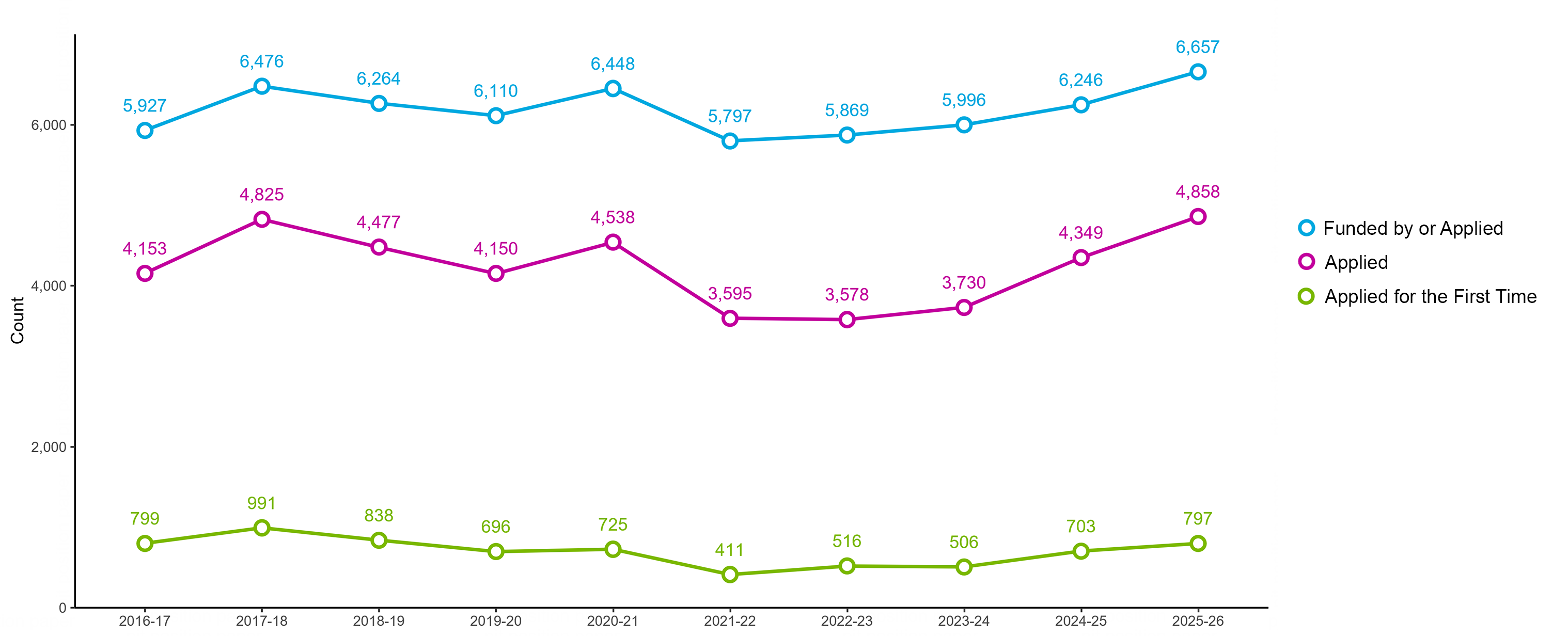
Figure 1 long description
| Fiscal Year | NPA Applied or Funded | NPA Applied | NPA Applied for the First Time |
|---|---|---|---|
| 2016-17 | 5927 | 4153 | 799 |
| 2017-18 | 6476 | 4825 | 991 |
| 2018-19 | 6264 | 4477 | 838 |
| 2019-20 | 6110 | 4150 | 696 |
| 2020-21 | 6448 | 4538 | 725 |
| 2021-22 | 5797 | 3595 | 411 |
| 2022-23 | 5869 | 3578 | 516 |
| 2023-24 | 5996 | 3730 | 506 |
| 2024-25 | 6246 | 4349 | 703 |
| 2025-26 | 6657 | 4858 | 797 |
Figure 2: Count of number of real and forecast applications submitted across competitions
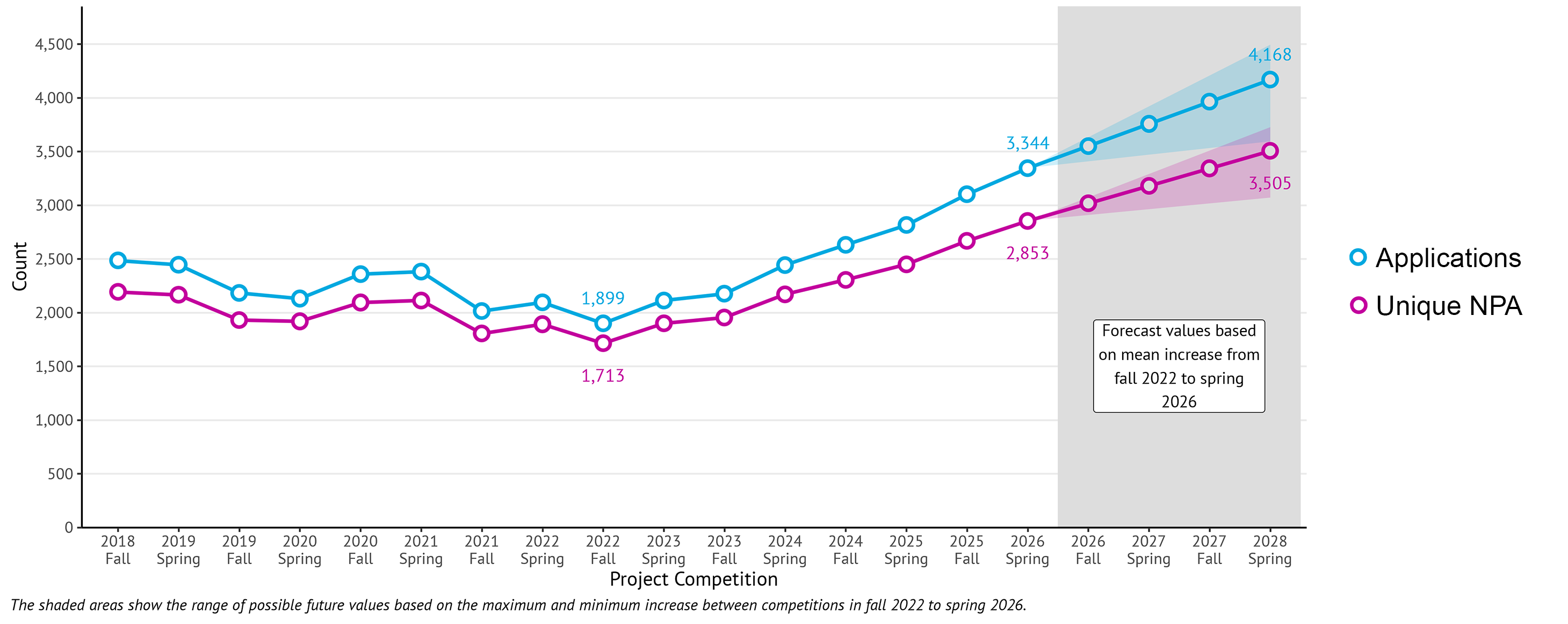
Figure 2 long description
| Project Competition | Competition Type | Applications | Applications Lower Bound | Applications Upper Bound | Unique NPA | Unique NPA Lower Bound | Unique NPA Upper Bound |
|---|---|---|---|---|---|---|---|
| 2018 Fall | Historic | 2484 | 2191 | ||||
| 2019 Spring | Historic | 2445 | 2164 | ||||
| 2019 Fall | Historic | 2183 | 1930 | ||||
| 2020 Spring | Historic | 2130 | 1918 | ||||
| 2020 Fall | Historic | 2358 | 2093 | ||||
| 2021 Spring | Historic | 2381 | 2113 | ||||
| 2021 Fall | Historic | 2014 | 1804 | ||||
| 2022 Spring | Historic | 2095 | 1891 | ||||
| 2022 Fall | Historic | 1899 | 1713 | ||||
| 2023 Spring | Historic | 2113 | 1899 | ||||
| 2023 Fall | Historic | 2175 | 1953 | ||||
| 2024 Spring | Historic | 2443 | 2170 | ||||
| 2024 Fall | Historic | 2631 | 2305 | ||||
| 2025 Spring | Historic | 2814 | 2449 | ||||
| 2025 Fall | Historic | 3101 | 2667 | ||||
| 2026 Spring | Historic | 3344 | 2853 | ||||
| 2026 Fall | Forecast | 3550 | 3406 | 3631 | 3016 | 2907 | 3071 |
| 2027 Spring | Forecast | 3756 | 3468 | 3918 | 3179 | 2961 | 3289 |
| 2027 Fall | Forecast | 3962 | 3530 | 4205 | 3342 | 3015 | 3507 |
| 2028 Spring | Forecast | 4168 | 3592 | 4492 | 3505 | 3069 | 3725 |
Figure 2.1: Percentage of applications by the proportion of institutions
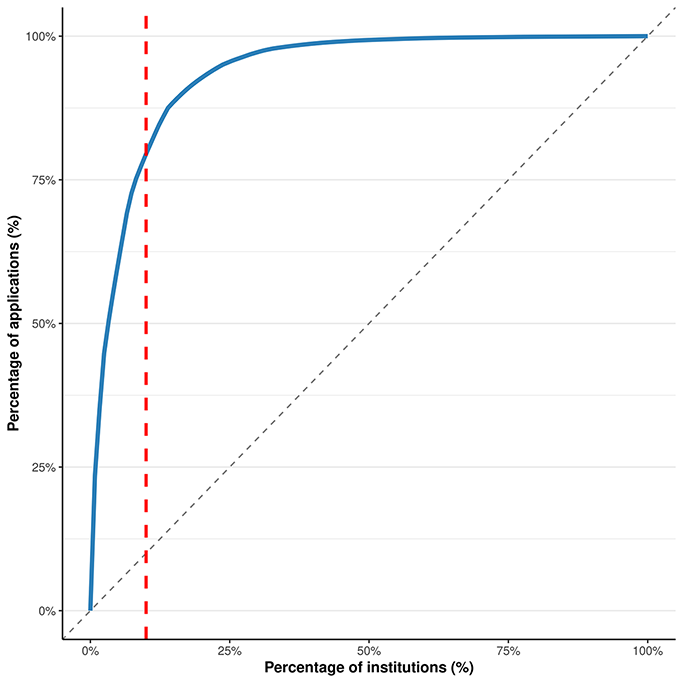
Figure 2.1 long description
This chart shows the cumulative percentage of applications submitted by institutions, ranked from those with the most to the fewest applications. The blue curve rises sharply and then levels off, indicating that applications are concentrated among a relatively small number of institutions rather than being evenly distributed. A dashed grey diagonal line represents an equal distribution of applications across institutions. A dashed red vertical line marks the top 10% of institutions, which, together, account for approx. 80% of all applications. This means that a small proportion of institutions submit the majority of applications.
Figure 2.2: Number of grants held by NPA
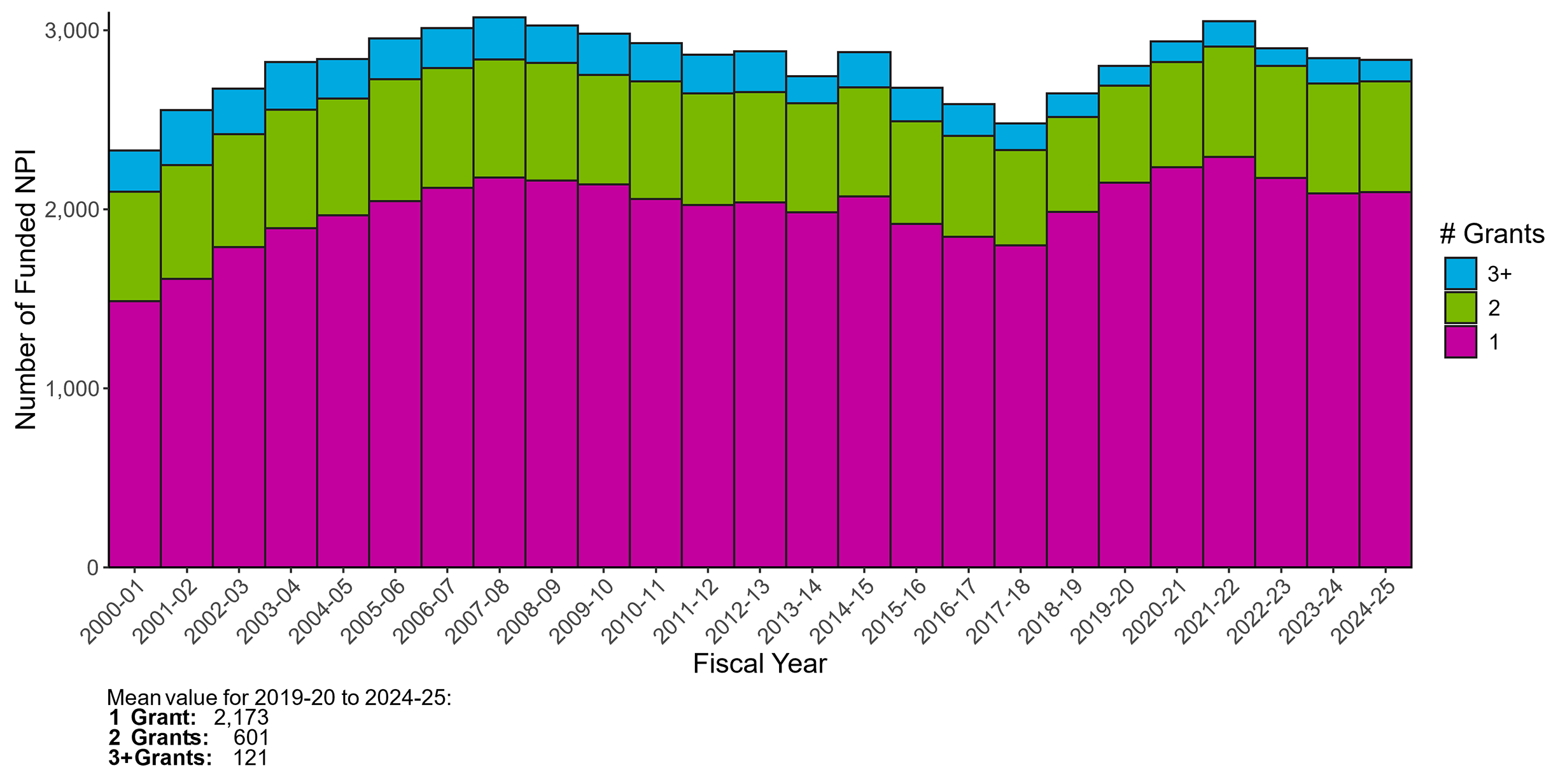
Figure 2.2 long description
| Fiscal Year | Number of Grants Held | Number of NPI |
|---|---|---|
| 2000-01 | 2 | 611 |
| 2000-01 | 3+ | 230 |
| 2000-01 | 1 | 1487 |
| 2001-02 | 3+ | 306 |
| 2001-02 | 1 | 1612 |
| 2001-02 | 2 | 636 |
| 2002-03 | 2 | 631 |
| 2002-03 | 3+ | 254 |
| 2002-03 | 1 | 1790 |
| 2003-04 | 3+ | 267 |
| 2003-04 | 1 | 1895 |
| 2003-04 | 2 | 662 |
| 2004-05 | 2 | 654 |
| 2004-05 | 3+ | 219 |
| 2004-05 | 1 | 1966 |
| 2005-06 | 2 | 682 |
| 2005-06 | 3+ | 229 |
| 2005-06 | 1 | 2045 |
| 2006-07 | 2 | 668 |
| 2006-07 | 3+ | 224 |
| 2006-07 | 1 | 2121 |
| 2007-08 | 2 | 659 |
| 2007-08 | 3+ | 234 |
| 2007-08 | 1 | 2179 |
| 2008-09 | 2 | 657 |
| 2008-09 | 3+ | 210 |
| 2008-09 | 1 | 2160 |
| 2009-10 | 2 | 612 |
| 2009-10 | 3+ | 229 |
| 2009-10 | 1 | 2140 |
| 2010-11 | 2 | 657 |
| 2010-11 | 3+ | 212 |
| 2010-11 | 1 | 2059 |
| 2011-12 | 3+ | 215 |
| 2011-12 | 2 | 625 |
| 2011-12 | 1 | 2024 |
| 2012-13 | 2 | 618 |
| 2012-13 | 1 | 2038 |
| 2012-13 | 3+ | 228 |
| 2013-14 | 1 | 1984 |
| 2013-14 | 2 | 609 |
| 2013-14 | 3+ | 152 |
| 2014-15 | 3+ | 196 |
| 2014-15 | 2 | 609 |
| 2014-15 | 1 | 2072 |
| 2015-16 | 3+ | 187 |
| 2015-16 | 2 | 574 |
| 2015-16 | 1 | 1919 |
| 2016-17 | 3+ | 177 |
| 2016-17 | 2 | 562 |
| 2016-17 | 1 | 1848 |
| 2017-18 | 3+ | 148 |
| 2017-18 | 2 | 533 |
| 2017-18 | 1 | 1798 |
| 2018-19 | 3+ | 131 |
| 2018-19 | 2 | 531 |
| 2018-19 | 1 | 1986 |
| 2019-20 | 2 | 544 |
| 2019-20 | 3+ | 110 |
| 2019-20 | 1 | 2148 |
| 2020-21 | 2 | 588 |
| 2020-21 | 3+ | 114 |
| 2020-21 | 1 | 2235 |
| 2021-22 | 1 | 2292 |
| 2021-22 | 2 | 617 |
| 2021-22 | 3+ | 142 |
| 2022-23 | 2 | 626 |
| 2022-23 | 1 | 2175 |
| 2022-23 | 3+ | 98 |
| 2023-24 | 2 | 614 |
| 2023-24 | 1 | 2089 |
| 2023-24 | 3+ | 141 |
| 2024-25 | 1 | 2097 |
| 2024-25 | 3+ | 119 |
| 2024-25 | 2 | 618 |
Figure 3: Count of number of real and forecast applications submitted across competitions by pillar
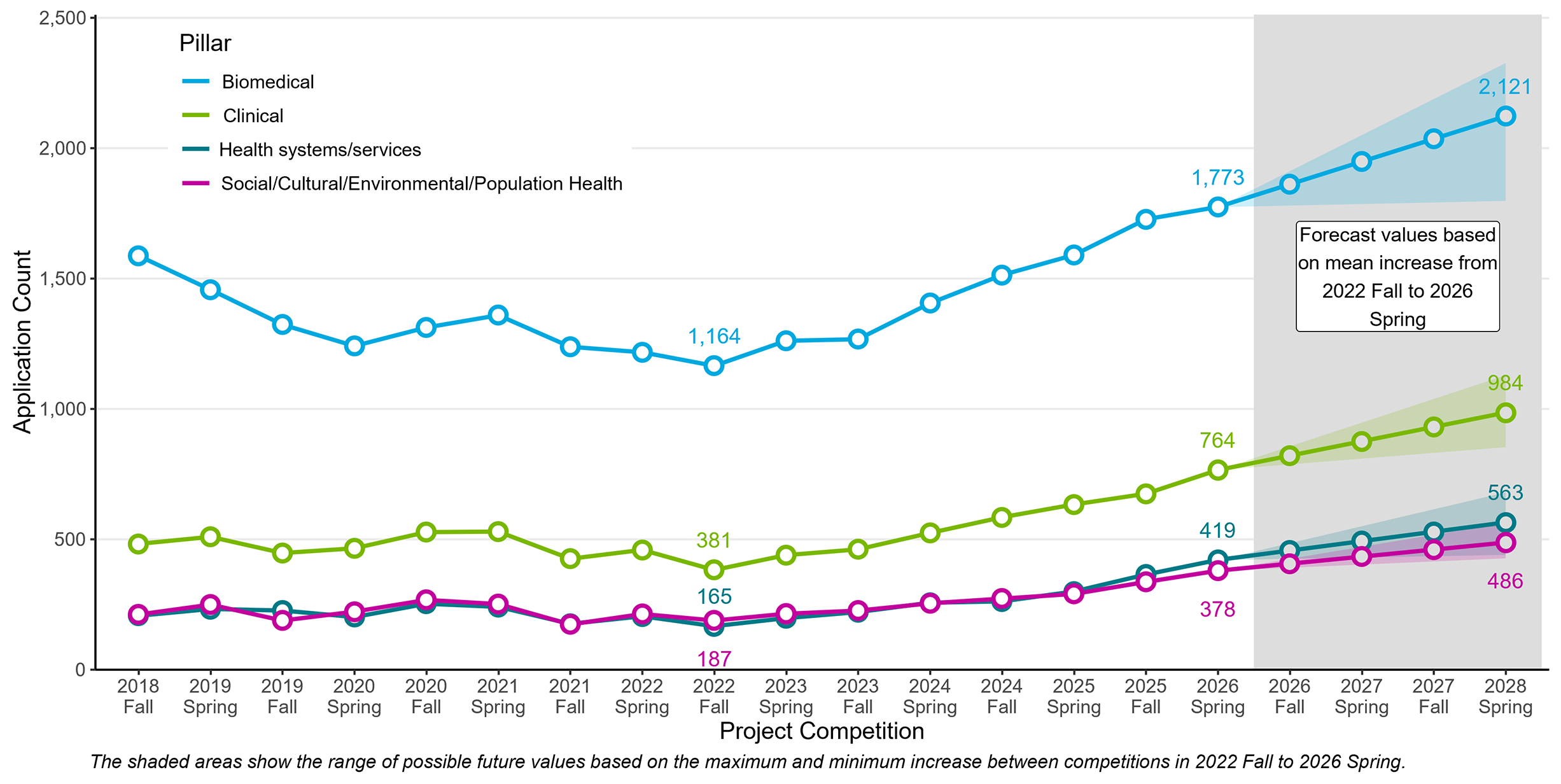
Figure 3 long description
| Project Competition | Competition Type | Pillar | Applications | Applications Lower Bound | Applications Upper Bound |
|---|---|---|---|---|---|
| 2018 Fall | Historic | Biomedical | 1586 | ||
| 2018 Fall | Historic | Clinical | 481 | ||
| 2018 Fall | Historic | Health systems/services | 205 | ||
| 2018 Fall | Historic | Social/Cultural/Environmental/Population Health | 210 | ||
| 2019 Spring | Historic | Biomedical | 1456 | ||
| 2019 Spring | Historic | Clinical | 508 | ||
| 2019 Spring | Historic | Health systems/services | 231 | ||
| 2019 Spring | Historic | Social/Cultural/Environmental/Population Health | 248 | ||
| 2019 Fall | Historic | Biomedical | 1322 | ||
| 2019 Fall | Historic | Clinical | 446 | ||
| 2019 Fall | Historic | Health systems/services | 225 | ||
| 2019 Fall | Historic | Social/Cultural/Environmental/Population Health | 187 | ||
| 2020 Spring | Historic | Biomedical | 1240 | ||
| 2020 Spring | Historic | Clinical | 464 | ||
| 2020 Spring | Historic | Health systems/services | 200 | ||
| 2020 Spring | Historic | Social/Cultural/Environmental/Population Health | 221 | ||
| 2020 Fall | Historic | Biomedical | 1311 | ||
| 2020 Fall | Historic | Clinical | 526 | ||
| 2020 Fall | Historic | Health systems/services | 251 | ||
| 2020 Fall | Historic | Social/Cultural/Environmental/Population Health | 266 | ||
| 2021 Spring | Historic | Biomedical | 1358 | ||
| 2021 Spring | Historic | Clinical | 528 | ||
| 2021 Spring | Historic | Health systems/services | 239 | ||
| 2021 Spring | Historic | Social/Cultural/Environmental/Population Health | 250 | ||
| 2021 Fall | Historic | Biomedical | 1237 | ||
| 2021 Fall | Historic | Clinical | 424 | ||
| 2021 Fall | Historic | Health systems/services | 174 | ||
| 2021 Fall | Historic | Social/Cultural/Environmental/Population Health | 172 | ||
| 2022 Spring | Historic | Biomedical | 1216 | ||
| 2022 Spring | Historic | Clinical | 458 | ||
| 2022 Spring | Historic | Health systems/services | 203 | ||
| 2022 Spring | Historic | Social/Cultural/Environmental/Population Health | 212 | ||
| 2022 Fall | Historic | Biomedical | 1164 | ||
| 2022 Fall | Historic | Clinical | 381 | ||
| 2022 Fall | Historic | Health systems/services | 165 | ||
| 2022 Fall | Historic | Social/Cultural/Environmental/Population Health | 187 | ||
| 2023 Spring | Historic | Biomedical | 1260 | ||
| 2023 Spring | Historic | Clinical | 438 | ||
| 2023 Spring | Historic | Health systems/services | 196 | ||
| 2023 Spring | Historic | Social/Cultural/Environmental/Population Health | 213 | ||
| 2023 Fall | Historic | Biomedical | 1266 | ||
| 2023 Fall | Historic | Clinical | 460 | ||
| 2023 Fall | Historic | Health systems/services | 219 | ||
| 2023 Fall | Historic | Social/Cultural/Environmental/Population Health | 225 | ||
| 2024 Spring | Historic | Biomedical | 1404 | ||
| 2024 Spring | Historic | Clinical | 523 | ||
| 2024 Spring | Historic | Health systems/services | 255 | ||
| 2024 Spring | Historic | Social/Cultural/Environmental/Population Health | 253 | ||
| 2024 Fall | Historic | Biomedical | 1512 | ||
| 2024 Fall | Historic | Clinical | 583 | ||
| 2024 Fall | Historic | Health systems/services | 260 | ||
| 2024 Fall | Historic | Social/Cultural/Environmental/Population Health | 271 | ||
| 2025 Spring | Historic | Biomedical | 1589 | ||
| 2025 Spring | Historic | Clinical | 632 | ||
| 2025 Spring | Historic | Health systems/services | 298 | ||
| 2025 Spring | Historic | Social/Cultural/Environmental/Population Health | 289 | ||
| 2025 Fall | Historic | Biomedical | 1726 | ||
| 2025 Fall | Historic | Clinical | 673 | ||
| 2025 Fall | Historic | Health systems/services | 363 | ||
| 2025 Fall | Historic | Social/Cultural/Environmental/Population Health | 335 | ||
| 2026 Spring | Historic | Biomedical | 1773 | ||
| 2026 Spring | Historic | Clinical | 764 | ||
| 2026 Spring | Historic | Health systems/services | 419 | ||
| 2026 Spring | Historic | Social/Cultural/Environmental/Population Health | 378 | ||
| 2026 Fall | Forecast | Biomedical | 1860 | 1779 | 1911 |
| 2026 Fall | Forecast | Clinical | 819 | 786 | 855 |
| 2026 Fall | Forecast | Health systems/services | 455 | 424 | 484 |
| 2026 Fall | Forecast | Social/Cultural/Environmental/Population Health | 405 | 390 | 424 |
| 2027 Spring | Forecast | Biomedical | 1947 | 1785 | 2049 |
| 2027 Spring | Forecast | Clinical | 874 | 808 | 946 |
| 2027 Spring | Forecast | Health systems/services | 491 | 429 | 549 |
| 2027 Spring | Forecast | Social/Cultural/Environmental/Population Health | 432 | 402 | 470 |
| 2027 Fall | Forecast | Biomedical | 2034 | 1791 | 2187 |
| 2027 Fall | Forecast | Clinical | 929 | 830 | 1037 |
| 2027 Fall | Forecast | Health systems/services | 527 | 434 | 614 |
| 2027 Fall | Forecast | Social/Cultural/Environmental/Population Health | 459 | 414 | 516 |
| 2028 Spring | Forecast | Biomedical | 2121 | 1797 | 2325 |
| 2028 Spring | Forecast | Clinical | 984 | 852 | 1128 |
| 2028 Spring | Forecast | Health systems/services | 563 | 439 | 679 |
| 2028 Spring | Forecast | Social/Cultural/Environmental/Population Health | 486 | 426 | 562 |
Figure 4: Count of number of real and forecast applications submitted across competitions by career stage
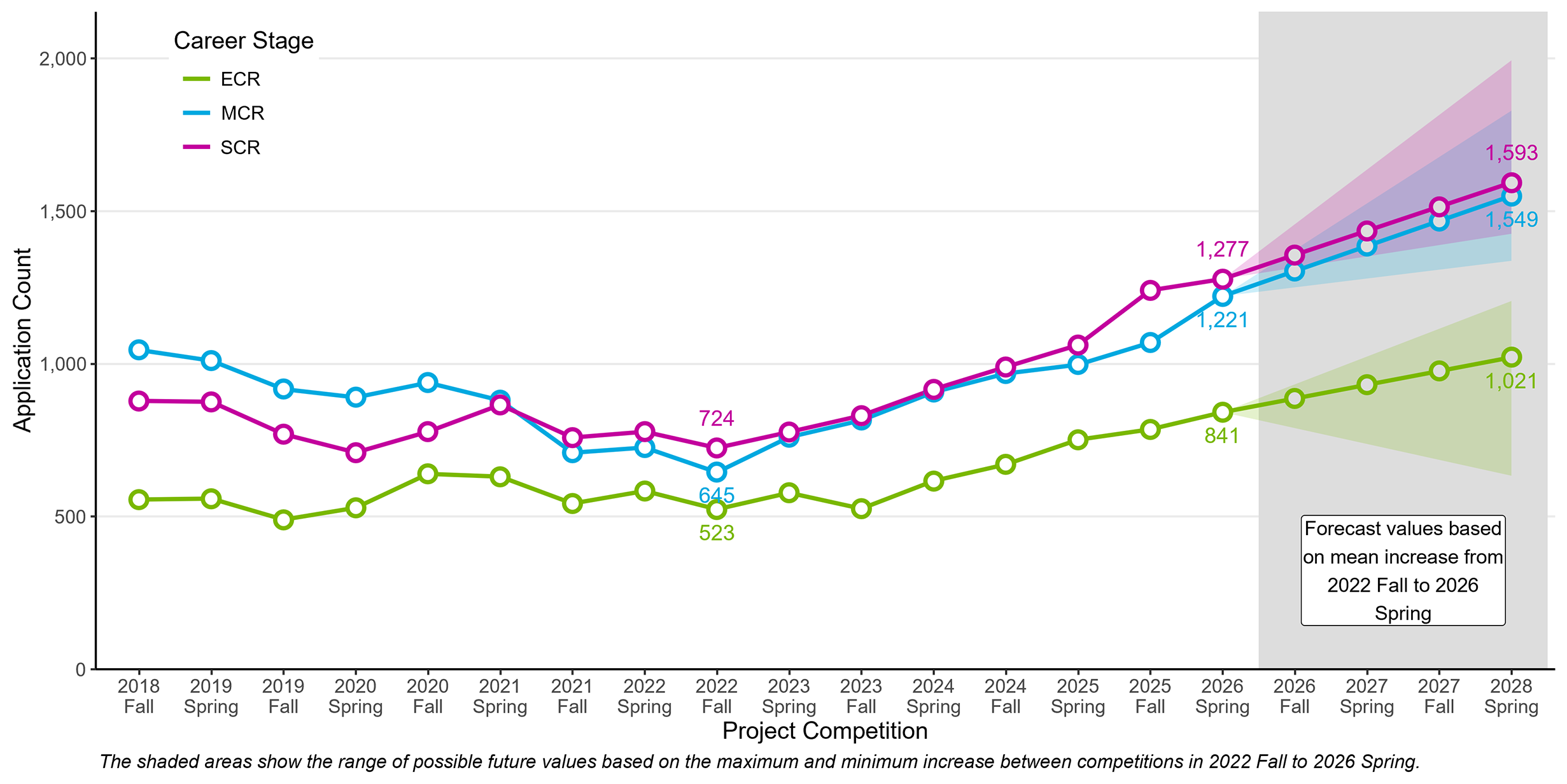
Figure 4 long description
| Project Competition | Competition Type | Career Stage | Applications | Applications Lower Bound | Applications Upper Bound |
|---|---|---|---|---|---|
| 2018 Fall | Historic | ECR | 555 | ||
| 2018 Fall | Historic | MCR | 1045 | ||
| 2018 Fall | Historic | SCR | 878 | ||
| 2019 Spring | Historic | ECR | 558 | ||
| 2019 Spring | Historic | MCR | 1010 | ||
| 2019 Spring | Historic | SCR | 875 | ||
| 2019 Fall | Historic | ECR | 489 | ||
| 2019 Fall | Historic | MCR | 917 | ||
| 2019 Fall | Historic | SCR | 769 | ||
| 2020 Spring | Historic | ECR | 528 | ||
| 2020 Spring | Historic | MCR | 890 | ||
| 2020 Spring | Historic | SCR | 709 | ||
| 2020 Fall | Historic | ECR | 639 | ||
| 2020 Fall | Historic | MCR | 938 | ||
| 2020 Fall | Historic | SCR | 777 | ||
| 2021 Spring | Historic | ECR | 630 | ||
| 2021 Spring | Historic | MCR | 880 | ||
| 2021 Spring | Historic | SCR | 865 | ||
| 2021 Fall | Historic | ECR | 542 | ||
| 2021 Fall | Historic | MCR | 709 | ||
| 2021 Fall | Historic | SCR | 758 | ||
| 2022 Spring | Historic | ECR | 583 | ||
| 2022 Spring | Historic | MCR | 726 | ||
| 2022 Spring | Historic | SCR | 777 | ||
| 2022 Fall | Historic | ECR | 523 | ||
| 2022 Fall | Historic | MCR | 645 | ||
| 2022 Fall | Historic | SCR | 724 | ||
| 2023 Spring | Historic | ECR | 577 | ||
| 2023 Spring | Historic | MCR | 760 | ||
| 2023 Spring | Historic | SCR | 776 | ||
| 2023 Fall | Historic | ECR | 525 | ||
| 2023 Fall | Historic | MCR | 815 | ||
| 2023 Fall | Historic | SCR | 830 | ||
| 2024 Spring | Historic | ECR | 616 | ||
| 2024 Spring | Historic | MCR | 907 | ||
| 2024 Spring | Historic | SCR | 916 | ||
| 2024 Fall | Historic | ECR | 670 | ||
| 2024 Fall | Historic | MCR | 968 | ||
| 2024 Fall | Historic | SCR | 989 | ||
| 2025 Spring | Historic | ECR | 751 | ||
| 2025 Spring | Historic | MCR | 997 | ||
| 2025 Spring | Historic | SCR | 1061 | ||
| 2025 Fall | Historic | ECR | 785 | ||
| 2025 Fall | Historic | MCR | 1069 | ||
| 2025 Fall | Historic | SCR | 1240 | ||
| 2026 Spring | Historic | ECR | 841 | ||
| 2026 Spring | Historic | MCR | 1221 | ||
| 2026 Spring | Historic | SCR | 1277 | ||
| 2026 Fall | Forecast | ECR | 886 | 789 | 932 |
| 2026 Fall | Forecast | MCR | 1303 | 1250 | 1373 |
| 2026 Fall | Forecast | SCR | 1356 | 1314 | 1456 |
| 2027 Spring | Forecast | ECR | 931 | 737 | 1023 |
| 2027 Spring | Forecast | MCR | 1385 | 1279 | 1525 |
| 2027 Spring | Forecast | SCR | 1435 | 1351 | 1635 |
| 2027 Fall | Forecast | ECR | 976 | 685 | 1114 |
| 2027 Fall | Forecast | MCR | 1467 | 1308 | 1677 |
| 2027 Fall | Forecast | SCR | 1514 | 1388 | 1814 |
| 2028 Spring | Forecast | ECR | 1021 | 633 | 1205 |
| 2028 Spring | Forecast | MCR | 1549 | 1337 | 1829 |
| 2028 Spring | Forecast | SCR | 1593 | 1425 | 1993 |
Figure 5: Count of number of real and forecast applications submitted across competitions by panel for Health Services Evaluation & Interventions Research (HS1), Public, Community & Population Health (PH1), and Randomized Controlled Trials (RC1)
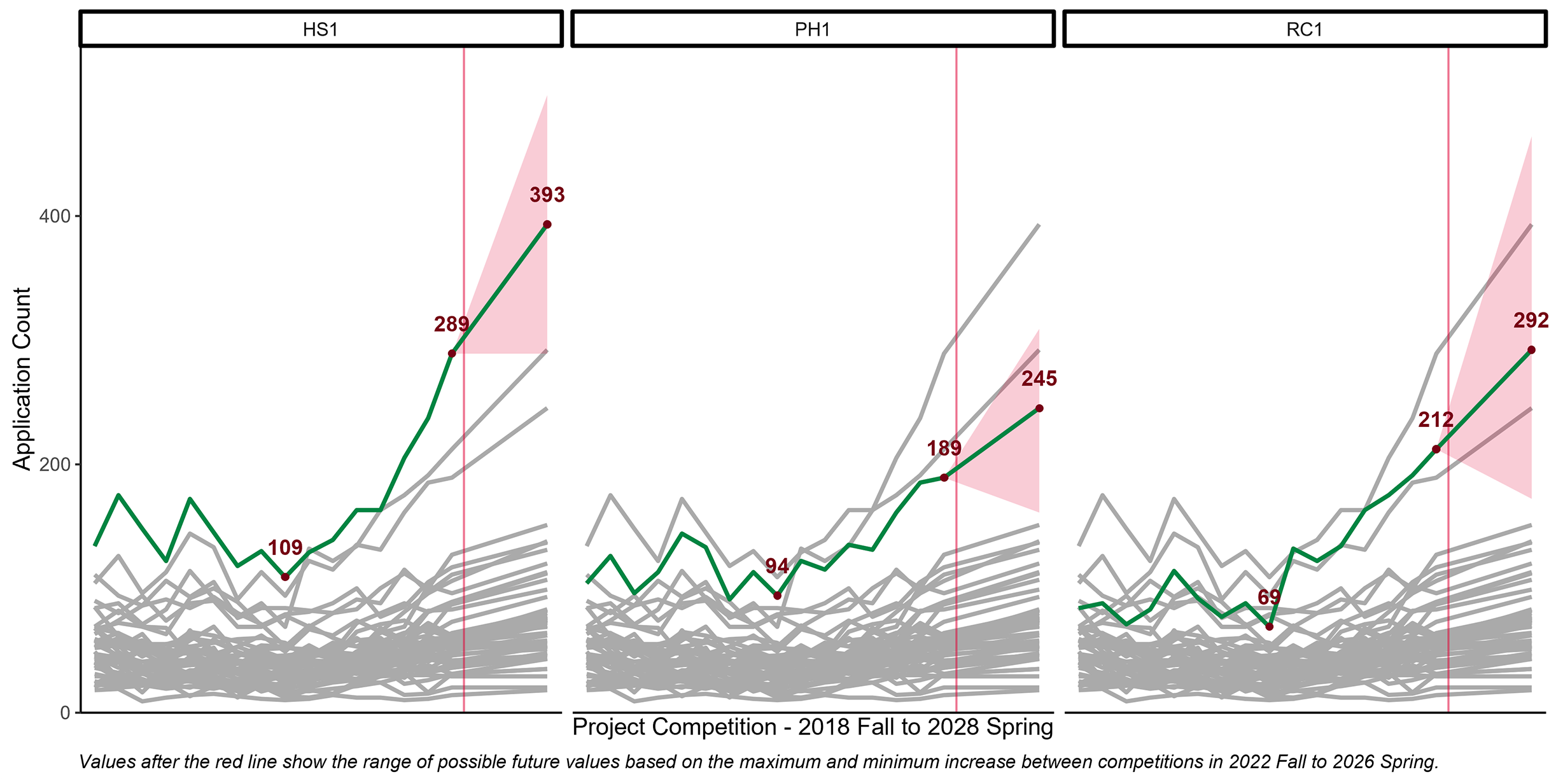
Figure 5 long description
| Project Competition | Competition Type | Career Stage | Applications | Applications Lower Bound | Applications Upper Bound |
|---|---|---|---|---|---|
| 2018 Fall | Historic | BCA | 68 | ||
| 2018 Fall | Historic | BMA | 31 | ||
| 2018 Fall | Historic | BMB | 41 | ||
| 2018 Fall | Historic | BME | 45 | ||
| 2018 Fall | Historic | BSA | 68 | ||
| 2018 Fall | Historic | BSB | 63 | ||
| 2018 Fall | Historic | BSC | 52 | ||
| 2018 Fall | Historic | CBB | 85 | ||
| 2018 Fall | Historic | CBC | 29 | ||
| 2018 Fall | Historic | CBT | 111 | ||
| 2018 Fall | Historic | CHI | 53 | ||
| 2018 Fall | Historic | CIA | 69 | ||
| 2018 Fall | Historic | CIB | 68 | ||
| 2018 Fall | Historic | CIC | 23 | ||
| 2018 Fall | Historic | CID | 42 | ||
| 2018 Fall | Historic | CMZ | 25 | ||
| 2018 Fall | Historic | CPT | 90 | ||
| 2018 Fall | Historic | CSA | 23 | ||
| 2018 Fall | Historic | CSB | 49 | ||
| 2018 Fall | Historic | CSC | 38 | ||
| 2018 Fall | Historic | DOL | 46 | ||
| 2018 Fall | Historic | G | 59 | ||
| 2018 Fall | Historic | GMX | 23 | ||
| 2018 Fall | Historic | GSH | 40 | ||
| 2018 Fall | Historic | HDK | 47 | ||
| 2018 Fall | Historic | HLE | 18 | ||
| 2018 Fall | Historic | HPM | 36 | ||
| 2018 Fall | Historic | HS1 | 134 | ||
| 2018 Fall | Historic | IHR | 23 | ||
| 2018 Fall | Historic | KTR | 20 | ||
| 2018 Fall | Historic | MCC | 46 | ||
| 2018 Fall | Historic | MID | 55 | ||
| 2018 Fall | Historic | MOV | 58 | ||
| 2018 Fall | Historic | MPI | 57 | ||
| 2018 Fall | Historic | NSA | 59 | ||
| 2018 Fall | Historic | NSB | 70 | ||
| 2018 Fall | Historic | NUT | 52 | ||
| 2018 Fall | Historic | PB1 | 67 | ||
| 2018 Fall | Historic | PH1 | 104 | ||
| 2018 Fall | Historic | PS | 47 | ||
| 2018 Fall | Historic | PT | 40 | ||
| 2018 Fall | Historic | RC1 | 84 | ||
| 2018 Fall | Historic | RS | 41 | ||
| 2018 Fall | Historic | SDA | 21 | ||
| 2018 Fall | Historic | VVP | 57 | ||
| 2019 Spring | Historic | BCA | 54 | ||
| 2019 Spring | Historic | BMA | 27 | ||
| 2019 Spring | Historic | BMB | 30 | ||
| 2019 Spring | Historic | BME | 36 | ||
| 2019 Spring | Historic | BSA | 49 | ||
| 2019 Spring | Historic | BSB | 74 | ||
| 2019 Spring | Historic | BSC | 54 | ||
| 2019 Spring | Historic | CB1 | 38 | ||
| 2019 Spring | Historic | CBB | 61 | ||
| 2019 Spring | Historic | CBC | 29 | ||
| 2019 Spring | Historic | CBT | 94 | ||
| 2019 Spring | Historic | CHI | 58 | ||
| 2019 Spring | Historic | CIA | 82 | ||
| 2019 Spring | Historic | CIB | 64 | ||
| 2019 Spring | Historic | CIC | 32 | ||
| 2019 Spring | Historic | CID | 40 | ||
| 2019 Spring | Historic | CMZ | 22 | ||
| 2019 Spring | Historic | CPT | 80 | ||
| 2019 Spring | Historic | CSA | 25 | ||
| 2019 Spring | Historic | CSB | 27 | ||
| 2019 Spring | Historic | CSC | 27 | ||
| 2019 Spring | Historic | DOL | 41 | ||
| 2019 Spring | Historic | G | 52 | ||
| 2019 Spring | Historic | GMX | 20 | ||
| 2019 Spring | Historic | GSH | 28 | ||
| 2019 Spring | Historic | HDK | 41 | ||
| 2019 Spring | Historic | HLE | 19 | ||
| 2019 Spring | Historic | HPM | 32 | ||
| 2019 Spring | Historic | HS1 | 175 | ||
| 2019 Spring | Historic | IHR | 26 | ||
| 2019 Spring | Historic | KTR | 32 | ||
| 2019 Spring | Historic | MCC | 42 | ||
| 2019 Spring | Historic | MID | 46 | ||
| 2019 Spring | Historic | MOV | 45 | ||
| 2019 Spring | Historic | MPI | 64 | ||
| 2019 Spring | Historic | NSA | 53 | ||
| 2019 Spring | Historic | NSB | 63 | ||
| 2019 Spring | Historic | NUT | 60 | ||
| 2019 Spring | Historic | PB1 | 72 | ||
| 2019 Spring | Historic | PH1 | 126 | ||
| 2019 Spring | Historic | PS | 44 | ||
| 2019 Spring | Historic | PT | 40 | ||
| 2019 Spring | Historic | RC1 | 88 | ||
| 2019 Spring | Historic | RS | 48 | ||
| 2019 Spring | Historic | SDA | 25 | ||
| 2019 Spring | Historic | VVP | 54 | ||
| 2019 Fall | Historic | BCA | 58 | ||
| 2019 Fall | Historic | BMA | 34 | ||
| 2019 Fall | Historic | BMB | 25 | ||
| 2019 Fall | Historic | BME | 36 | ||
| 2019 Fall | Historic | BSA | 37 | ||
| 2019 Fall | Historic | BSB | 86 | ||
| 2019 Fall | Historic | BSC | 37 | ||
| 2019 Fall | Historic | CB1 | 25 | ||
| 2019 Fall | Historic | CBB | 52 | ||
| 2019 Fall | Historic | CBC | 24 | ||
| 2019 Fall | Historic | CBT | 86 | ||
| 2019 Fall | Historic | CHI | 45 | ||
| 2019 Fall | Historic | CIA | 69 | ||
| 2019 Fall | Historic | CIB | 55 | ||
| 2019 Fall | Historic | CIC | 16 | ||
| 2019 Fall | Historic | CID | 50 | ||
| 2019 Fall | Historic | CMZ | 22 | ||
| 2019 Fall | Historic | CPT | 94 | ||
| 2019 Fall | Historic | CSA | 22 | ||
| 2019 Fall | Historic | CSB | 31 | ||
| 2019 Fall | Historic | CSC | 32 | ||
| 2019 Fall | Historic | DOL | 32 | ||
| 2019 Fall | Historic | G | 63 | ||
| 2019 Fall | Historic | GSH | 33 | ||
| 2019 Fall | Historic | HDK | 36 | ||
| 2019 Fall | Historic | HLE | 9 | ||
| 2019 Fall | Historic | HPM | 41 | ||
| 2019 Fall | Historic | HS1 | 148 | ||
| 2019 Fall | Historic | IHR | 23 | ||
| 2019 Fall | Historic | KTR | 27 | ||
| 2019 Fall | Historic | MCC | 34 | ||
| 2019 Fall | Historic | MID | 41 | ||
| 2019 Fall | Historic | MOV | 37 | ||
| 2019 Fall | Historic | MPI | 46 | ||
| 2019 Fall | Historic | NSA | 55 | ||
| 2019 Fall | Historic | NSB | 51 | ||
| 2019 Fall | Historic | NUT | 49 | ||
| 2019 Fall | Historic | PB1 | 69 | ||
| 2019 Fall | Historic | PH1 | 96 | ||
| 2019 Fall | Historic | PS | 50 | ||
| 2019 Fall | Historic | PT | 31 | ||
| 2019 Fall | Historic | RC1 | 71 | ||
| 2019 Fall | Historic | RS | 36 | ||
| 2019 Fall | Historic | SDA | 25 | ||
| 2019 Fall | Historic | VVP | 48 | ||
| 2020 Spring | Historic | BCA | 42 | ||
| 2020 Spring | Historic | BMA | 25 | ||
| 2020 Spring | Historic | BMB | 21 | ||
| 2020 Spring | Historic | BME | 31 | ||
| 2020 Spring | Historic | BSA | 30 | ||
| 2020 Spring | Historic | BSB | 106 | ||
| 2020 Spring | Historic | BSC | 44 | ||
| 2020 Spring | Historic | CB1 | 29 | ||
| 2020 Spring | Historic | CBB | 42 | ||
| 2020 Spring | Historic | CBC | 29 | ||
| 2020 Spring | Historic | CBT | 91 | ||
| 2020 Spring | Historic | CHI | 55 | ||
| 2020 Spring | Historic | CIA | 63 | ||
| 2020 Spring | Historic | CIB | 51 | ||
| 2020 Spring | Historic | CIC | 35 | ||
| 2020 Spring | Historic | CID | 45 | ||
| 2020 Spring | Historic | CMZ | 24 | ||
| 2020 Spring | Historic | CPT | 74 | ||
| 2020 Spring | Historic | CSA | 19 | ||
| 2020 Spring | Historic | CSB | 29 | ||
| 2020 Spring | Historic | CSC | 25 | ||
| 2020 Spring | Historic | DOL | 21 | ||
| 2020 Spring | Historic | G | 41 | ||
| 2020 Spring | Historic | GMX | 23 | ||
| 2020 Spring | Historic | GSH | 36 | ||
| 2020 Spring | Historic | HDK | 39 | ||
| 2020 Spring | Historic | HLE | 12 | ||
| 2020 Spring | Historic | HPM | 43 | ||
| 2020 Spring | Historic | HS1 | 122 | ||
| 2020 Spring | Historic | IHR | 22 | ||
| 2020 Spring | Historic | KTR | 20 | ||
| 2020 Spring | Historic | MCC | 37 | ||
| 2020 Spring | Historic | MID | 38 | ||
| 2020 Spring | Historic | MOV | 32 | ||
| 2020 Spring | Historic | MPI | 55 | ||
| 2020 Spring | Historic | NSA | 55 | ||
| 2020 Spring | Historic | NSB | 51 | ||
| 2020 Spring | Historic | NUT | 46 | ||
| 2020 Spring | Historic | PB1 | 68 | ||
| 2020 Spring | Historic | PH1 | 113 | ||
| 2020 Spring | Historic | PS | 48 | ||
| 2020 Spring | Historic | PT | 25 | ||
| 2020 Spring | Historic | RC1 | 83 | ||
| 2020 Spring | Historic | RS | 42 | ||
| 2020 Spring | Historic | SDA | 26 | ||
| 2020 Spring | Historic | VVP | 38 | ||
| 2020 Fall | Historic | BCA | 50 | ||
| 2020 Fall | Historic | BMA | 25 | ||
| 2020 Fall | Historic | BMB | 26 | ||
| 2020 Fall | Historic | BME | 45 | ||
| 2020 Fall | Historic | BSA | 31 | ||
| 2020 Fall | Historic | BSB | 93 | ||
| 2020 Fall | Historic | BSC | 39 | ||
| 2020 Fall | Historic | CB1 | 31 | ||
| 2020 Fall | Historic | CBB | 42 | ||
| 2020 Fall | Historic | CBC | 32 | ||
| 2020 Fall | Historic | CBT | 84 | ||
| 2020 Fall | Historic | CHI | 52 | ||
| 2020 Fall | Historic | CIA | 92 | ||
| 2020 Fall | Historic | CIB | 65 | ||
| 2020 Fall | Historic | CIC | 28 | ||
| 2020 Fall | Historic | CID | 58 | ||
| 2020 Fall | Historic | CMZ | 13 | ||
| 2020 Fall | Historic | CPT | 88 | ||
| 2020 Fall | Historic | CSA | 21 | ||
| 2020 Fall | Historic | CSB | 31 | ||
| 2020 Fall | Historic | CSC | 34 | ||
| 2020 Fall | Historic | DOL | 31 | ||
| 2020 Fall | Historic | G | 50 | ||
| 2020 Fall | Historic | GMX | 20 | ||
| 2020 Fall | Historic | GSH | 38 | ||
| 2020 Fall | Historic | HDK | 31 | ||
| 2020 Fall | Historic | HLE | 14 | ||
| 2020 Fall | Historic | HPM | 62 | ||
| 2020 Fall | Historic | HS1 | 172 | ||
| 2020 Fall | Historic | IHR | 30 | ||
| 2020 Fall | Historic | KTR | 28 | ||
| 2020 Fall | Historic | MCC | 31 | ||
| 2020 Fall | Historic | MID | 41 | ||
| 2020 Fall | Historic | MOV | 30 | ||
| 2020 Fall | Historic | MPI | 60 | ||
| 2020 Fall | Historic | NSA | 53 | ||
| 2020 Fall | Historic | NSB | 48 | ||
| 2020 Fall | Historic | NUT | 48 | ||
| 2020 Fall | Historic | PB1 | 45 | ||
| 2020 Fall | Historic | PH1 | 144 | ||
| 2020 Fall | Historic | PS | 50 | ||
| 2020 Fall | Historic | PT | 32 | ||
| 2020 Fall | Historic | RC1 | 114 | ||
| 2020 Fall | Historic | RS | 38 | ||
| 2020 Fall | Historic | SDA | 30 | ||
| 2020 Fall | Historic | VVP | 66 | ||
| 2021 Spring | Historic | BCA | 45 | ||
| 2021 Spring | Historic | BMA | 21 | ||
| 2021 Spring | Historic | BMB | 29 | ||
| 2021 Spring | Historic | BME | 42 | ||
| 2021 Spring | Historic | BSA | 39 | ||
| 2021 Spring | Historic | BSB | 105 | ||
| 2021 Spring | Historic | BSC | 41 | ||
| 2021 Spring | Historic | CB1 | 33 | ||
| 2021 Spring | Historic | CBB | 43 | ||
| 2021 Spring | Historic | CBC | 30 | ||
| 2021 Spring | Historic | CBT | 93 | ||
| 2021 Spring | Historic | CHI | 48 | ||
| 2021 Spring | Historic | CIA | 100 | ||
| 2021 Spring | Historic | CIB | 62 | ||
| 2021 Spring | Historic | CIC | 21 | ||
| 2021 Spring | Historic | CID | 69 | ||
| 2021 Spring | Historic | CMZ | 21 | ||
| 2021 Spring | Historic | CPT | 90 | ||
| 2021 Spring | Historic | CSA | 19 | ||
| 2021 Spring | Historic | CSB | 32 | ||
| 2021 Spring | Historic | CSC | 34 | ||
| 2021 Spring | Historic | DOL | 37 | ||
| 2021 Spring | Historic | G | 36 | ||
| 2021 Spring | Historic | GMX | 27 | ||
| 2021 Spring | Historic | GSH | 43 | ||
| 2021 Spring | Historic | HDK | 39 | ||
| 2021 Spring | Historic | HLE | 15 | ||
| 2021 Spring | Historic | HPM | 50 | ||
| 2021 Spring | Historic | HS1 | 145 | ||
| 2021 Spring | Historic | IHR | 28 | ||
| 2021 Spring | Historic | KTR | 23 | ||
| 2021 Spring | Historic | MCC | 46 | ||
| 2021 Spring | Historic | MID | 59 | ||
| 2021 Spring | Historic | MOV | 48 | ||
| 2021 Spring | Historic | MPI | 57 | ||
| 2021 Spring | Historic | NSA | 56 | ||
| 2021 Spring | Historic | NSB | 47 | ||
| 2021 Spring | Historic | NUT | 40 | ||
| 2021 Spring | Historic | PB1 | 52 | ||
| 2021 Spring | Historic | PH1 | 133 | ||
| 2021 Spring | Historic | PS | 47 | ||
| 2021 Spring | Historic | PT | 36 | ||
| 2021 Spring | Historic | RC1 | 92 | ||
| 2021 Spring | Historic | RS | 39 | ||
| 2021 Spring | Historic | SDA | 25 | ||
| 2021 Spring | Historic | VVP | 46 | ||
| 2021 Fall | Historic | BCA | 46 | ||
| 2021 Fall | Historic | BMA | 27 | ||
| 2021 Fall | Historic | BMB | 24 | ||
| 2021 Fall | Historic | BME | 53 | ||
| 2021 Fall | Historic | BSA | 31 | ||
| 2021 Fall | Historic | BSB | 76 | ||
| 2021 Fall | Historic | BSC | 35 | ||
| 2021 Fall | Historic | CB1 | 27 | ||
| 2021 Fall | Historic | CBB | 45 | ||
| 2021 Fall | Historic | CBC | 21 | ||
| 2021 Fall | Historic | CBT | 80 | ||
| 2021 Fall | Historic | CHI | 42 | ||
| 2021 Fall | Historic | CIA | 89 | ||
| 2021 Fall | Historic | CIB | 57 | ||
| 2021 Fall | Historic | CIC | 25 | ||
| 2021 Fall | Historic | CID | 47 | ||
| 2021 Fall | Historic | CMZ | 17 | ||
| 2021 Fall | Historic | CPT | 69 | ||
| 2021 Fall | Historic | CSA | 23 | ||
| 2021 Fall | Historic | CSB | 34 | ||
| 2021 Fall | Historic | CSC | 33 | ||
| 2021 Fall | Historic | DOL | 40 | ||
| 2021 Fall | Historic | G | 39 | ||
| 2021 Fall | Historic | GMX | 33 | ||
| 2021 Fall | Historic | GSH | 33 | ||
| 2021 Fall | Historic | HDK | 40 | ||
| 2021 Fall | Historic | HPM | 32 | ||
| 2021 Fall | Historic | HS1 | 118 | ||
| 2021 Fall | Historic | IHR | 18 | ||
| 2021 Fall | Historic | KTR | 26 | ||
| 2021 Fall | Historic | MCC | 33 | ||
| 2021 Fall | Historic | MID | 48 | ||
| 2021 Fall | Historic | MOV | 39 | ||
| 2021 Fall | Historic | MPI | 49 | ||
| 2021 Fall | Historic | NSA | 59 | ||
| 2021 Fall | Historic | NSB | 53 | ||
| 2021 Fall | Historic | NUT | 31 | ||
| 2021 Fall | Historic | PB1 | 24 | ||
| 2021 Fall | Historic | PH1 | 91 | ||
| 2021 Fall | Historic | PS | 40 | ||
| 2021 Fall | Historic | PT | 35 | ||
| 2021 Fall | Historic | RC1 | 77 | ||
| 2021 Fall | Historic | RS | 41 | ||
| 2021 Fall | Historic | SDA | 12 | ||
| 2021 Fall | Historic | TIR | 14 | ||
| 2021 Fall | Historic | VVP | 32 | ||
| 2022 Spring | Historic | BCA | 50 | ||
| 2022 Spring | Historic | BMA | 17 | ||
| 2022 Spring | Historic | BMB | 19 | ||
| 2022 Spring | Historic | BME | 62 | ||
| 2022 Spring | Historic | BSA | 28 | ||
| 2022 Spring | Historic | BSB | 84 | ||
| 2022 Spring | Historic | BSC | 37 | ||
| 2022 Spring | Historic | CB1 | 28 | ||
| 2022 Spring | Historic | CBB | 54 | ||
| 2022 Spring | Historic | CBC | 25 | ||
| 2022 Spring | Historic | CBT | 71 | ||
| 2022 Spring | Historic | CHI | 39 | ||
| 2022 Spring | Historic | CIA | 70 | ||
| 2022 Spring | Historic | CIB | 51 | ||
| 2022 Spring | Historic | CIC | 26 | ||
| 2022 Spring | Historic | CID | 43 | ||
| 2022 Spring | Historic | CMZ | 25 | ||
| 2022 Spring | Historic | CPT | 69 | ||
| 2022 Spring | Historic | CSA | 25 | ||
| 2022 Spring | Historic | CSB | 24 | ||
| 2022 Spring | Historic | CSC | 30 | ||
| 2022 Spring | Historic | DOL | 29 | ||
| 2022 Spring | Historic | G | 45 | ||
| 2022 Spring | Historic | GMX | 44 | ||
| 2022 Spring | Historic | GSH | 32 | ||
| 2022 Spring | Historic | HDK | 33 | ||
| 2022 Spring | Historic | HLE | 11 | ||
| 2022 Spring | Historic | HPM | 35 | ||
| 2022 Spring | Historic | HS1 | 130 | ||
| 2022 Spring | Historic | IHR | 21 | ||
| 2022 Spring | Historic | KTR | 24 | ||
| 2022 Spring | Historic | MCC | 37 | ||
| 2022 Spring | Historic | MID | 45 | ||
| 2022 Spring | Historic | MOV | 49 | ||
| 2022 Spring | Historic | MPI | 42 | ||
| 2022 Spring | Historic | NSA | 60 | ||
| 2022 Spring | Historic | NSB | 46 | ||
| 2022 Spring | Historic | NUT | 28 | ||
| 2022 Spring | Historic | PB1 | 45 | ||
| 2022 Spring | Historic | PH1 | 113 | ||
| 2022 Spring | Historic | PS | 42 | ||
| 2022 Spring | Historic | PT | 41 | ||
| 2022 Spring | Historic | RC1 | 88 | ||
| 2022 Spring | Historic | RS | 32 | ||
| 2022 Spring | Historic | SDA | 22 | ||
| 2022 Spring | Historic | TIR | 21 | ||
| 2022 Spring | Historic | VVP | 44 | ||
| 2022 Fall | Historic | BCA | 43 | ||
| 2022 Fall | Historic | BMA | 22 | ||
| 2022 Fall | Historic | BMB | 25 | ||
| 2022 Fall | Historic | BME | 49 | ||
| 2022 Fall | Historic | BSA | 34 | ||
| 2022 Fall | Historic | BSB | 84 | ||
| 2022 Fall | Historic | BSC | 35 | ||
| 2022 Fall | Historic | CB1 | 30 | ||
| 2022 Fall | Historic | CBB | 53 | ||
| 2022 Fall | Historic | CBC | 29 | ||
| 2022 Fall | Historic | CBT | 53 | ||
| 2022 Fall | Historic | CHI | 38 | ||
| 2022 Fall | Historic | CIA | 79 | ||
| 2022 Fall | Historic | CIB | 52 | ||
| 2022 Fall | Historic | CIC | 19 | ||
| 2022 Fall | Historic | CID | 31 | ||
| 2022 Fall | Historic | CMZ | 30 | ||
| 2022 Fall | Historic | CPT | 78 | ||
| 2022 Fall | Historic | CSA | 17 | ||
| 2022 Fall | Historic | CSB | 22 | ||
| 2022 Fall | Historic | CSC | 27 | ||
| 2022 Fall | Historic | DOL | 36 | ||
| 2022 Fall | Historic | G | 35 | ||
| 2022 Fall | Historic | GMX | 45 | ||
| 2022 Fall | Historic | GSH | 28 | ||
| 2022 Fall | Historic | HDK | 24 | ||
| 2022 Fall | Historic | HLE | 10 | ||
| 2022 Fall | Historic | HPM | 28 | ||
| 2022 Fall | Historic | HS1 | 109 | ||
| 2022 Fall | Historic | IHR | 12 | ||
| 2022 Fall | Historic | IMN | 46 | ||
| 2022 Fall | Historic | KTR | 21 | ||
| 2022 Fall | Historic | MCC | 37 | ||
| 2022 Fall | Historic | MID | 46 | ||
| 2022 Fall | Historic | MOV | 37 | ||
| 2022 Fall | Historic | MPI | 38 | ||
| 2022 Fall | Historic | NSA | 56 | ||
| 2022 Fall | Historic | NSB | 40 | ||
| 2022 Fall | Historic | NUT | 31 | ||
| 2022 Fall | Historic | PB1 | 44 | ||
| 2022 Fall | Historic | PH1 | 94 | ||
| 2022 Fall | Historic | PS | 37 | ||
| 2022 Fall | Historic | PT | 39 | ||
| 2022 Fall | Historic | RC1 | 69 | ||
| 2022 Fall | Historic | RS | 25 | ||
| 2022 Fall | Historic | SDA | 13 | ||
| 2022 Fall | Historic | TIR | 14 | ||
| 2022 Fall | Historic | VVP | 35 | ||
| 2023 Spring | Historic | BCA | 54 | ||
| 2023 Spring | Historic | BMA | 32 | ||
| 2023 Spring | Historic | BMB | 30 | ||
| 2023 Spring | Historic | BME | 67 | ||
| 2023 Spring | Historic | BSA | 39 | ||
| 2023 Spring | Historic | BSB | 82 | ||
| 2023 Spring | Historic | BSC | 29 | ||
| 2023 Spring | Historic | CB1 | 29 | ||
| 2023 Spring | Historic | CBB | 48 | ||
| 2023 Spring | Historic | CBC | 24 | ||
| 2023 Spring | Historic | CBT | 70 | ||
| 2023 Spring | Historic | CHI | 30 | ||
| 2023 Spring | Historic | CIA | 81 | ||
| 2023 Spring | Historic | CIB | 51 | ||
| 2023 Spring | Historic | CIC | 22 | ||
| 2023 Spring | Historic | CID | 29 | ||
| 2023 Spring | Historic | CMZ | 35 | ||
| 2023 Spring | Historic | CPT | 69 | ||
| 2023 Spring | Historic | CSA | 17 | ||
| 2023 Spring | Historic | CSB | 26 | ||
| 2023 Spring | Historic | CSC | 30 | ||
| 2023 Spring | Historic | DOL | 33 | ||
| 2023 Spring | Historic | G | 45 | ||
| 2023 Spring | Historic | GMX | 29 | ||
| 2023 Spring | Historic | GSH | 21 | ||
| 2023 Spring | Historic | HDK | 30 | ||
| 2023 Spring | Historic | HLE | 11 | ||
| 2023 Spring | Historic | HPM | 33 | ||
| 2023 Spring | Historic | HS1 | 129 | ||
| 2023 Spring | Historic | IHR | 18 | ||
| 2023 Spring | Historic | IMN | 43 | ||
| 2023 Spring | Historic | KTR | 29 | ||
| 2023 Spring | Historic | MCC | 42 | ||
| 2023 Spring | Historic | MID | 48 | ||
| 2023 Spring | Historic | MOV | 45 | ||
| 2023 Spring | Historic | MPI | 54 | ||
| 2023 Spring | Historic | NSA | 44 | ||
| 2023 Spring | Historic | NSB | 48 | ||
| 2023 Spring | Historic | NUT | 35 | ||
| 2023 Spring | Historic | PB1 | 44 | ||
| 2023 Spring | Historic | PH1 | 122 | ||
| 2023 Spring | Historic | PS | 42 | ||
| 2023 Spring | Historic | PT | 44 | ||
| 2023 Spring | Historic | RC1 | 132 | ||
| 2023 Spring | Historic | RS | 28 | ||
| 2023 Spring | Historic | SDA | 12 | ||
| 2023 Spring | Historic | TIR | 20 | ||
| 2023 Spring | Historic | VVP | 38 | ||
| 2023 Fall | Historic | BCA | 44 | ||
| 2023 Fall | Historic | BMA | 28 | ||
| 2023 Fall | Historic | BMB | 30 | ||
| 2023 Fall | Historic | BME | 62 | ||
| 2023 Fall | Historic | BSA | 39 | ||
| 2023 Fall | Historic | BSB | 80 | ||
| 2023 Fall | Historic | BSC | 47 | ||
| 2023 Fall | Historic | CB1 | 33 | ||
| 2023 Fall | Historic | CBB | 48 | ||
| 2023 Fall | Historic | CBC | 34 | ||
| 2023 Fall | Historic | CBT | 60 | ||
| 2023 Fall | Historic | CHI | 31 | ||
| 2023 Fall | Historic | CIA | 88 | ||
| 2023 Fall | Historic | CIB | 49 | ||
| 2023 Fall | Historic | CIC | 25 | ||
| 2023 Fall | Historic | CID | 34 | ||
| 2023 Fall | Historic | CMZ | 29 | ||
| 2023 Fall | Historic | CPT | 80 | ||
| 2023 Fall | Historic | CSA | 19 | ||
| 2023 Fall | Historic | CSB | 28 | ||
| 2023 Fall | Historic | CSC | 26 | ||
| 2023 Fall | Historic | DOL | 30 | ||
| 2023 Fall | Historic | G | 56 | ||
| 2023 Fall | Historic | GMX | 38 | ||
| 2023 Fall | Historic | GSH | 41 | ||
| 2023 Fall | Historic | HDK | 32 | ||
| 2023 Fall | Historic | HLE | 14 | ||
| 2023 Fall | Historic | HPM | 39 | ||
| 2023 Fall | Historic | HS1 | 139 | ||
| 2023 Fall | Historic | IHR | 15 | ||
| 2023 Fall | Historic | IMN | 53 | ||
| 2023 Fall | Historic | KTR | 30 | ||
| 2023 Fall | Historic | MCC | 41 | ||
| 2023 Fall | Historic | MID | 45 | ||
| 2023 Fall | Historic | MOV | 47 | ||
| 2023 Fall | Historic | MPI | 44 | ||
| 2023 Fall | Historic | NSA | 50 | ||
| 2023 Fall | Historic | NSB | 43 | ||
| 2023 Fall | Historic | NUT | 32 | ||
| 2023 Fall | Historic | PB1 | 49 | ||
| 2023 Fall | Historic | PH1 | 115 | ||
| 2023 Fall | Historic | PS | 36 | ||
| 2023 Fall | Historic | PT | 35 | ||
| 2023 Fall | Historic | RC1 | 122 | ||
| 2023 Fall | Historic | RS | 40 | ||
| 2023 Fall | Historic | SDA | 15 | ||
| 2023 Fall | Historic | TIR | 24 | ||
| 2023 Fall | Historic | VVP | 36 | ||
| 2024 Spring | Historic | BCA | 65 | ||
| 2024 Spring | Historic | BMA | 34 | ||
| 2024 Spring | Historic | BMB | 27 | ||
| 2024 Spring | Historic | BME | 74 | ||
| 2024 Spring | Historic | BSA | 37 | ||
| 2024 Spring | Historic | BSB | 83 | ||
| 2024 Spring | Historic | BSC | 43 | ||
| 2024 Spring | Historic | CB1 | 35 | ||
| 2024 Spring | Historic | CBB | 72 | ||
| 2024 Spring | Historic | CBC | 31 | ||
| 2024 Spring | Historic | CBT | 53 | ||
| 2024 Spring | Historic | CHI | 44 | ||
| 2024 Spring | Historic | CIA | 100 | ||
| 2024 Spring | Historic | CIB | 47 | ||
| 2024 Spring | Historic | CIC | 34 | ||
| 2024 Spring | Historic | CID | 34 | ||
| 2024 Spring | Historic | CMZ | 40 | ||
| 2024 Spring | Historic | CPT | 91 | ||
| 2024 Spring | Historic | CSA | 21 | ||
| 2024 Spring | Historic | CSB | 27 | ||
| 2024 Spring | Historic | CSC | 32 | ||
| 2024 Spring | Historic | DOL | 38 | ||
| 2024 Spring | Historic | G | 53 | ||
| 2024 Spring | Historic | GMX | 36 | ||
| 2024 Spring | Historic | GSH | 48 | ||
| 2024 Spring | Historic | HDK | 25 | ||
| 2024 Spring | Historic | HLE | 12 | ||
| 2024 Spring | Historic | HPM | 47 | ||
| 2024 Spring | Historic | HS1 | 163 | ||
| 2024 Spring | Historic | IHR | 25 | ||
| 2024 Spring | Historic | IMN | 59 | ||
| 2024 Spring | Historic | KTR | 48 | ||
| 2024 Spring | Historic | MCC | 42 | ||
| 2024 Spring | Historic | MID | 60 | ||
| 2024 Spring | Historic | MOV | 41 | ||
| 2024 Spring | Historic | MPI | 44 | ||
| 2024 Spring | Historic | NSA | 58 | ||
| 2024 Spring | Historic | NSB | 46 | ||
| 2024 Spring | Historic | NUT | 37 | ||
| 2024 Spring | Historic | PB1 | 46 | ||
| 2024 Spring | Historic | PH1 | 135 | ||
| 2024 Spring | Historic | PS | 49 | ||
| 2024 Spring | Historic | PT | 36 | ||
| 2024 Spring | Historic | RC1 | 134 | ||
| 2024 Spring | Historic | RS | 42 | ||
| 2024 Spring | Historic | SDA | 22 | ||
| 2024 Spring | Historic | TIR | 26 | ||
| 2024 Spring | Historic | VVP | 47 | ||
| 2024 Fall | Historic | BCA | 71 | ||
| 2024 Fall | Historic | BMA | 35 | ||
| 2024 Fall | Historic | BMB | 34 | ||
| 2024 Fall | Historic | BME | 65 | ||
| 2024 Fall | Historic | BSA | 41 | ||
| 2024 Fall | Historic | BSB | 100 | ||
| 2024 Fall | Historic | BSC | 57 | ||
| 2024 Fall | Historic | CB1 | 45 | ||
| 2024 Fall | Historic | CBB | 80 | ||
| 2024 Fall | Historic | CBC | 34 | ||
| 2024 Fall | Historic | CBT | 64 | ||
| 2024 Fall | Historic | CHI | 40 | ||
| 2024 Fall | Historic | CIA | 77 | ||
| 2024 Fall | Historic | CIB | 50 | ||
| 2024 Fall | Historic | CIC | 31 | ||
| 2024 Fall | Historic | CID | 45 | ||
| 2024 Fall | Historic | CMZ | 42 | ||
| 2024 Fall | Historic | CPT | 88 | ||
| 2024 Fall | Historic | CSA | 24 | ||
| 2024 Fall | Historic | CSB | 36 | ||
| 2024 Fall | Historic | CSC | 29 | ||
| 2024 Fall | Historic | DOL | 47 | ||
| 2024 Fall | Historic | G | 57 | ||
| 2024 Fall | Historic | GMX | 38 | ||
| 2024 Fall | Historic | GSH | 68 | ||
| 2024 Fall | Historic | HDK | 30 | ||
| 2024 Fall | Historic | HLE | 12 | ||
| 2024 Fall | Historic | HPM | 54 | ||
| 2024 Fall | Historic | HS1 | 163 | ||
| 2024 Fall | Historic | IHR | 24 | ||
| 2024 Fall | Historic | IMN | 49 | ||
| 2024 Fall | Historic | KTR | 36 | ||
| 2024 Fall | Historic | MCC | 58 | ||
| 2024 Fall | Historic | MID | 48 | ||
| 2024 Fall | Historic | MOV | 48 | ||
| 2024 Fall | Historic | MPI | 56 | ||
| 2024 Fall | Historic | NSA | 60 | ||
| 2024 Fall | Historic | NSB | 44 | ||
| 2024 Fall | Historic | NUT | 41 | ||
| 2024 Fall | Historic | PB1 | 65 | ||
| 2024 Fall | Historic | PH1 | 131 | ||
| 2024 Fall | Historic | PS | 58 | ||
| 2024 Fall | Historic | PT | 40 | ||
| 2024 Fall | Historic | RC1 | 163 | ||
| 2024 Fall | Historic | RS | 53 | ||
| 2024 Fall | Historic | SDA | 29 | ||
| 2024 Fall | Historic | TIR | 38 | ||
| 2024 Fall | Historic | VVP | 33 | ||
| 2025 Spring | Historic | BCA | 74 | ||
| 2025 Spring | Historic | BMA | 40 | ||
| 2025 Spring | Historic | BMB | 28 | ||
| 2025 Spring | Historic | BME | 81 | ||
| 2025 Spring | Historic | BSA | 37 | ||
| 2025 Spring | Historic | BSB | 112 | ||
| 2025 Spring | Historic | BSC | 57 | ||
| 2025 Spring | Historic | CB1 | 48 | ||
| 2025 Spring | Historic | CBB | 88 | ||
| 2025 Spring | Historic | CBC | 34 | ||
| 2025 Spring | Historic | CBT | 69 | ||
| 2025 Spring | Historic | CHI | 48 | ||
| 2025 Spring | Historic | CIA | 85 | ||
| 2025 Spring | Historic | CIB | 63 | ||
| 2025 Spring | Historic | CIC | 36 | ||
| 2025 Spring | Historic | CID | 49 | ||
| 2025 Spring | Historic | CMZ | 48 | ||
| 2025 Spring | Historic | CPT | 115 | ||
| 2025 Spring | Historic | CSA | 14 | ||
| 2025 Spring | Historic | CSB | 23 | ||
| 2025 Spring | Historic | CSC | 30 | ||
| 2025 Spring | Historic | DOL | 37 | ||
| 2025 Spring | Historic | G | 64 | ||
| 2025 Spring | Historic | GMX | 53 | ||
| 2025 Spring | Historic | GSH | 58 | ||
| 2025 Spring | Historic | HDK | 35 | ||
| 2025 Spring | Historic | HLE | 10 | ||
| 2025 Spring | Historic | HPM | 44 | ||
| 2025 Spring | Historic | HS1 | 205 | ||
| 2025 Spring | Historic | IHR | 29 | ||
| 2025 Spring | Historic | IMN | 60 | ||
| 2025 Spring | Historic | KTR | 40 | ||
| 2025 Spring | Historic | MCC | 47 | ||
| 2025 Spring | Historic | MID | 46 | ||
| 2025 Spring | Historic | MOV | 56 | ||
| 2025 Spring | Historic | MPI | 58 | ||
| 2025 Spring | Historic | NSA | 45 | ||
| 2025 Spring | Historic | NSB | 42 | ||
| 2025 Spring | Historic | NUT | 48 | ||
| 2025 Spring | Historic | PB1 | 57 | ||
| 2025 Spring | Historic | PH1 | 161 | ||
| 2025 Spring | Historic | PS | 52 | ||
| 2025 Spring | Historic | PT | 40 | ||
| 2025 Spring | Historic | RC1 | 175 | ||
| 2025 Spring | Historic | RS | 56 | ||
| 2025 Spring | Historic | SDA | 32 | ||
| 2025 Spring | Historic | TIR | 39 | ||
| 2025 Spring | Historic | VVP | 46 | ||
| 2025 Fall | Historic | BCA | 64 | ||
| 2025 Fall | Historic | BMA | 33 | ||
| 2025 Fall | Historic | BMB | 43 | ||
| 2025 Fall | Historic | BME | 96 | ||
| 2025 Fall | Historic | BSA | 35 | ||
| 2025 Fall | Historic | BSB | 100 | ||
| 2025 Fall | Historic | BSC | 69 | ||
| 2025 Fall | Historic | CB1 | 59 | ||
| 2025 Fall | Historic | CBB | 81 | ||
| 2025 Fall | Historic | CBC | 33 | ||
| 2025 Fall | Historic | CBT | 102 | ||
| 2025 Fall | Historic | CHI | 54 | ||
| 2025 Fall | Historic | CIA | 105 | ||
| 2025 Fall | Historic | CIB | 82 | ||
| 2025 Fall | Historic | CIC | 44 | ||
| 2025 Fall | Historic | CID | 56 | ||
| 2025 Fall | Historic | CMZ | 60 | ||
| 2025 Fall | Historic | CPT | 97 | ||
| 2025 Fall | Historic | CSA | 15 | ||
| 2025 Fall | Historic | CSB | 26 | ||
| 2025 Fall | Historic | CSC | 30 | ||
| 2025 Fall | Historic | DOL | 46 | ||
| 2025 Fall | Historic | G | 66 | ||
| 2025 Fall | Historic | GMX | 50 | ||
| 2025 Fall | Historic | GSH | 72 | ||
| 2025 Fall | Historic | HDK | 38 | ||
| 2025 Fall | Historic | HLE | 11 | ||
| 2025 Fall | Historic | HPM | 55 | ||
| 2025 Fall | Historic | HS1 | 237 | ||
| 2025 Fall | Historic | IHR | 32 | ||
| 2025 Fall | Historic | IMN | 54 | ||
| 2025 Fall | Historic | KTR | 58 | ||
| 2025 Fall | Historic | MCC | 60 | ||
| 2025 Fall | Historic | MID | 56 | ||
| 2025 Fall | Historic | MOV | 48 | ||
| 2025 Fall | Historic | MPI | 62 | ||
| 2025 Fall | Historic | NSA | 61 | ||
| 2025 Fall | Historic | NSB | 52 | ||
| 2025 Fall | Historic | NUT | 41 | ||
| 2025 Fall | Historic | PB1 | 81 | ||
| 2025 Fall | Historic | PH1 | 185 | ||
| 2025 Fall | Historic | PS | 49 | ||
| 2025 Fall | Historic | PT | 48 | ||
| 2025 Fall | Historic | RC1 | 191 | ||
| 2025 Fall | Historic | RS | 54 | ||
| 2025 Fall | Historic | SDA | 16 | ||
| 2025 Fall | Historic | TIR | 47 | ||
| 2025 Fall | Historic | VVP | 47 | ||
| 2026 Spring | Historic | BCA | 88 | ||
| 2026 Spring | Historic | BMA | 36 | ||
| 2026 Spring | Historic | BMB | 39 | ||
| 2026 Spring | Historic | BME | 106 | ||
| 2026 Spring | Historic | BSA | 46 | ||
| 2026 Spring | Historic | BSB | 127 | ||
| 2026 Spring | Historic | BSC | 62 | ||
| 2026 Spring | Historic | CB1 | 61 | ||
| 2026 Spring | Historic | CBB | 87 | ||
| 2026 Spring | Historic | CBC | 39 | ||
| 2026 Spring | Historic | CBT | 96 | ||
| 2026 Spring | Historic | CHI | 64 | ||
| 2026 Spring | Historic | CIA | 117 | ||
| 2026 Spring | Historic | CIB | 83 | ||
| 2026 Spring | Historic | CIC | 41 | ||
| 2026 Spring | Historic | CID | 58 | ||
| 2026 Spring | Historic | CMZ | 58 | ||
| 2026 Spring | Historic | CPT | 111 | ||
| 2026 Spring | Historic | CSA | 20 | ||
| 2026 Spring | Historic | CSB | 31 | ||
| 2026 Spring | Historic | CSC | 29 | ||
| 2026 Spring | Historic | DOL | 42 | ||
| 2026 Spring | Historic | G | 60 | ||
| 2026 Spring | Historic | GMX | 53 | ||
| 2026 Spring | Historic | GSH | 62 | ||
| 2026 Spring | Historic | HDK | 31 | ||
| 2026 Spring | Historic | HLE | 14 | ||
| 2026 Spring | Historic | HPM | 59 | ||
| 2026 Spring | Historic | HS1 | 289 | ||
| 2026 Spring | Historic | IHR | 36 | ||
| 2026 Spring | Historic | IMN | 51 | ||
| 2026 Spring | Historic | KTR | 54 | ||
| 2026 Spring | Historic | MCC | 50 | ||
| 2026 Spring | Historic | MID | 61 | ||
| 2026 Spring | Historic | MOV | 60 | ||
| 2026 Spring | Historic | MPI | 73 | ||
| 2026 Spring | Historic | NSA | 56 | ||
| 2026 Spring | Historic | NSB | 47 | ||
| 2026 Spring | Historic | NUT | 50 | ||
| 2026 Spring | Historic | PB1 | 89 | ||
| 2026 Spring | Historic | PH1 | 189 | ||
| 2026 Spring | Historic | PS | 61 | ||
| 2026 Spring | Historic | PT | 56 | ||
| 2026 Spring | Historic | RC1 | 212 | ||
| 2026 Spring | Historic | RS | 54 | ||
| 2026 Spring | Historic | SDA | 31 | ||
| 2026 Spring | Historic | TIR | 59 | ||
| 2026 Spring | Historic | VVP | 46 | ||
| 2026 Fall | Forecast | BCA | 94 | 78 | 112 |
| 2026 Fall | Forecast | BMA | 38 | 29 | 46 |
| 2026 Fall | Forecast | BMB | 41 | 33 | 54 |
| 2026 Fall | Forecast | BME | 114 | 97 | 124 |
| 2026 Fall | Forecast | BSA | 48 | 42 | 57 |
| 2026 Fall | Forecast | BSB | 133 | 115 | 154 |
| 2026 Fall | Forecast | BSC | 66 | 55 | 80 |
| 2026 Fall | Forecast | CB1 | 65 | 60 | 72 |
| 2026 Fall | Forecast | CBB | 92 | 80 | 111 |
| 2026 Fall | Forecast | CBC | 40 | 34 | 49 |
| 2026 Fall | Forecast | CBT | 102 | 86 | 129 |
| 2026 Fall | Forecast | CHI | 68 | 56 | 77 |
| 2026 Fall | Forecast | CIA | 122 | 94 | 137 |
| 2026 Fall | Forecast | CIB | 87 | 81 | 102 |
| 2026 Fall | Forecast | CIC | 44 | 38 | 50 |
| 2026 Fall | Forecast | CID | 62 | 56 | 69 |
| 2026 Fall | Forecast | CMZ | 62 | 52 | 70 |
| 2026 Fall | Forecast | CPT | 116 | 93 | 138 |
| 2026 Fall | Forecast | CSA | 20 | 10 | 25 |
| 2026 Fall | Forecast | CSB | 32 | 18 | 40 |
| 2026 Fall | Forecast | CSC | 29 | 25 | 35 |
| 2026 Fall | Forecast | DOL | 43 | 32 | 51 |
| 2026 Fall | Forecast | G | 64 | 54 | 71 |
| 2026 Fall | Forecast | GMX | 54 | 37 | 68 |
| 2026 Fall | Forecast | GSH | 67 | 52 | 82 |
| 2026 Fall | Forecast | HDK | 32 | 24 | 37 |
| 2026 Fall | Forecast | HLE | 15 | 12 | 17 |
| 2026 Fall | Forecast | HPM | 63 | 49 | 70 |
| 2026 Fall | Forecast | HS1 | 315 | 289 | 341 |
| 2026 Fall | Forecast | IHR | 39 | 33 | 46 |
| 2026 Fall | Forecast | IMN | 52 | 41 | 62 |
| 2026 Fall | Forecast | KTR | 59 | 42 | 72 |
| 2026 Fall | Forecast | MCC | 52 | 39 | 66 |
| 2026 Fall | Forecast | MID | 63 | 49 | 76 |
| 2026 Fall | Forecast | MOV | 63 | 52 | 72 |
| 2026 Fall | Forecast | MPI | 78 | 63 | 89 |
| 2026 Fall | Forecast | NSA | 56 | 41 | 72 |
| 2026 Fall | Forecast | NSB | 48 | 42 | 57 |
| 2026 Fall | Forecast | NUT | 53 | 43 | 59 |
| 2026 Fall | Forecast | PB1 | 95 | 81 | 113 |
| 2026 Fall | Forecast | PH1 | 203 | 182 | 219 |
| 2026 Fall | Forecast | PS | 64 | 55 | 74 |
| 2026 Fall | Forecast | PT | 58 | 47 | 64 |
| 2026 Fall | Forecast | RC1 | 232 | 202 | 275 |
| 2026 Fall | Forecast | RS | 58 | 52 | 66 |
| 2026 Fall | Forecast | SDA | 34 | 15 | 46 |
| 2026 Fall | Forecast | TIR | 65 | 60 | 71 |
| 2026 Fall | Forecast | VVP | 48 | 32 | 59 |
| 2027 Spring | Forecast | BCA | 100 | 68 | 136 |
| 2027 Spring | Forecast | BMA | 40 | 22 | 56 |
| 2027 Spring | Forecast | BMB | 43 | 27 | 69 |
| 2027 Spring | Forecast | BME | 122 | 88 | 142 |
| 2027 Spring | Forecast | BSA | 50 | 38 | 68 |
| 2027 Spring | Forecast | BSB | 139 | 103 | 181 |
| 2027 Spring | Forecast | BSC | 70 | 48 | 98 |
| 2027 Spring | Forecast | CB1 | 69 | 59 | 83 |
| 2027 Spring | Forecast | CBB | 97 | 73 | 135 |
| 2027 Spring | Forecast | CBC | 41 | 29 | 59 |
| 2027 Spring | Forecast | CBT | 108 | 76 | 162 |
| 2027 Spring | Forecast | CHI | 72 | 48 | 90 |
| 2027 Spring | Forecast | CIA | 127 | 71 | 157 |
| 2027 Spring | Forecast | CIB | 91 | 79 | 121 |
| 2027 Spring | Forecast | CIC | 47 | 35 | 59 |
| 2027 Spring | Forecast | CID | 66 | 54 | 80 |
| 2027 Spring | Forecast | CMZ | 66 | 46 | 82 |
| 2027 Spring | Forecast | CPT | 121 | 75 | 165 |
| 2027 Spring | Forecast | CSA | 20 | 0 | 30 |
| 2027 Spring | Forecast | CSB | 33 | 5 | 49 |
| 2027 Spring | Forecast | CSC | 29 | 21 | 41 |
| 2027 Spring | Forecast | DOL | 44 | 22 | 60 |
| 2027 Spring | Forecast | G | 68 | 48 | 82 |
| 2027 Spring | Forecast | GMX | 55 | 21 | 83 |
| 2027 Spring | Forecast | GSH | 72 | 42 | 102 |
| 2027 Spring | Forecast | HDK | 33 | 17 | 43 |
| 2027 Spring | Forecast | HLE | 16 | 10 | 20 |
| 2027 Spring | Forecast | HPM | 67 | 39 | 81 |
| 2027 Spring | Forecast | HS1 | 341 | 289 | 393 |
| 2027 Spring | Forecast | IHR | 42 | 30 | 56 |
| 2027 Spring | Forecast | IMN | 53 | 31 | 73 |
| 2027 Spring | Forecast | KTR | 64 | 30 | 90 |
| 2027 Spring | Forecast | MCC | 54 | 28 | 82 |
| 2027 Spring | Forecast | MID | 65 | 37 | 91 |
| 2027 Spring | Forecast | MOV | 66 | 44 | 84 |
| 2027 Spring | Forecast | MPI | 83 | 53 | 105 |
| 2027 Spring | Forecast | NSA | 56 | 26 | 88 |
| 2027 Spring | Forecast | NSB | 49 | 37 | 67 |
| 2027 Spring | Forecast | NUT | 56 | 36 | 68 |
| 2027 Spring | Forecast | PB1 | 101 | 73 | 137 |
| 2027 Spring | Forecast | PH1 | 217 | 175 | 249 |
| 2027 Spring | Forecast | PS | 67 | 49 | 87 |
| 2027 Spring | Forecast | PT | 60 | 38 | 72 |
| 2027 Spring | Forecast | RC1 | 252 | 192 | 338 |
| 2027 Spring | Forecast | RS | 62 | 50 | 78 |
| 2027 Spring | Forecast | SDA | 37 | 0 | 61 |
| 2027 Spring | Forecast | TIR | 71 | 61 | 83 |
| 2027 Spring | Forecast | VVP | 50 | 18 | 72 |
| 2027 Fall | Forecast | BCA | 106 | 58 | 160 |
| 2027 Fall | Forecast | BMA | 42 | 15 | 66 |
| 2027 Fall | Forecast | BMB | 45 | 21 | 84 |
| 2027 Fall | Forecast | BME | 130 | 79 | 160 |
| 2027 Fall | Forecast | BSA | 52 | 34 | 79 |
| 2027 Fall | Forecast | BSB | 145 | 91 | 208 |
| 2027 Fall | Forecast | BSC | 74 | 41 | 116 |
| 2027 Fall | Forecast | CB1 | 73 | 58 | 94 |
| 2027 Fall | Forecast | CBB | 102 | 66 | 159 |
| 2027 Fall | Forecast | CBC | 42 | 24 | 69 |
| 2027 Fall | Forecast | CBT | 114 | 66 | 195 |
| 2027 Fall | Forecast | CHI | 76 | 40 | 103 |
| 2027 Fall | Forecast | CIA | 132 | 48 | 177 |
| 2027 Fall | Forecast | CIB | 95 | 77 | 140 |
| 2027 Fall | Forecast | CIC | 50 | 32 | 68 |
| 2027 Fall | Forecast | CID | 70 | 52 | 91 |
| 2027 Fall | Forecast | CMZ | 70 | 40 | 94 |
| 2027 Fall | Forecast | CPT | 126 | 57 | 192 |
| 2027 Fall | Forecast | CSA | 20 | 0 | 35 |
| 2027 Fall | Forecast | CSB | 34 | 0 | 58 |
| 2027 Fall | Forecast | CSC | 29 | 17 | 47 |
| 2027 Fall | Forecast | DOL | 45 | 12 | 69 |
| 2027 Fall | Forecast | G | 72 | 42 | 93 |
| 2027 Fall | Forecast | GMX | 56 | 5 | 98 |
| 2027 Fall | Forecast | GSH | 77 | 32 | 122 |
| 2027 Fall | Forecast | HDK | 34 | 10 | 49 |
| 2027 Fall | Forecast | HLE | 17 | 8 | 23 |
| 2027 Fall | Forecast | HPM | 71 | 29 | 92 |
| 2027 Fall | Forecast | HS1 | 367 | 289 | 445 |
| 2027 Fall | Forecast | IHR | 45 | 27 | 66 |
| 2027 Fall | Forecast | IMN | 54 | 21 | 84 |
| 2027 Fall | Forecast | KTR | 69 | 18 | 108 |
| 2027 Fall | Forecast | MCC | 56 | 17 | 98 |
| 2027 Fall | Forecast | MID | 67 | 25 | 106 |
| 2027 Fall | Forecast | MOV | 69 | 36 | 96 |
| 2027 Fall | Forecast | MPI | 88 | 43 | 121 |
| 2027 Fall | Forecast | NSA | 56 | 11 | 104 |
| 2027 Fall | Forecast | NSB | 50 | 32 | 77 |
| 2027 Fall | Forecast | NUT | 59 | 29 | 77 |
| 2027 Fall | Forecast | PB1 | 107 | 65 | 161 |
| 2027 Fall | Forecast | PH1 | 231 | 168 | 279 |
| 2027 Fall | Forecast | PS | 70 | 43 | 100 |
| 2027 Fall | Forecast | PT | 62 | 29 | 80 |
| 2027 Fall | Forecast | RC1 | 272 | 182 | 401 |
| 2027 Fall | Forecast | RS | 66 | 48 | 90 |
| 2027 Fall | Forecast | SDA | 40 | 0 | 76 |
| 2027 Fall | Forecast | TIR | 77 | 62 | 95 |
| 2027 Fall | Forecast | VVP | 52 | 4 | 85 |
| 2028 Spring | Forecast | BCA | 112 | 48 | 184 |
| 2028 Spring | Forecast | BMA | 44 | 8 | 76 |
| 2028 Spring | Forecast | BMB | 47 | 15 | 99 |
| 2028 Spring | Forecast | BME | 138 | 70 | 178 |
| 2028 Spring | Forecast | BSA | 54 | 30 | 90 |
| 2028 Spring | Forecast | BSB | 151 | 79 | 235 |
| 2028 Spring | Forecast | BSC | 78 | 34 | 134 |
| 2028 Spring | Forecast | CB1 | 77 | 57 | 105 |
| 2028 Spring | Forecast | CBB | 107 | 59 | 183 |
| 2028 Spring | Forecast | CBC | 43 | 19 | 79 |
| 2028 Spring | Forecast | CBT | 120 | 56 | 228 |
| 2028 Spring | Forecast | CHI | 80 | 32 | 116 |
| 2028 Spring | Forecast | CIA | 137 | 25 | 197 |
| 2028 Spring | Forecast | CIB | 99 | 75 | 159 |
| 2028 Spring | Forecast | CIC | 53 | 29 | 77 |
| 2028 Spring | Forecast | CID | 74 | 50 | 102 |
| 2028 Spring | Forecast | CMZ | 74 | 34 | 106 |
| 2028 Spring | Forecast | CPT | 131 | 39 | 219 |
| 2028 Spring | Forecast | CSA | 20 | 0 | 40 |
| 2028 Spring | Forecast | CSB | 35 | 0 | 67 |
| 2028 Spring | Forecast | CSC | 29 | 13 | 53 |
| 2028 Spring | Forecast | DOL | 46 | 2 | 78 |
| 2028 Spring | Forecast | G | 76 | 36 | 104 |
| 2028 Spring | Forecast | GMX | 57 | 0 | 113 |
| 2028 Spring | Forecast | GSH | 82 | 22 | 142 |
| 2028 Spring | Forecast | HDK | 35 | 3 | 55 |
| 2028 Spring | Forecast | HLE | 18 | 6 | 26 |
| 2028 Spring | Forecast | HPM | 75 | 19 | 103 |
| 2028 Spring | Forecast | HS1 | 393 | 289 | 497 |
| 2028 Spring | Forecast | IHR | 48 | 24 | 76 |
| 2028 Spring | Forecast | IMN | 55 | 11 | 95 |
| 2028 Spring | Forecast | KTR | 74 | 6 | 126 |
| 2028 Spring | Forecast | MCC | 58 | 6 | 114 |
| 2028 Spring | Forecast | MID | 69 | 13 | 121 |
| 2028 Spring | Forecast | MOV | 72 | 28 | 108 |
| 2028 Spring | Forecast | MPI | 93 | 33 | 137 |
| 2028 Spring | Forecast | NSA | 56 | 0 | 120 |
| 2028 Spring | Forecast | NSB | 51 | 27 | 87 |
| 2028 Spring | Forecast | NUT | 62 | 22 | 86 |
| 2028 Spring | Forecast | PB1 | 113 | 57 | 185 |
| 2028 Spring | Forecast | PH1 | 245 | 161 | 309 |
| 2028 Spring | Forecast | PS | 73 | 37 | 113 |
| 2028 Spring | Forecast | PT | 64 | 20 | 88 |
| 2028 Spring | Forecast | RC1 | 292 | 172 | 464 |
| 2028 Spring | Forecast | RS | 70 | 46 | 102 |
| 2028 Spring | Forecast | SDA | 43 | 0 | 91 |
| 2028 Spring | Forecast | TIR | 83 | 63 | 107 |
| 2028 Spring | Forecast | VVP | 54 | 0 | 98 |
Figure 6: Count of number of real and forecast applications submitted across competitions by primary institute for the Institute of Aging (IA), Cancer Research (ICR), Circulatory and Respiratory Health (ICRH), Genetics (IG), Gender and Health (IGH), Human Development, Child and youth Health (IHDCYH), Health Services and Policy Research (IHSPR), Infection and immunity (III), Indigenous Peoples’ Health (IIPH), Musculoskeletal Health and Arthritis (IMHA), Nutrition, Metabolism and Diabetes (INMD), Neurosciences, Mental Health and Addiction (INMHA) and Population and Public Health (IPPH)
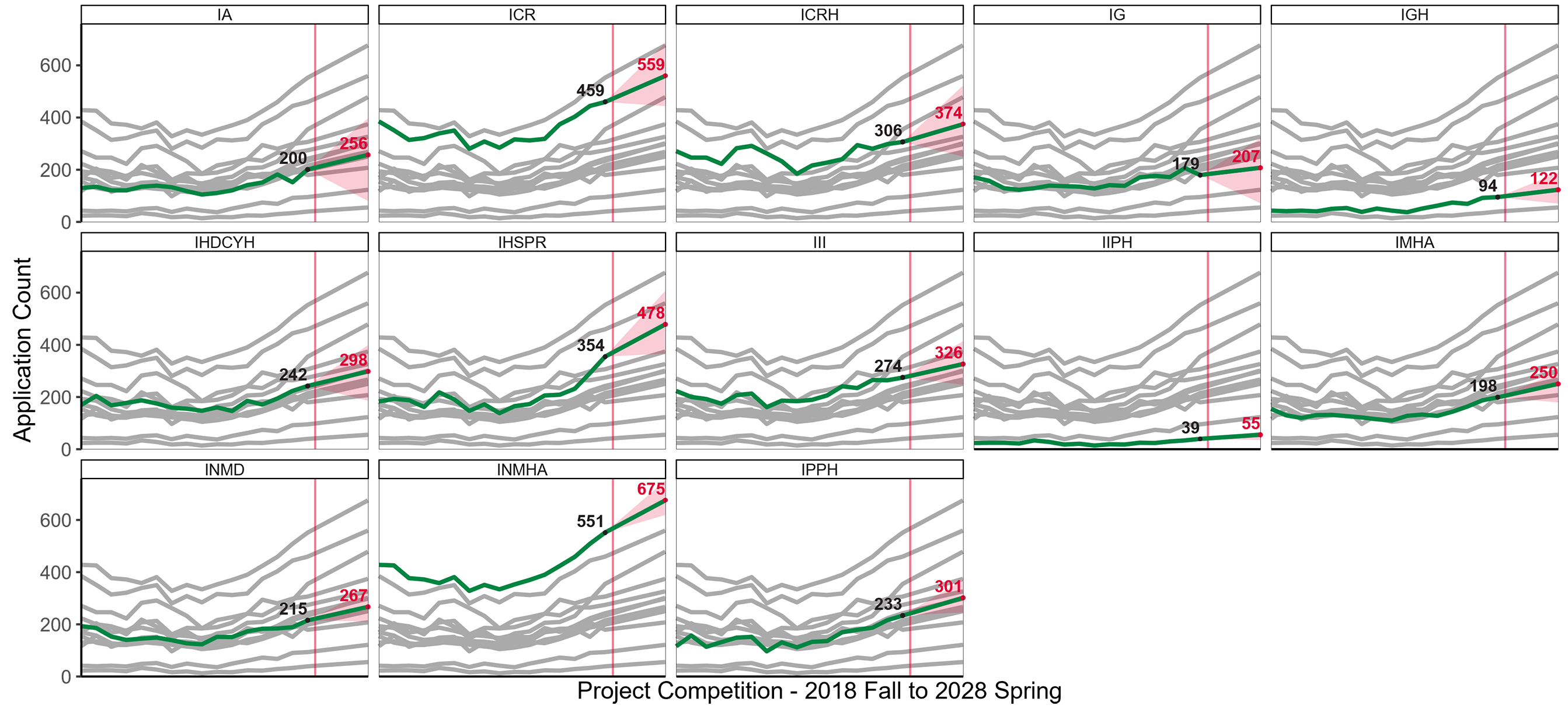
Figure 6 long description
| Project Competition | Competition Type | Primary Institute | Applications | Applications Lower Bound | Applications Upper Bound |
|---|---|---|---|---|---|
| 2018 Fall | Historic | IA | 129 | ||
| 2018 Fall | Historic | ICR | 385 | ||
| 2018 Fall | Historic | ICRH | 271 | ||
| 2018 Fall | Historic | IG | 170 | ||
| 2018 Fall | Historic | IGH | 42 | ||
| 2018 Fall | Historic | IHDCYH | 169 | ||
| 2018 Fall | Historic | IHSPR | 182 | ||
| 2018 Fall | Historic | III | 223 | ||
| 2018 Fall | Historic | IIPH | 23 | ||
| 2018 Fall | Historic | IMHA | 154 | ||
| 2018 Fall | Historic | INMD | 193 | ||
| 2018 Fall | Historic | INMHA | 427 | ||
| 2018 Fall | Historic | IPPH | 116 | ||
| 2019 Spring | Historic | IA | 134 | ||
| 2019 Spring | Historic | ICR | 351 | ||
| 2019 Spring | Historic | ICRH | 246 | ||
| 2019 Spring | Historic | IG | 157 | ||
| 2019 Spring | Historic | IGH | 40 | ||
| 2019 Spring | Historic | IHDCYH | 204 | ||
| 2019 Spring | Historic | IHSPR | 192 | ||
| 2019 Spring | Historic | III | 200 | ||
| 2019 Spring | Historic | IIPH | 24 | ||
| 2019 Spring | Historic | IMHA | 129 | ||
| 2019 Spring | Historic | INMD | 186 | ||
| 2019 Spring | Historic | INMHA | 425 | ||
| 2019 Spring | Historic | IPPH | 157 | ||
| 2019 Fall | Historic | IA | 120 | ||
| 2019 Fall | Historic | ICR | 314 | ||
| 2019 Fall | Historic | ICRH | 246 | ||
| 2019 Fall | Historic | IG | 128 | ||
| 2019 Fall | Historic | IGH | 42 | ||
| 2019 Fall | Historic | IHDCYH | 168 | ||
| 2019 Fall | Historic | IHSPR | 187 | ||
| 2019 Fall | Historic | III | 192 | ||
| 2019 Fall | Historic | IIPH | 24 | ||
| 2019 Fall | Historic | IMHA | 119 | ||
| 2019 Fall | Historic | INMD | 153 | ||
| 2019 Fall | Historic | INMHA | 376 | ||
| 2019 Fall | Historic | IPPH | 114 | ||
| 2020 Spring | Historic | IA | 120 | ||
| 2020 Spring | Historic | ICR | 321 | ||
| 2020 Spring | Historic | ICRH | 222 | ||
| 2020 Spring | Historic | IG | 122 | ||
| 2020 Spring | Historic | IGH | 39 | ||
| 2020 Spring | Historic | IHDCYH | 177 | ||
| 2020 Spring | Historic | IHSPR | 161 | ||
| 2020 Spring | Historic | III | 174 | ||
| 2020 Spring | Historic | IIPH | 21 | ||
| 2020 Spring | Historic | IMHA | 130 | ||
| 2020 Spring | Historic | INMD | 140 | ||
| 2020 Spring | Historic | INMHA | 371 | ||
| 2020 Spring | Historic | IPPH | 132 | ||
| 2020 Fall | Historic | IA | 134 | ||
| 2020 Fall | Historic | ICR | 339 | ||
| 2020 Fall | Historic | ICRH | 282 | ||
| 2020 Fall | Historic | IG | 128 | ||
| 2020 Fall | Historic | IGH | 49 | ||
| 2020 Fall | Historic | IHDCYH | 187 | ||
| 2020 Fall | Historic | IHSPR | 217 | ||
| 2020 Fall | Historic | III | 207 | ||
| 2020 Fall | Historic | IIPH | 33 | ||
| 2020 Fall | Historic | IMHA | 131 | ||
| 2020 Fall | Historic | INMD | 145 | ||
| 2020 Fall | Historic | INMHA | 357 | ||
| 2020 Fall | Historic | IPPH | 149 | ||
| 2021 Spring | Historic | IA | 138 | ||
| 2021 Spring | Historic | ICR | 350 | ||
| 2021 Spring | Historic | ICRH | 291 | ||
| 2021 Spring | Historic | IG | 138 | ||
| 2021 Spring | Historic | IGH | 52 | ||
| 2021 Spring | Historic | IHDCYH | 175 | ||
| 2021 Spring | Historic | IHSPR | 190 | ||
| 2021 Spring | Historic | III | 213 | ||
| 2021 Spring | Historic | IIPH | 27 | ||
| 2021 Spring | Historic | IMHA | 126 | ||
| 2021 Spring | Historic | INMD | 149 | ||
| 2021 Spring | Historic | INMHA | 380 | ||
| 2021 Spring | Historic | IPPH | 152 | ||
| 2021 Fall | Historic | IA | 132 | ||
| 2021 Fall | Historic | ICR | 280 | ||
| 2021 Fall | Historic | ICRH | 262 | ||
| 2021 Fall | Historic | IG | 136 | ||
| 2021 Fall | Historic | IGH | 37 | ||
| 2021 Fall | Historic | IHDCYH | 159 | ||
| 2021 Fall | Historic | IHSPR | 146 | ||
| 2021 Fall | Historic | III | 161 | ||
| 2021 Fall | Historic | IIPH | 17 | ||
| 2021 Fall | Historic | IMHA | 121 | ||
| 2021 Fall | Historic | INMD | 139 | ||
| 2021 Fall | Historic | INMHA | 327 | ||
| 2021 Fall | Historic | IPPH | 97 | ||
| 2022 Spring | Historic | IA | 117 | ||
| 2022 Spring | Historic | ICR | 308 | ||
| 2022 Spring | Historic | ICRH | 232 | ||
| 2022 Spring | Historic | IG | 134 | ||
| 2022 Spring | Historic | IGH | 50 | ||
| 2022 Spring | Historic | IHDCYH | 155 | ||
| 2022 Spring | Historic | IHSPR | 171 | ||
| 2022 Spring | Historic | III | 186 | ||
| 2022 Spring | Historic | IIPH | 20 | ||
| 2022 Spring | Historic | IMHA | 114 | ||
| 2022 Spring | Historic | INMD | 127 | ||
| 2022 Spring | Historic | INMHA | 350 | ||
| 2022 Spring | Historic | IPPH | 131 | ||
| 2022 Fall | Historic | IA | 104 | ||
| 2022 Fall | Historic | ICR | 284 | ||
| 2022 Fall | Historic | ICRH | 184 | ||
| 2022 Fall | Historic | IG | 127 | ||
| 2022 Fall | Historic | IGH | 42 | ||
| 2022 Fall | Historic | IHDCYH | 147 | ||
| 2022 Fall | Historic | IHSPR | 137 | ||
| 2022 Fall | Historic | III | 184 | ||
| 2022 Fall | Historic | IIPH | 13 | ||
| 2022 Fall | Historic | IMHA | 109 | ||
| 2022 Fall | Historic | INMD | 123 | ||
| 2022 Fall | Historic | INMHA | 333 | ||
| 2022 Fall | Historic | IPPH | 112 | ||
| 2023 Spring | Historic | IA | 110 | ||
| 2023 Spring | Historic | ICR | 316 | ||
| 2023 Spring | Historic | ICRH | 216 | ||
| 2023 Spring | Historic | IG | 140 | ||
| 2023 Spring | Historic | IGH | 36 | ||
| 2023 Spring | Historic | IHDCYH | 160 | ||
| 2023 Spring | Historic | IHSPR | 164 | ||
| 2023 Spring | Historic | III | 189 | ||
| 2023 Spring | Historic | IIPH | 18 | ||
| 2023 Spring | Historic | IMHA | 127 | ||
| 2023 Spring | Historic | INMD | 152 | ||
| 2023 Spring | Historic | INMHA | 352 | ||
| 2023 Spring | Historic | IPPH | 133 | ||
| 2023 Fall | Historic | IA | 120 | ||
| 2023 Fall | Historic | ICR | 312 | ||
| 2023 Fall | Historic | ICRH | 227 | ||
| 2023 Fall | Historic | IG | 137 | ||
| 2023 Fall | Historic | IGH | 50 | ||
| 2023 Fall | Historic | IHDCYH | 146 | ||
| 2023 Fall | Historic | IHSPR | 172 | ||
| 2023 Fall | Historic | III | 206 | ||
| 2023 Fall | Historic | IIPH | 17 | ||
| 2023 Fall | Historic | IMHA | 132 | ||
| 2023 Fall | Historic | INMD | 151 | ||
| 2023 Fall | Historic | INMHA | 369 | ||
| 2023 Fall | Historic | IPPH | 136 | ||
| 2024 Spring | Historic | IA | 140 | ||
| 2024 Spring | Historic | ICR | 318 | ||
| 2024 Spring | Historic | ICRH | 240 | ||
| 2024 Spring | Historic | IG | 170 | ||
| 2024 Spring | Historic | IGH | 61 | ||
| 2024 Spring | Historic | IHDCYH | 185 | ||
| 2024 Spring | Historic | IHSPR | 205 | ||
| 2024 Spring | Historic | III | 241 | ||
| 2024 Spring | Historic | IIPH | 24 | ||
| 2024 Spring | Historic | IMHA | 127 | ||
| 2024 Spring | Historic | INMD | 173 | ||
| 2024 Spring | Historic | INMHA | 389 | ||
| 2024 Spring | Historic | IPPH | 170 | ||
| 2024 Fall | Historic | IA | 150 | ||
| 2024 Fall | Historic | ICR | 374 | ||
| 2024 Fall | Historic | ICRH | 294 | ||
| 2024 Fall | Historic | IG | 176 | ||
| 2024 Fall | Historic | IGH | 73 | ||
| 2024 Fall | Historic | IHDCYH | 171 | ||
| 2024 Fall | Historic | IHSPR | 208 | ||
| 2024 Fall | Historic | III | 234 | ||
| 2024 Fall | Historic | IIPH | 23 | ||
| 2024 Fall | Historic | IMHA | 143 | ||
| 2024 Fall | Historic | INMD | 183 | ||
| 2024 Fall | Historic | INMHA | 423 | ||
| 2024 Fall | Historic | IPPH | 179 | ||
| 2025 Spring | Historic | IA | 181 | ||
| 2025 Spring | Historic | ICR | 403 | ||
| 2025 Spring | Historic | ICRH | 280 | ||
| 2025 Spring | Historic | IG | 171 | ||
| 2025 Spring | Historic | IGH | 68 | ||
| 2025 Spring | Historic | IHDCYH | 194 | ||
| 2025 Spring | Historic | IHSPR | 231 | ||
| 2025 Spring | Historic | III | 265 | ||
| 2025 Spring | Historic | IIPH | 29 | ||
| 2025 Spring | Historic | IMHA | 163 | ||
| 2025 Spring | Historic | INMD | 184 | ||
| 2025 Spring | Historic | INMHA | 458 | ||
| 2025 Spring | Historic | IPPH | 187 | ||
| 2025 Fall | Historic | IA | 151 | ||
| 2025 Fall | Historic | ICR | 444 | ||
| 2025 Fall | Historic | ICRH | 298 | ||
| 2025 Fall | Historic | IG | 206 | ||
| 2025 Fall | Historic | IGH | 91 | ||
| 2025 Fall | Historic | IHDCYH | 223 | ||
| 2025 Fall | Historic | IHSPR | 291 | ||
| 2025 Fall | Historic | III | 264 | ||
| 2025 Fall | Historic | IIPH | 33 | ||
| 2025 Fall | Historic | IMHA | 187 | ||
| 2025 Fall | Historic | INMD | 189 | ||
| 2025 Fall | Historic | INMHA | 508 | ||
| 2025 Fall | Historic | IPPH | 216 | ||
| 2026 Spring | Historic | IA | 200 | ||
| 2026 Spring | Historic | ICR | 459 | ||
| 2026 Spring | Historic | ICRH | 306 | ||
| 2026 Spring | Historic | IG | 179 | ||
| 2026 Spring | Historic | IGH | 94 | ||
| 2026 Spring | Historic | IHDCYH | 242 | ||
| 2026 Spring | Historic | IHSPR | 354 | ||
| 2026 Spring | Historic | III | 274 | ||
| 2026 Spring | Historic | IIPH | 39 | ||
| 2026 Spring | Historic | IMHA | 198 | ||
| 2026 Spring | Historic | INMD | 215 | ||
| 2026 Spring | Historic | INMHA | 551 | ||
| 2026 Spring | Historic | IPPH | 233 | ||
| 2026 Fall | Forecast | IA | 214 | 170 | 249 |
| 2026 Fall | Forecast | ICR | 484 | 455 | 515 |
| 2026 Fall | Forecast | ICRH | 323 | 292 | 360 |
| 2026 Fall | Forecast | IG | 186 | 152 | 214 |
| 2026 Fall | Forecast | IGH | 101 | 88 | 117 |
| 2026 Fall | Forecast | IHDCYH | 256 | 228 | 281 |
| 2026 Fall | Forecast | IHSPR | 385 | 357 | 417 |
| 2026 Fall | Forecast | III | 287 | 267 | 309 |
| 2026 Fall | Forecast | IIPH | 43 | 38 | 46 |
| 2026 Fall | Forecast | IMHA | 211 | 193 | 222 |
| 2026 Fall | Forecast | INMD | 228 | 214 | 244 |
| 2026 Fall | Forecast | INMHA | 582 | 568 | 601 |
| 2026 Fall | Forecast | IPPH | 250 | 236 | 267 |
| 2027 Spring | Forecast | IA | 228 | 140 | 298 |
| 2027 Spring | Forecast | ICR | 509 | 451 | 571 |
| 2027 Spring | Forecast | ICRH | 340 | 278 | 414 |
| 2027 Spring | Forecast | IG | 193 | 125 | 249 |
| 2027 Spring | Forecast | IGH | 108 | 82 | 140 |
| 2027 Spring | Forecast | IHDCYH | 270 | 214 | 320 |
| 2027 Spring | Forecast | IHSPR | 416 | 360 | 480 |
| 2027 Spring | Forecast | III | 300 | 260 | 344 |
| 2027 Spring | Forecast | IIPH | 47 | 37 | 53 |
| 2027 Spring | Forecast | IMHA | 224 | 188 | 246 |
| 2027 Spring | Forecast | INMD | 241 | 213 | 273 |
| 2027 Spring | Forecast | INMHA | 613 | 585 | 651 |
| 2027 Spring | Forecast | IPPH | 267 | 239 | 301 |
| 2027 Fall | Forecast | IA | 242 | 110 | 347 |
| 2027 Fall | Forecast | ICR | 534 | 447 | 627 |
| 2027 Fall | Forecast | ICRH | 357 | 264 | 468 |
| 2027 Fall | Forecast | IG | 200 | 98 | 284 |
| 2027 Fall | Forecast | IGH | 115 | 76 | 163 |
| 2027 Fall | Forecast | IHDCYH | 284 | 200 | 359 |
| 2027 Fall | Forecast | IHSPR | 447 | 363 | 543 |
| 2027 Fall | Forecast | III | 313 | 253 | 379 |
| 2027 Fall | Forecast | IIPH | 51 | 36 | 60 |
| 2027 Fall | Forecast | IMHA | 237 | 183 | 270 |
| 2027 Fall | Forecast | INMD | 254 | 212 | 302 |
| 2027 Fall | Forecast | INMHA | 644 | 602 | 701 |
| 2027 Fall | Forecast | IPPH | 284 | 242 | 335 |
| 2028 Spring | Forecast | IA | 256 | 80 | 396 |
| 2028 Spring | Forecast | ICR | 559 | 443 | 683 |
| 2028 Spring | Forecast | ICRH | 374 | 250 | 522 |
| 2028 Spring | Forecast | IG | 207 | 71 | 319 |
| 2028 Spring | Forecast | IGH | 122 | 70 | 186 |
| 2028 Spring | Forecast | IHDCYH | 298 | 186 | 398 |
| 2028 Spring | Forecast | IHSPR | 478 | 366 | 606 |
| 2028 Spring | Forecast | III | 326 | 246 | 414 |
| 2028 Spring | Forecast | IIPH | 55 | 35 | 67 |
| 2028 Spring | Forecast | IMHA | 250 | 178 | 294 |
| 2028 Spring | Forecast | INMD | 267 | 211 | 331 |
| 2028 Spring | Forecast | INMHA | 675 | 619 | 751 |
| 2028 Spring | Forecast | IPPH | 301 | 245 | 369 |
Figure 7: The number and proportion of NPAs that submit multiple applications (left) and the success rate of second applications (right)
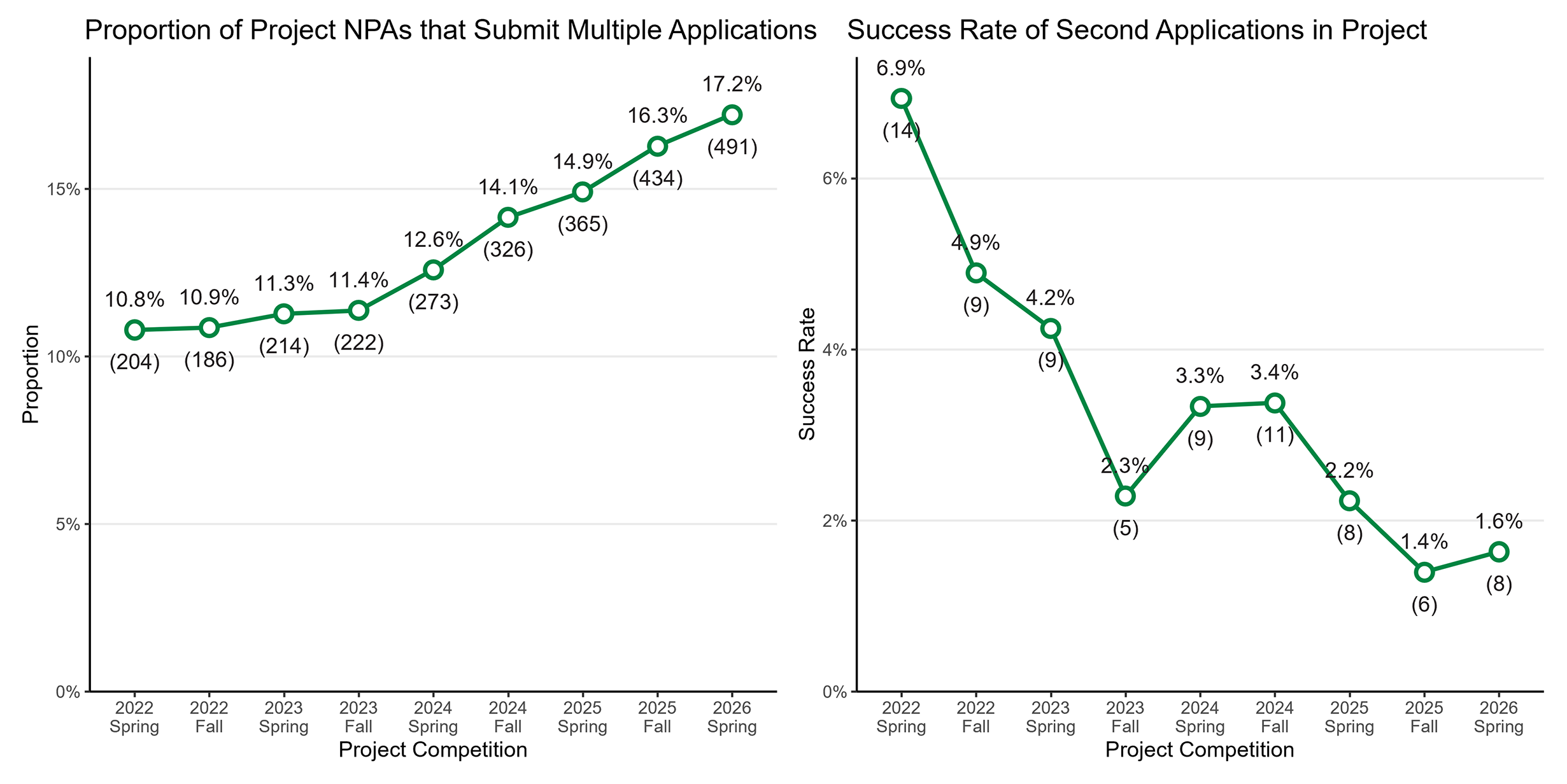
Figure 7 long description
| Project Competition | Number of NPA Submitting Two Applications | Proportion of NPA Submitting Two Applications | Number of Second Applications Funded | Success Rate of Second Applications |
|---|---|---|---|---|
| 2022 Spring | 204 | 10.8% | 14 | 6.9% |
| 2022 Fall | 186 | 10.9% | 9 | 4.9% |
| 2023 Spring | 214 | 11.3% | 9 | 4.2% |
| 2023 Fall | 222 | 11.4% | 5 | 2.3% |
| 2024 Spring | 273 | 12.6% | 9 | 3.3% |
| 2024 Fall | 326 | 14.1% | 11 | 3.4% |
| 2025 Spring | 365 | 14.9% | 8 | 2.2% |
| 2025 Fall | 434 | 16.3% | 6 | 1.4% |
| 2026 Spring | 491 | 17.2% | 8 | 1.6% |
Figure 8: The proportion of NPAs that submit multiple applications by pillar
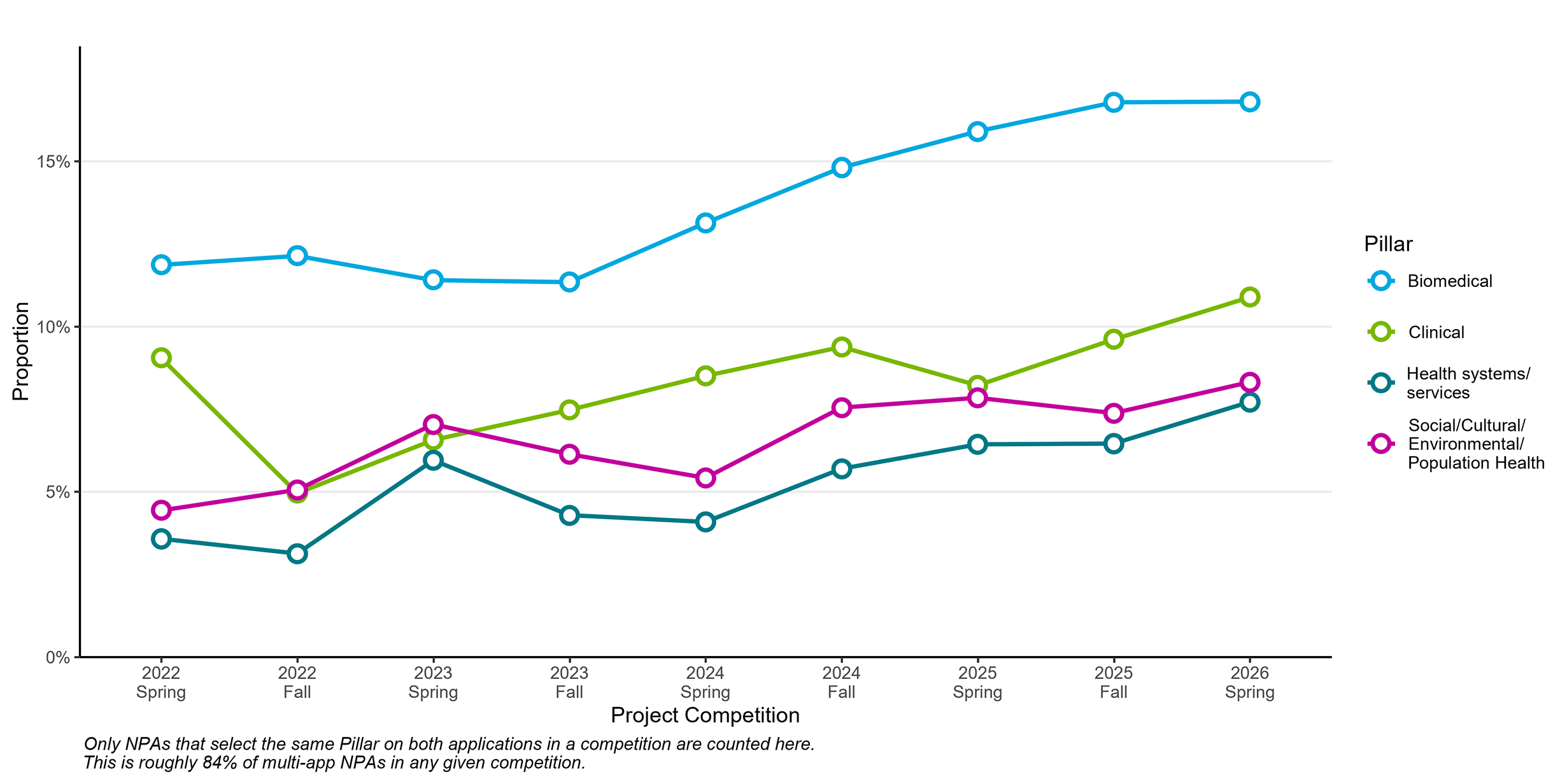
Figure 8 long description
| Project Competition | Pillar | Proportion of NPA Submitting Two Applications |
|---|---|---|
| 2022 Spring | Biomedical | 11.9% |
| 2022 Spring | Clinical | 9.0% |
| 2022 Spring | Health systems/services | 3.6% |
| 2022 Spring | Social/Cultural/Environmental/Population Health | 4.4% |
| 2022 Fall | Biomedical | 12.1% |
| 2022 Fall | Clinical | 5.0% |
| 2022 Fall | Health systems/services | 3.1% |
| 2022 Fall | Social/Cultural/Environmental/Population Health | 5.1% |
| 2023 Spring | Biomedical | 11.4% |
| 2023 Spring | Clinical | 6.6% |
| 2023 Spring | Health systems/services | 5.9% |
| 2023 Spring | Social/Cultural/Environmental/Population Health | 7.0% |
| 2023 Fall | Biomedical | 11.3% |
| 2023 Fall | Clinical | 7.5% |
| 2023 Fall | Health systems/services | 4.3% |
| 2023 Fall | Social/Cultural/Environmental/Population Health | 6.1% |
| 2024 Spring | Biomedical | 13.1% |
| 2024 Spring | Clinical | 8.5% |
| 2024 Spring | Health systems/services | 4.1% |
| 2024 Spring | Social/Cultural/Environmental/Population Health | 5.4% |
| 2024 Fall | Biomedical | 14.8% |
| 2024 Fall | Clinical | 9.4% |
| 2024 Fall | Health systems/services | 5.7% |
| 2024 Fall | Social/Cultural/Environmental/Population Health | 7.5% |
| 2025 Spring | Biomedical | 15.9% |
| 2025 Spring | Clinical | 8.2% |
| 2025 Spring | Health systems/services | 6.4% |
| 2025 Spring | Social/Cultural/Environmental/Population Health | 7.8% |
| 2025 Fall | Biomedical | 16.8% |
| 2025 Fall | Clinical | 9.6% |
| 2025 Fall | Health systems/services | 6.5% |
| 2025 Fall | Social/Cultural/Environmental/Population Health | 7.4% |
| 2026 Spring | Biomedical | 16.8% |
| 2026 Spring | Clinical | 10.9% |
| 2026 Spring | Health systems/services | 7.7% |
| 2026 Spring | Social/Cultural/Environmental/Population Health | 8.3% |
Figure 9: Proportion of NPAs that submit multiple applications that are second submissions from the same NPA by career stage
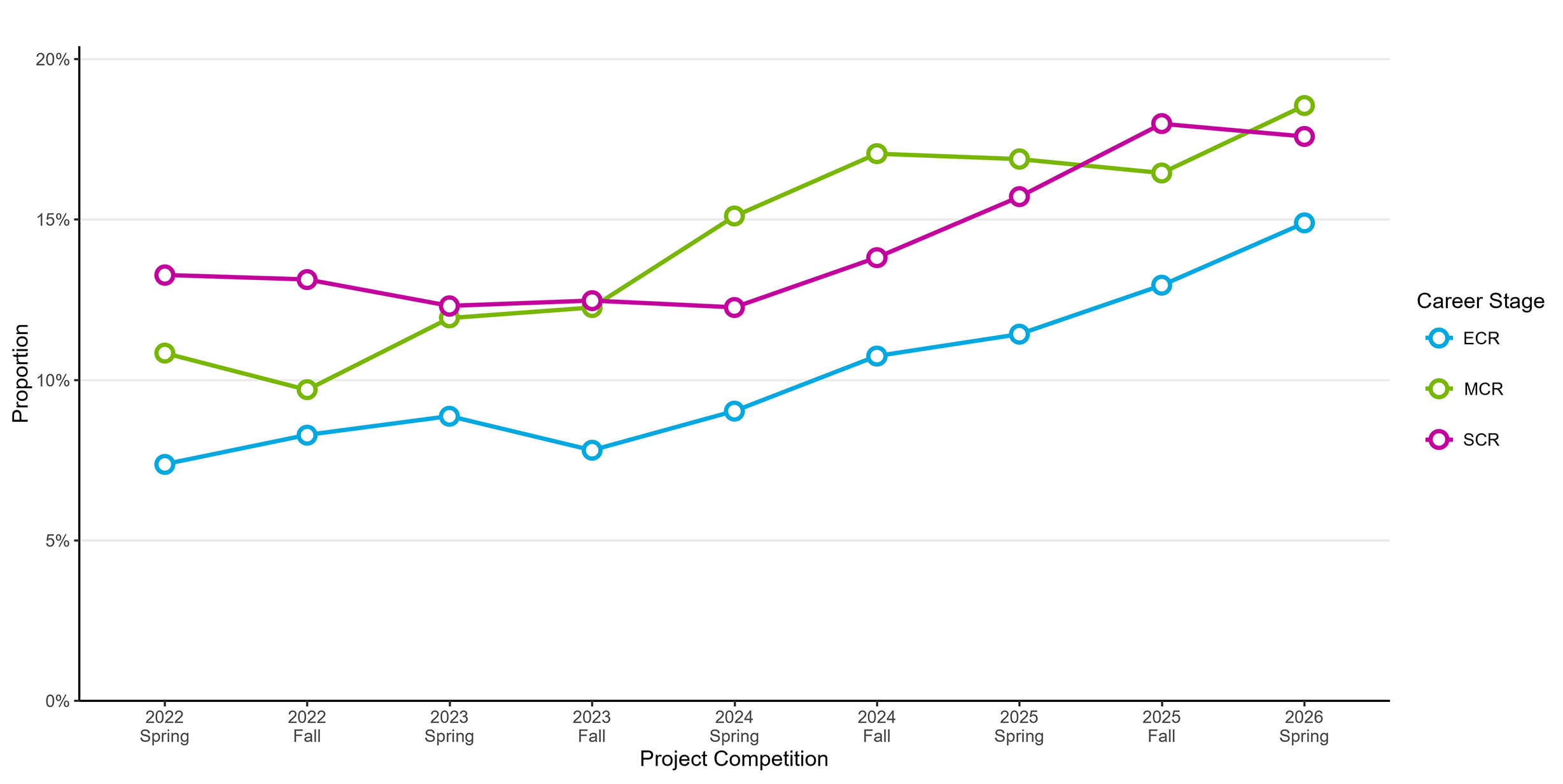
Figure 9 long description
| Project Competition | Career Stage | Proportion of NPA Submitting Two Applications |
|---|---|---|
| 2022 Spring | ECR | 7.4% |
| 2022 Spring | MCR | 10.8% |
| 2022 Spring | SCR | 13.3% |
| 2022 Fall | ECR | 8.3% |
| 2022 Fall | MCR | 9.7% |
| 2022 Fall | SCR | 13.1% |
| 2023 Spring | ECR | 8.9% |
| 2023 Spring | MCR | 11.9% |
| 2023 Spring | SCR | 12.3% |
| 2023 Fall | ECR | 7.8% |
| 2023 Fall | MCR | 12.3% |
| 2023 Fall | SCR | 12.5% |
| 2024 Spring | ECR | 9.0% |
| 2024 Spring | MCR | 15.1% |
| 2024 Spring | SCR | 12.3% |
| 2024 Fall | ECR | 10.7% |
| 2024 Fall | MCR | 17.0% |
| 2024 Fall | SCR | 13.8% |
| 2025 Spring | ECR | 11.4% |
| 2025 Spring | MCR | 16.9% |
| 2025 Spring | SCR | 15.7% |
| 2025 Fall | ECR | 12.9% |
| 2025 Fall | MCR | 16.4% |
| 2025 Fall | SCR | 18.0% |
| 2026 Spring | ECR | 14.9% |
| 2026 Spring | MCR | 18.5% |
| 2026 Spring | SCR | 17.6% |
Figure 10: Number of applications and percentage of resubmissions by fiscal year
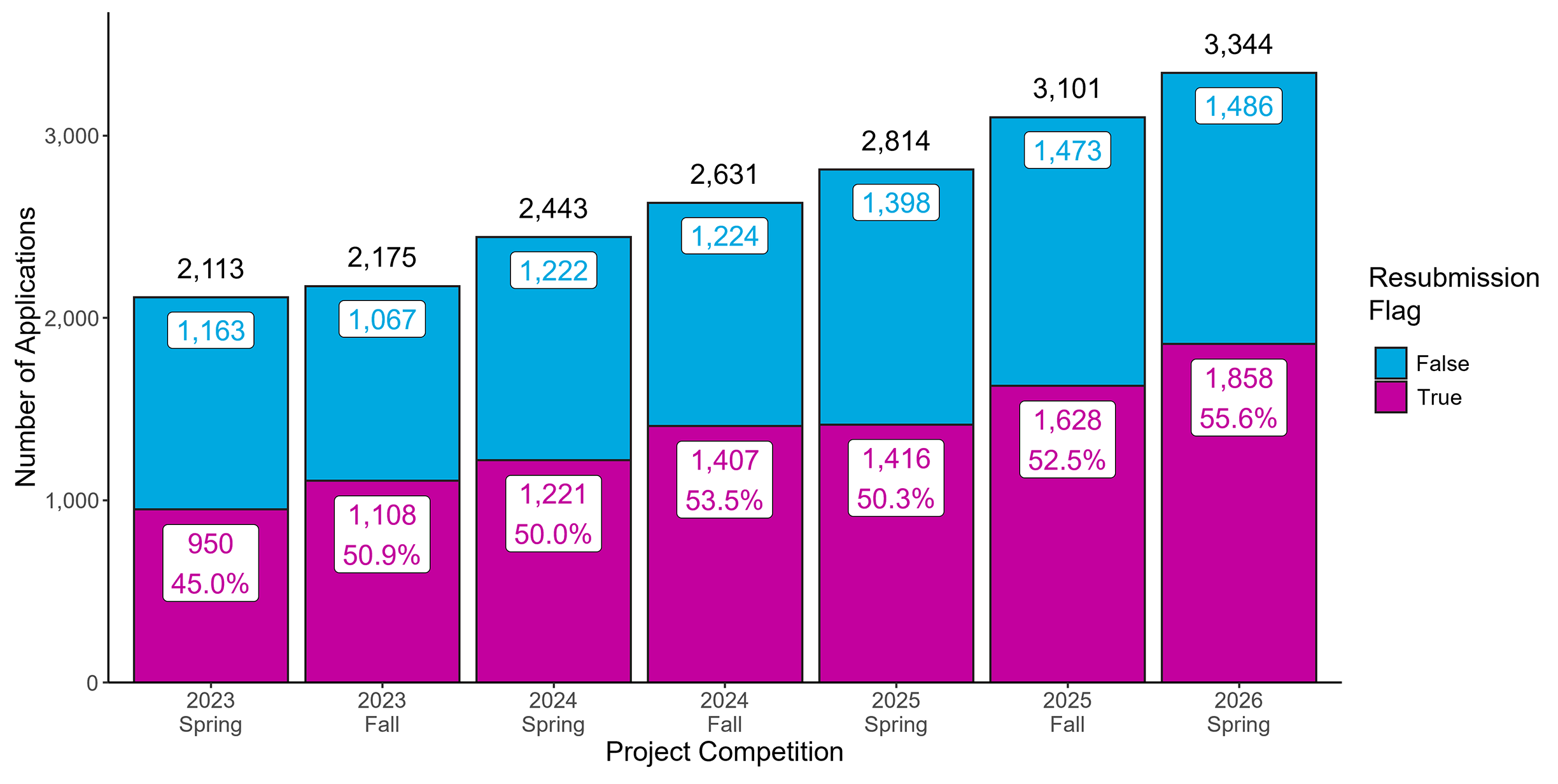
Figure 10 long description
| Project Competition | Applications | New Applications | Resubmissions | Proportion of Applications that are Resubmissions |
|---|---|---|---|---|
| 2023 Spring | 2113 | 1163 | 950 | 45.0% |
| 2023 Fall | 2175 | 1067 | 1108 | 50.9% |
| 2024 Spring | 2443 | 1222 | 1221 | 50.0% |
| 2024 Fall | 2631 | 1224 | 1407 | 53.5% |
| 2025 Spring | 2814 | 1398 | 1416 | 50.3% |
| 2025 Fall | 3101 | 1473 | 1628 | 52.5% |
| 2026 Spring | 3344 | 1486 | 1858 | 55.6% |
Figure 11: Application pressure from Foundation holders across Project Grant competitions
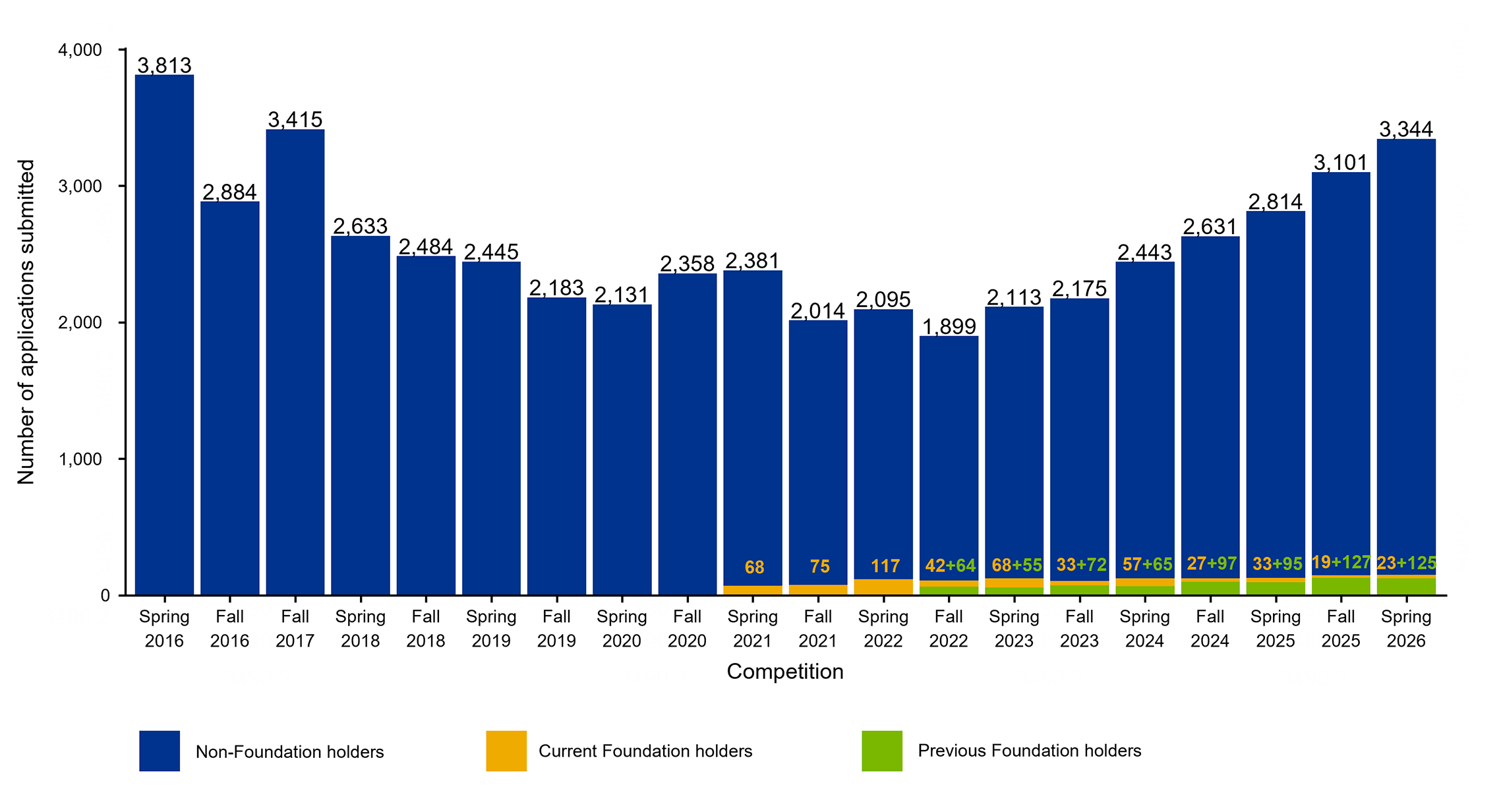
Figure 11 long description
| Competition | Number of applications submitted | Non Foundation holders | Current Foundation holders | Previous Foundation holders |
|---|---|---|---|---|
| Spring 2016 | 3813 | 3813 | 0 | 0 |
| Fall 2016 | 2884 | 2884 | 0 | 0 |
| Fall 2017 | 3415 | 3415 | 0 | 0 |
| Spring 2018 | 2633 | 2633 | 0 | 0 |
| Fall 2018 | 2484 | 2484 | 0 | 0 |
| Spring 2019 | 2445 | 2445 | 0 | 0 |
| Fall 2019 | 2183 | 2183 | 0 | 0 |
| Spring 2020 | 2131 | 2131 | 0 | 0 |
| Fall 2020 | 2358 | 2358 | 0 | 0 |
| Spring 2021 | 2381 | 2313 | 68 | 0 |
| Fall 2021 | 2014 | 1939 | 75 | 0 |
| Spring 2022 | 2095 | 1978 | 117 | 0 |
| Fall 2022 | 1899 | 1793 | 42 | 64 |
| Spring 2023 | 2113 | 1990 | 68 | 55 |
| Fall 2023 | 2175 | 2070 | 33 | 72 |
| Spring 2024 | 2443 | 2321 | 57 | 65 |
| Fall 2024 | 2631 | 2507 | 27 | 97 |
| Spring 2025 | 2814 | 2686 | 33 | 95 |
| Fall 2025 | 3101 | 2955 | 19 | 127 |
| Spring 2026 | 3344 | 3196 | 23 | 125 |
Figure 12: Active funded Project Grants by competition cycle and Foundation holder status
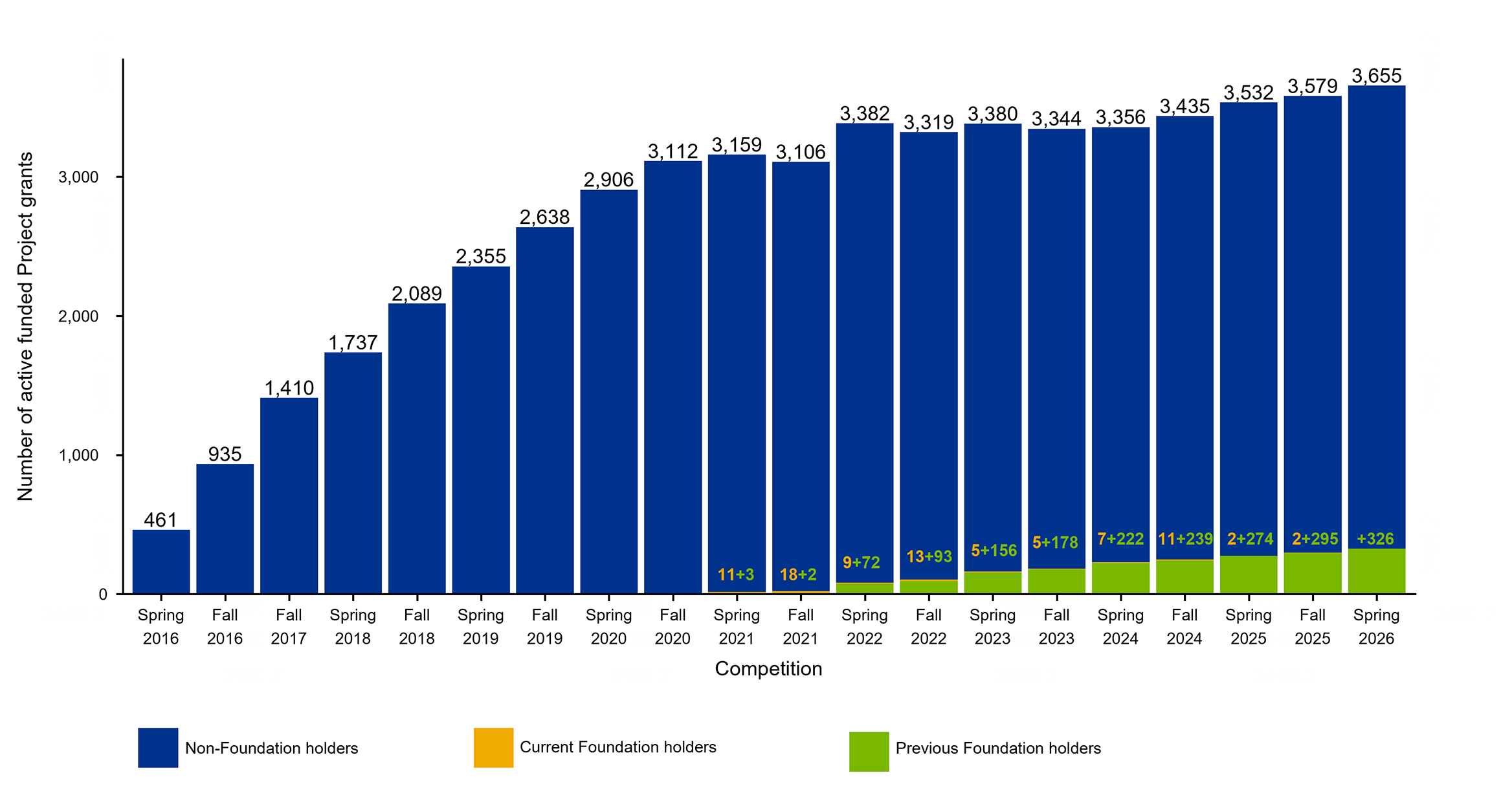
Figure 12 long description
| Competition | Number of active funded Project grants | Non Foundation holders | Current Foundation holders | Previous Foundation holders |
|---|---|---|---|---|
| Spring 2016 | 461 | 461 | 0 | 0 |
| Fall 2016 | 935 | 935 | 0 | 0 |
| Fall 2017 | 1410 | 1410 | 0 | 0 |
| Spring 2018 | 1737 | 1737 | 0 | 0 |
| Fall 2018 | 2089 | 2089 | 0 | 0 |
| Spring 2019 | 2355 | 2355 | 0 | 0 |
| Fall 2019 | 2638 | 2638 | 0 | 0 |
| Spring 2020 | 2906 | 2906 | 0 | 0 |
| Fall 2020 | 3112 | 3112 | 0 | 0 |
| Spring 2021 | 3159 | 3145 | 11 | 3 |
| Fall 2021 | 3106 | 3086 | 18 | 2 |
| Spring 2022 | 3382 | 3301 | 9 | 72 |
| Fall 2022 | 3319 | 3213 | 13 | 93 |
| Spring 2023 | 3380 | 3219 | 5 | 156 |
| Fall 2023 | 3344 | 3161 | 5 | 178 |
| Spring 2024 | 3356 | 3127 | 7 | 222 |
| Fall 2024 | 3435 | 3185 | 11 | 239 |
| Spring 2025 | 3532 | 3256 | 2 | 274 |
| Fall 2025 | 3579 | 3282 | 2 | 295 |
| Spring 2026 | 3655 | 3329 | 0 | 326 |
Figure 13: Application submission patterns among unique NPAs by Foundation holder status
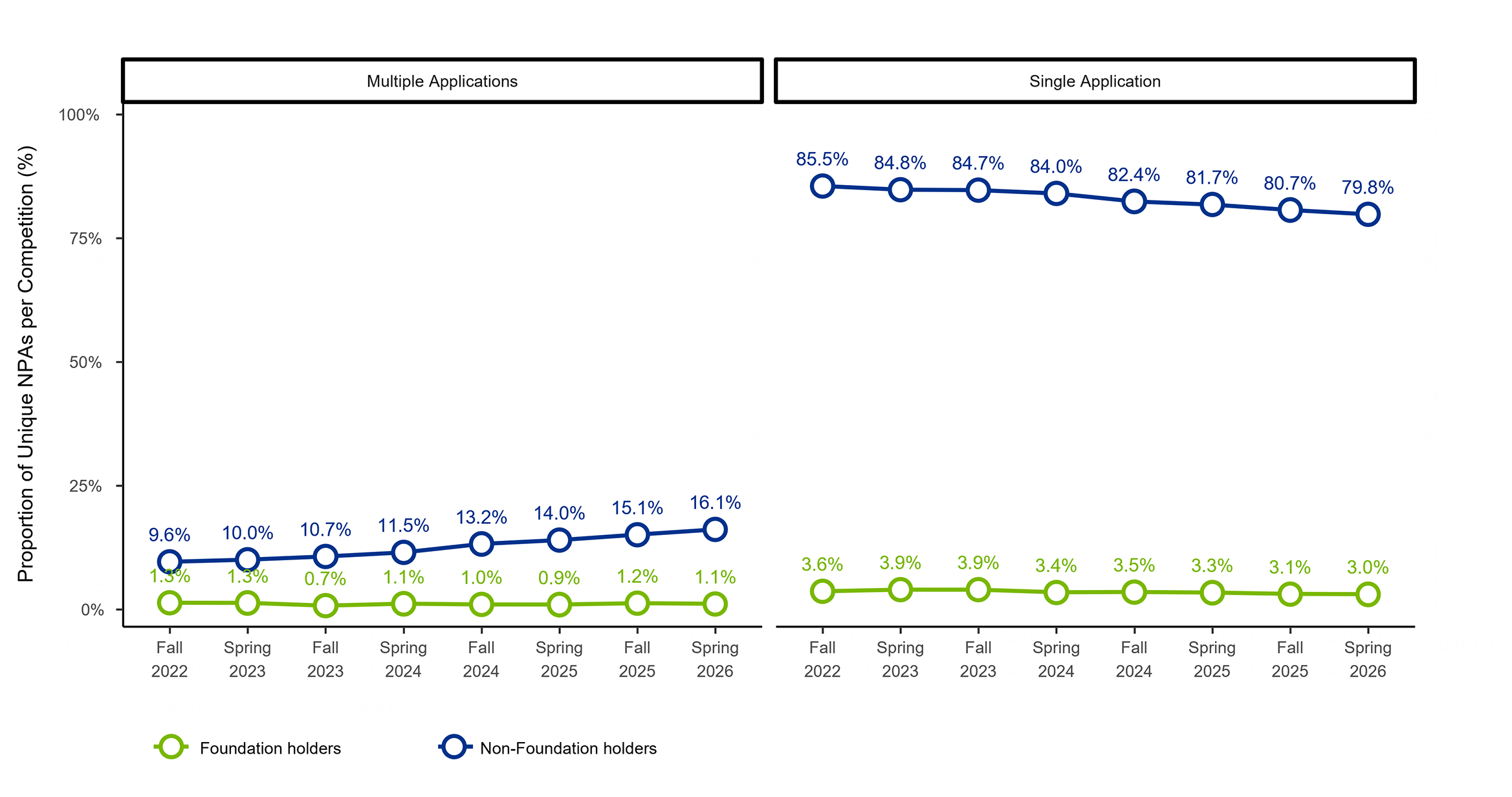
Figure 13 long description
| Competition | Foundation Holder Status | Multiple Applications | Single Application |
|---|---|---|---|
| Fall 2022 | Foundation holders | 1.28 % | 3.62 % |
| Fall 2022 | Non Foundation holders | 9.57 % | 85.52 % |
| Spring 2023 | Foundation holders | 1.26 % | 3.95 % |
| Spring 2023 | Non Foundation holders | 10.01 % | 84.78 % |
| Fall 2023 | Foundation holders | 0.72 % | 3.94 % |
| Fall 2023 | Non Foundation holders | 10.65 % | 84.69 % |
| Spring 2024 | Foundation holders | 1.11 % | 3.41 % |
| Spring 2024 | Non Foundation holders | 11.47 % | 84.01 % |
| Fall 2024 | Foundation holders | 0.95 % | 3.47 % |
| Fall 2024 | Non Foundation holders | 13.19 % | 82.39 % |
| Spring 2025 | Foundation holders | 0.94 % | 3.35 % |
| Spring 2025 | Non Foundation holders | 13.96 % | 81.75 % |
| Fall 2025 | Foundation holders | 1.20 % | 3.07 % |
| Fall 2025 | Non Foundation holders | 15.07 % | 80.65 % |
| Spring 2026 | Foundation holders | 1.09 % | 3.01 % |
| Spring 2026 | Non Foundation holders | 16.12 % | 79.78 % |
Figure 14: Mean requested and funded Project Grant size by fiscal year
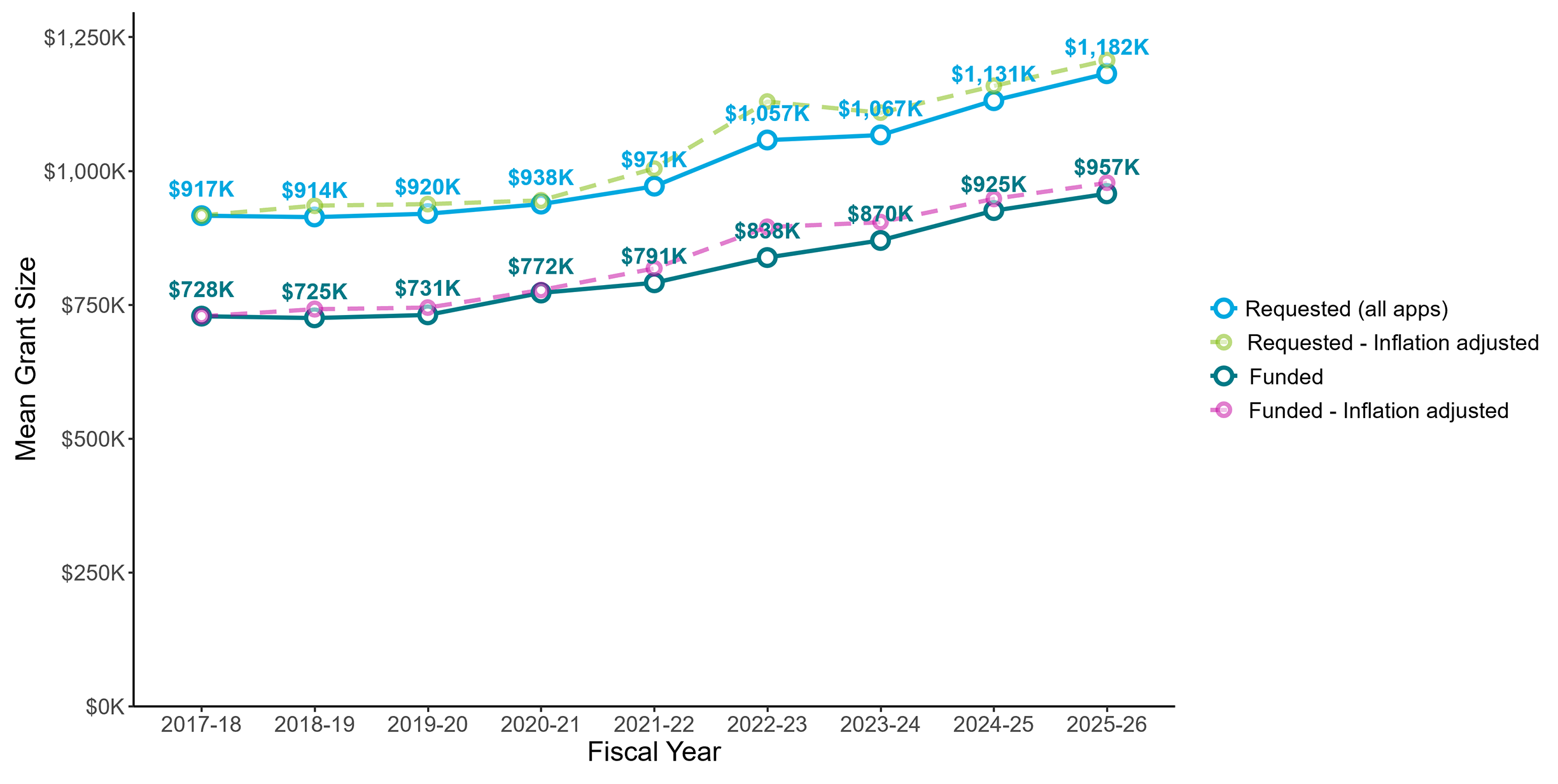
Figure 14 long description
| Fiscal Year | Requested (all apps) | Requested - Inflation adjusted | Funded | Funded - Inflation adjusted |
|---|---|---|---|---|
| 2017-18 | $916,503 | $916,503 | $728,433 | $728,433 |
| 2018-19 | $913,777 | $934,794 | $725,080 | $741,757 |
| 2019-20 | $920,195 | $937,679 | $730,853 | $744,739 |
| 2020-21 | $938,076 | $944,642 | $772,049 | $777,454 |
| 2021-22 | $971,204 | $1,004,225 | $790,869 | $817,759 |
| 2022-23 | $1,057,425 | $1,129,330 | $838,047 | $895,034 |
| 2023-24 | $1,066,834 | $1,108,441 | $870,079 | $904,012 |
| 2024-25 | $1,131,289 | $1,158,440 | $925,481 | $947,693 |
| 2025-26 | $1,181,679 | $1,206,495 | $957,321 | $977,425 |
Figure 15: Number (left panel) and proportion (right panel) of reviewer invitation responses. Data are fit using LOESS
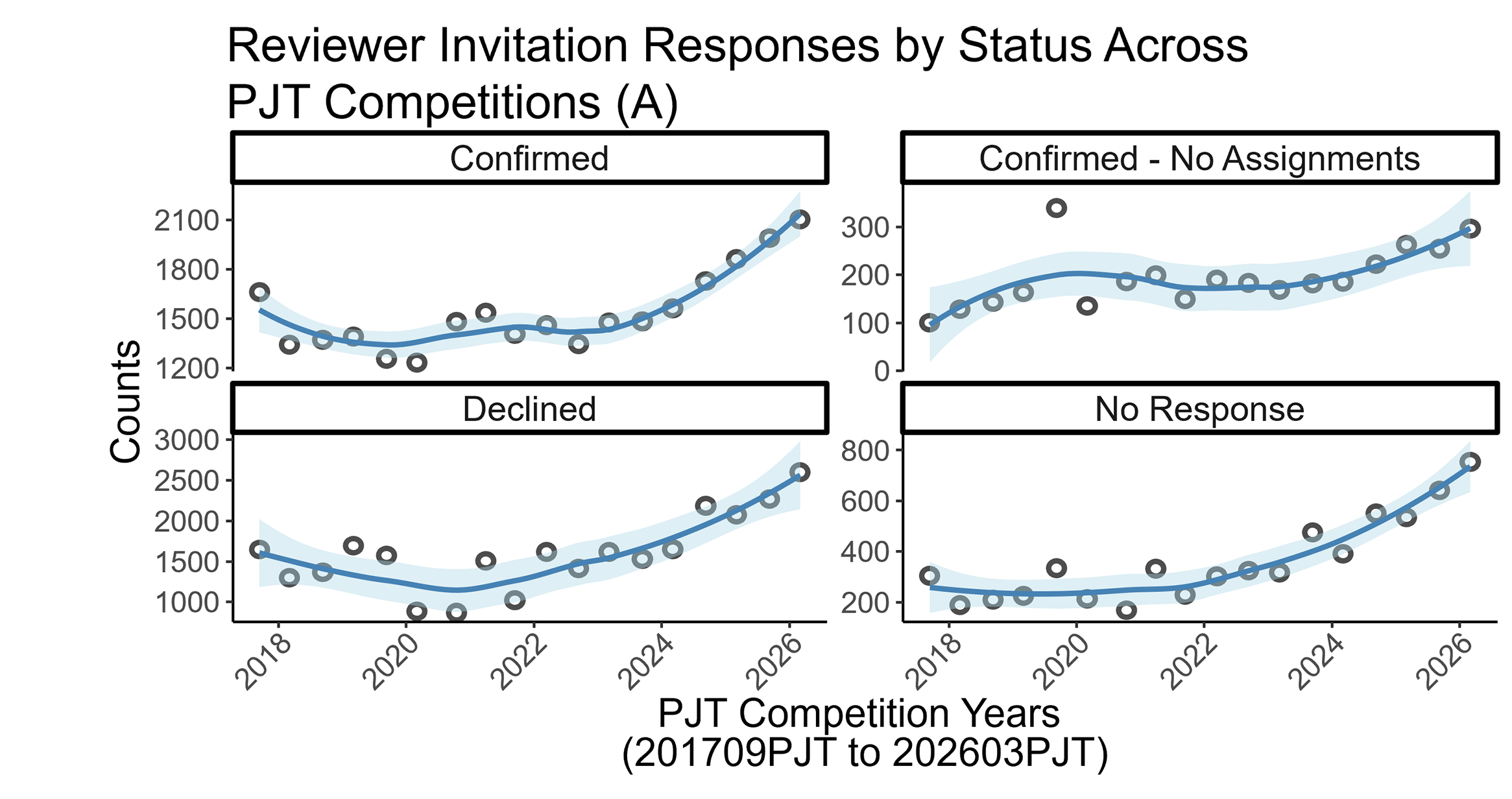
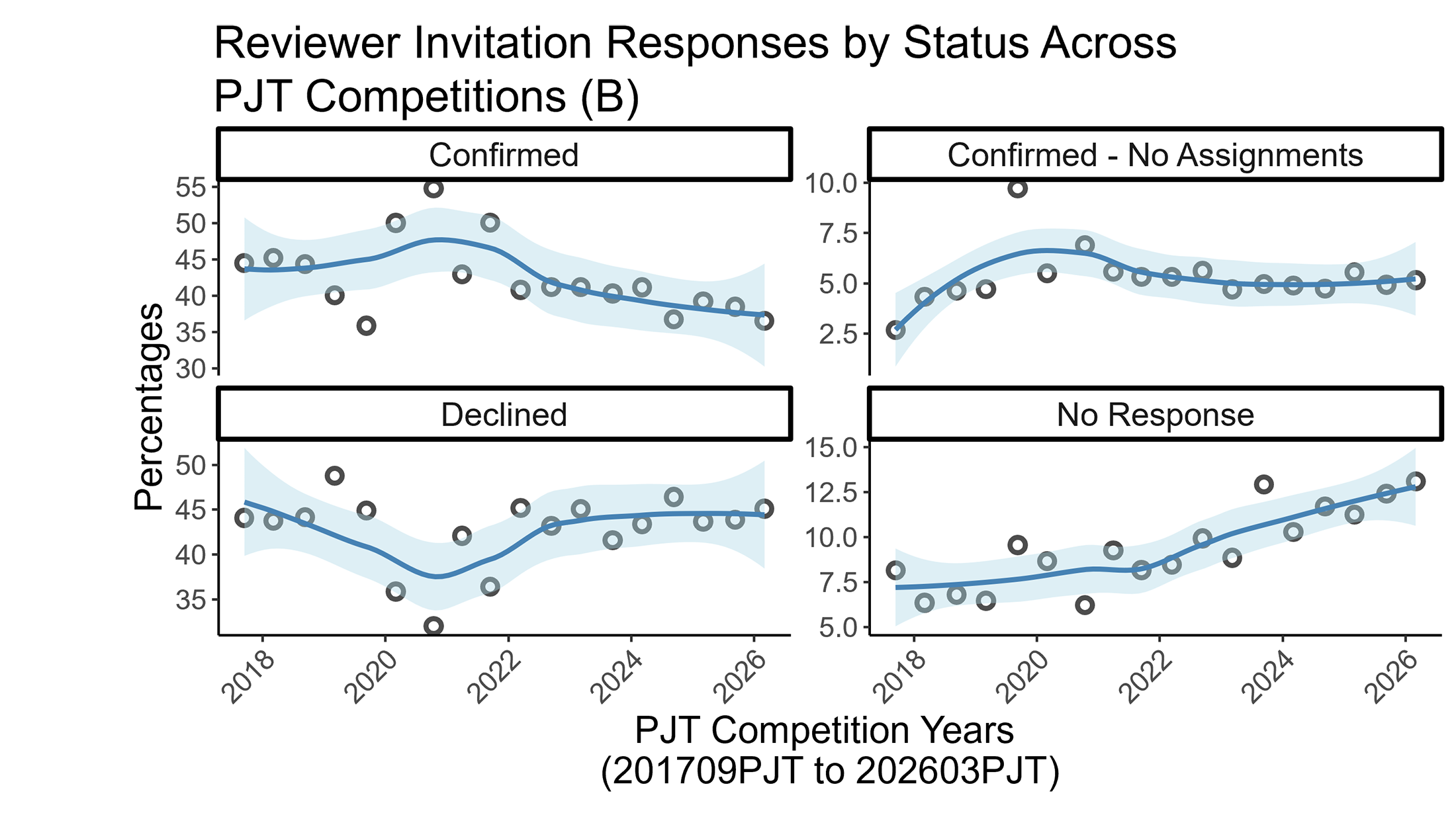
Figure 15 long description
| Confirmed | Confirmed-No Assignments | Declined | No Response | |||||||
|---|---|---|---|---|---|---|---|---|---|---|
| Competition Code | Competition Date | Total Competition | Count | Percentage | Count | Percentage | Count | Percentage | Count | Percentage |
| 201709PJT | 2017-09-15 | 3732 | 1660 | 44.5% | 100 | 2.7% | 1644 | 44.1% | 304 | 8.1% |
| 201803PJT | 2018-03-06 | 2964 | 1340 | 45.2% | 128 | 4.3% | 1296 | 43.7% | 188 | 6.3% |
| 201809PJT | 2018-09-12 | 3088 | 1370 | 44.4% | 143 | 4.6% | 1363 | 44.1% | 210 | 6.8% |
| 201903PJT | 2019-03-06 | 3469 | 1390 | 40.1% | 163 | 4.7% | 1691 | 48.7% | 224 | 6.5% |
| 201909PJT | 2019-09-11 | 3497 | 1254 | 35.9% | 339 | 9.7% | 1570 | 44.9% | 334 | 9.6% |
| 202003PJT | 2020-03-04 | 2462 | 1232 | 50.0% | 135 | 5.5% | 882 | 35.8% | 213 | 8.7% |
| 202010PJT | 2020-10-15 | 2702 | 1480 | 54.8% | 186 | 6.9% | 864 | 32.0% | 168 | 6.2% |
| 202104PJT | 2021-04-01 | 3574 | 1535 | 42.9% | 199 | 5.6% | 1503 | 42.1% | 331 | 9.3% |
| 202109PJT | 2021-09-15 | 2805 | 1404 | 50.1% | 149 | 5.3% | 1020 | 36.4% | 229 | 8.2% |
| 202203PJT | 2022-03-16 | 3573 | 1458 | 40.8% | 190 | 5.3% | 1613 | 45.1% | 302 | 8.5% |
| 202209PJT | 2022-09-14 | 3265 | 1344 | 41.2% | 183 | 5.6% | 1409 | 43.2% | 324 | 9.9% |
| 202303PJT | 2023-03-08 | 3584 | 1476 | 41.2% | 168 | 4.7% | 1614 | 45.0% | 317 | 8.8% |
| 202309PJT | 2023-09-14 | 3675 | 1481 | 40.3% | 182 | 5.0% | 1528 | 41.6% | 475 | 12.9% |
| 202403PJT | 2024-03-06 | 3794 | 1561 | 41.1% | 185 | 4.9% | 1645 | 43.4% | 390 | 10.3% |
| 202409PJT | 2024-09-11 | 4697 | 1727 | 36.8% | 222 | 4.7% | 2179 | 46.4% | 550 | 11.7% |
| 202503PJT | 2025-03-05 | 4746 | 1860 | 39.2% | 263 | 5.5% | 2072 | 43.7% | 534 | 11.3% |
| 202509PJT | 2025-09-10 | 5166 | 1987 | 38.5% | 254 | 4.9% | 2265 | 43.8% | 641 | 12.4% |
| 202603PJT | 2026-03-04 | 5752 | 2101 | 36.5% | 296 | 5.1% | 2593 | 45.1% | 753 | 13.1% |
Figure 16: Number of reviewers with no applications funded
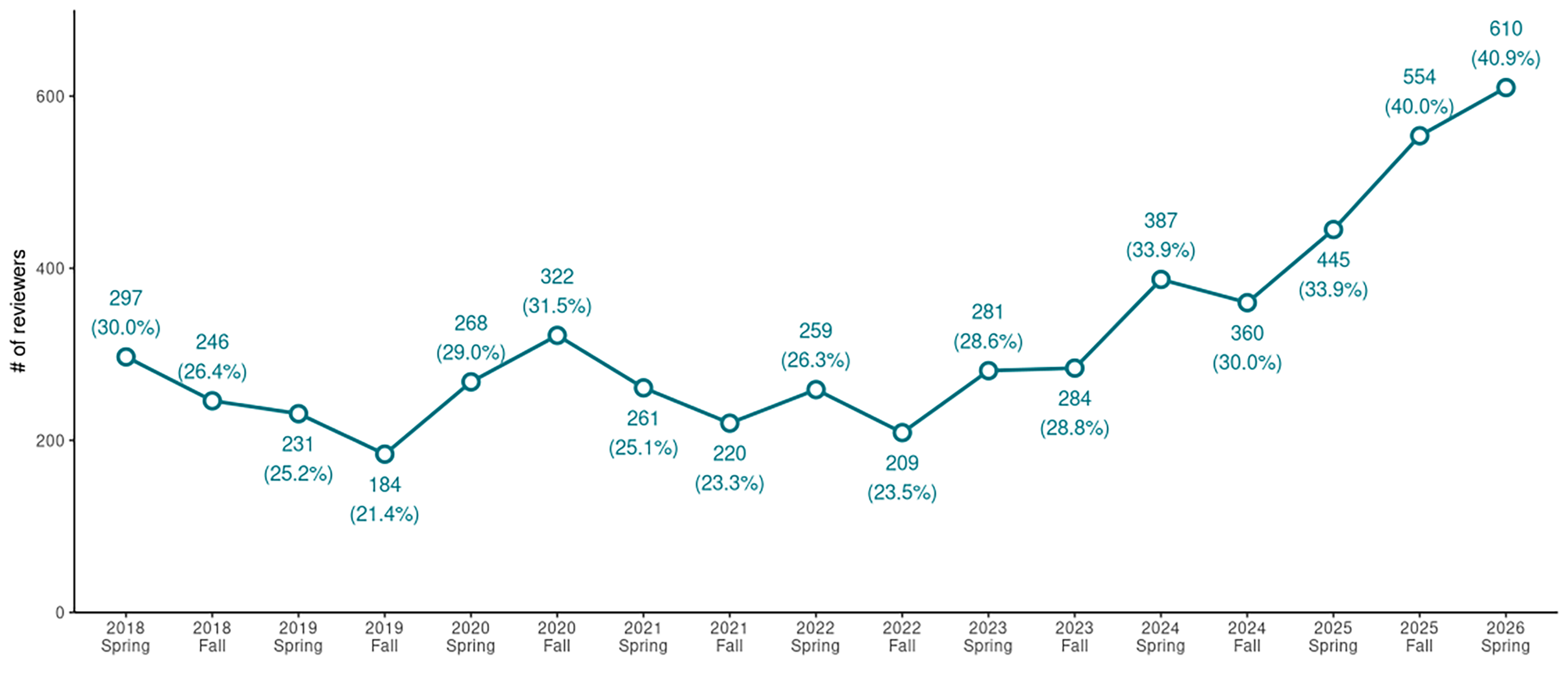
Figure 16 long description
| Competition | Number of reviewers | Proportion |
|---|---|---|
| 2018 Spring | 297 | 30.0% |
| 2018 Fall | 246 | 26.4% |
| 2019 Spring | 231 | 25.2% |
| 2019 Fall | 184 | 21.4% |
| 2020 Spring | 268 | 29.0% |
| 2020 Fall | 322 | 31.5% |
| 2021 Spring | 261 | 25.1% |
| 2021 Fall | 220 | 23.3% |
| 2022 Spring | 259 | 26.3% |
| 2022 Fall | 209 | 23.5% |
| 2023 Spring | 281 | 28.6% |
| 2023 Fall | 284 | 28.8% |
| 2024 Spring | 387 | 33.9% |
| 2024 Fall | 360 | 30.0% |
| 2025 Spring | 445 | 33.9% |
| 2025 Fall | 554 | 40.0% |
| 2026 Spring | 610 | 40.9% |
Figure 17: Number of reviewers with no applications discussed
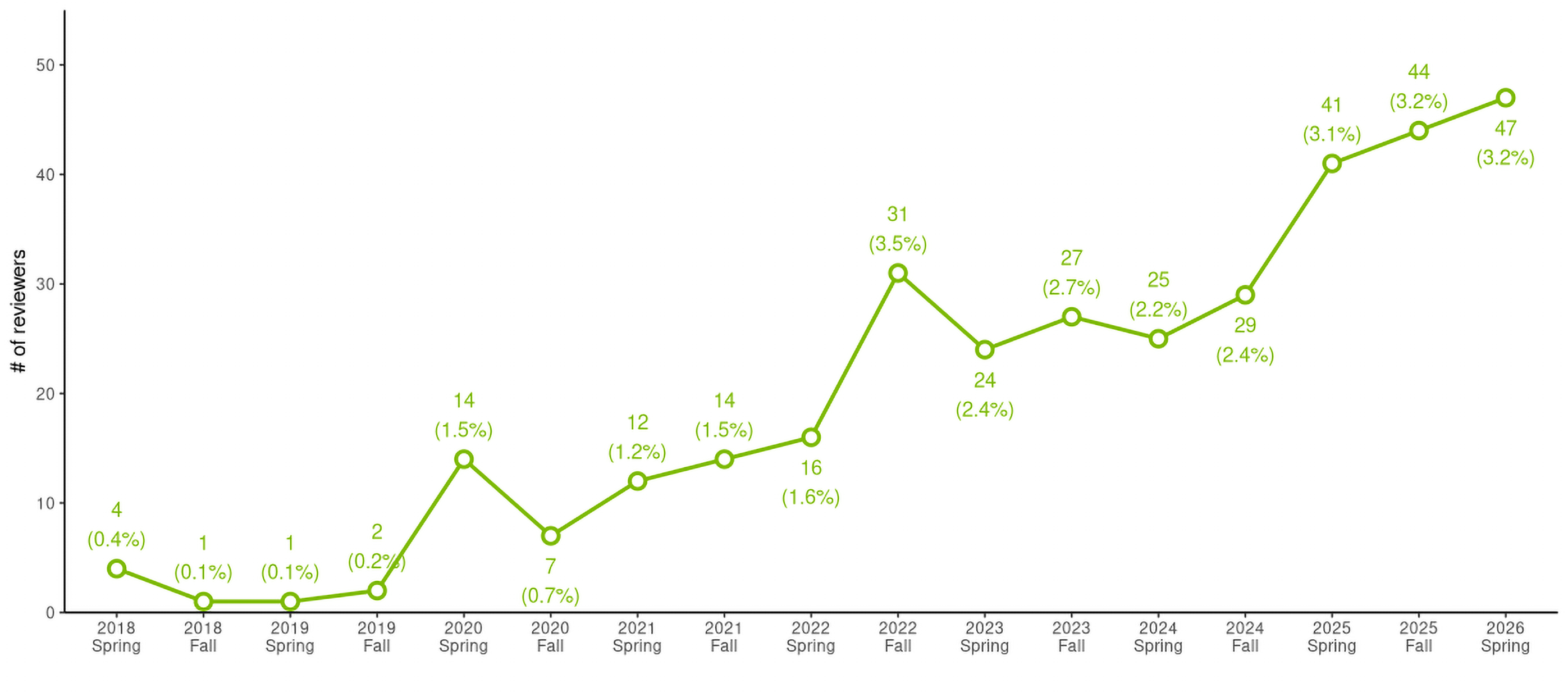
Figure 17 long description
| Competition | Number of reviewers | Proportion |
|---|---|---|
| 2018 Spring | 4 | 0.4% |
| 2018 Fall | 1 | 0.1% |
| 2019 Spring | 1 | 0.1% |
| 2019 Fall | 2 | 0.2% |
| 2020 Spring | 14 | 1.5% |
| 2020 Fall | 7 | 0.7% |
| 2021 Spring | 12 | 1.2% |
| 2021 Fall | 14 | 1.5% |
| 2022 Spring | 16 | 1.6% |
| 2022 Fall | 31 | 3.5% |
| 2023 Spring | 24 | 2.4% |
| 2023 Fall | 27 | 2.7% |
| 2024 Spring | 25 | 2.2% |
| 2024 Fall | 29 | 2.4% |
| 2025 Spring | 41 | 3.1% |
| 2025 Fall | 44 | 3.2% |
| 2026 Spring | 47 | 3.2% |
Figure 18: Proportion of NPAs who reviewed in the previous competition
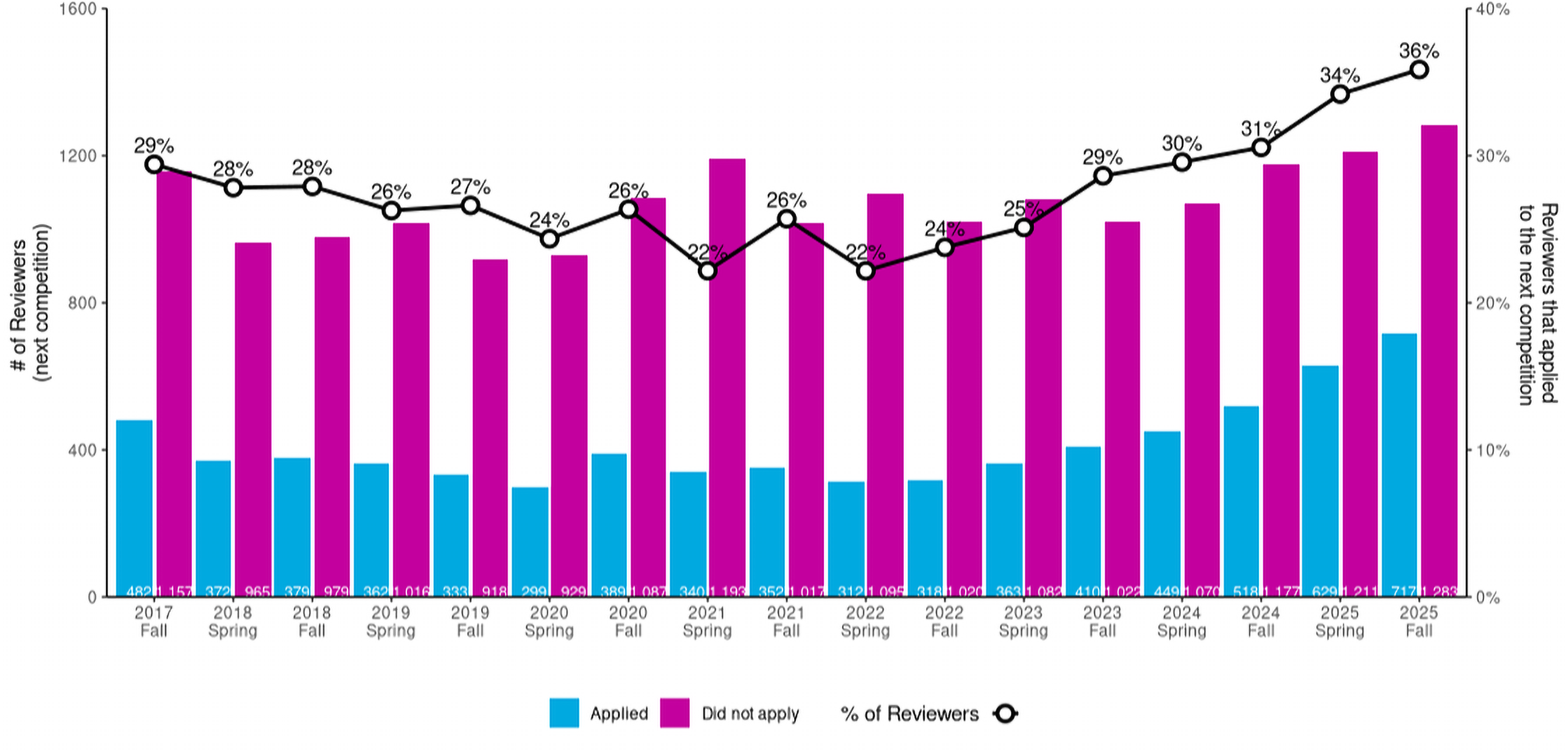
Figure 18 long description
| Competition | Reviewers who applied | Reviewers who did not apply | Percentage of reviewers that applied to the next comeptition |
|---|---|---|---|
| 2017 Fall | 482 | 1157 | 29.4% |
| 2018 Spring | 372 | 965 | 27.8% |
| 2018 Fall | 379 | 979 | 27.9% |
| 2019 Spring | 362 | 1016 | 26.3% |
| 2019 Fall | 333 | 918 | 26.6% |
| 2020 Spring | 299 | 929 | 24.3% |
| 2020 Fall | 389 | 1087 | 26.4% |
| 2021 Spring | 340 | 1193 | 22.2% |
| 2021 Fall | 352 | 1017 | 25.7% |
| 2022 Spring | 312 | 1095 | 22.2% |
| 2022 Fall | 318 | 1020 | 23.8% |
| 2023 Spring | 363 | 1082 | 25.1% |
| 2023 Fall | 410 | 1022 | 28.6% |
| 2024 Spring | 449 | 1070 | 29.6% |
| 2024 Fall | 518 | 1177 | 30.6% |
| 2025 Spring | 629 | 1211 | 34.2% |
| 2025 Fall | 717 | 1283 | 35.8% |
Figure 19: Success rate by resubmission attempt
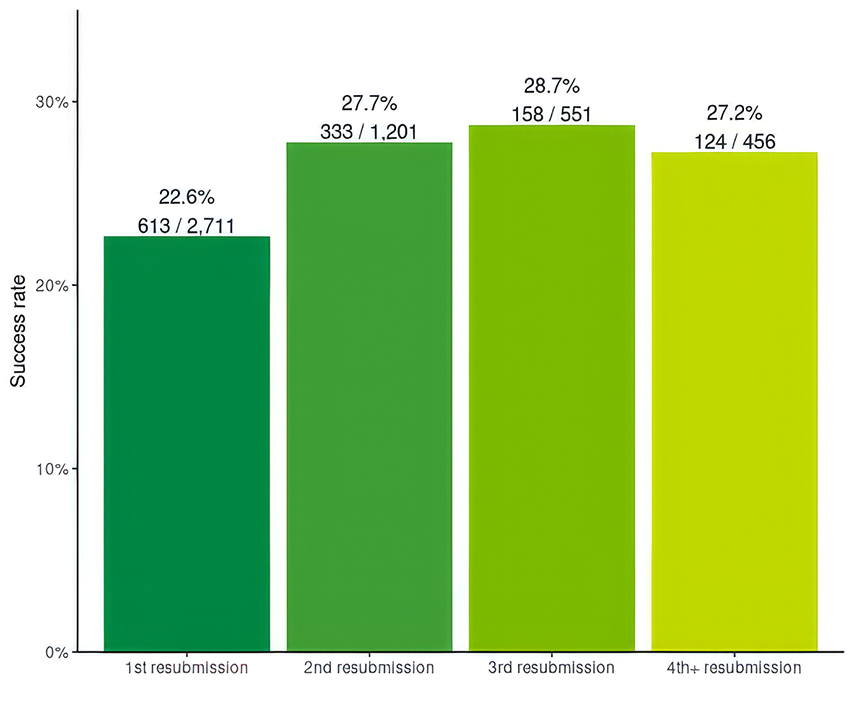
Figure 19 long description
| Resubmission type | N | N funded | Success rate |
|---|---|---|---|
| 1st resubmission | 2711 | 613 | 22.6% |
| 2nd resubmission | 1201 | 333 | 27.7% |
| 3rd resubmission | 551 | 158 | 28.7% |
| 4th+ resubmission | 456 | 124 | 27.2% |
Figure 20: Number of competitions before resubmission and proportion funded
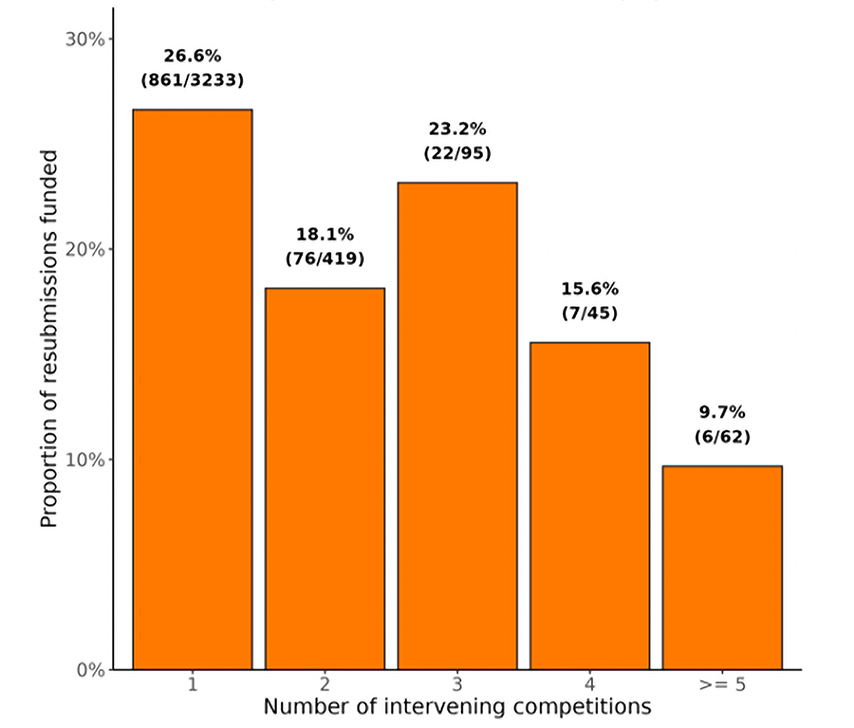
Figure 20 long description
| Number of intervening competitions | Proportion of resubmissions funded | Number of resubmissions funded | Total number of resubmissions |
|---|---|---|---|
| 1 | 26.6% | 861 | 3233 |
| 2 | 18.1% | 76 | 419 |
| 3 | 23.2% | 22 | 95 |
| 4 | 15.6% | 7 | 45 |
| >= 5 | 9.7% | 6 | 62 |
Figure 21: Success rates of applications and reviewers in common between previous submissions and resubmissions
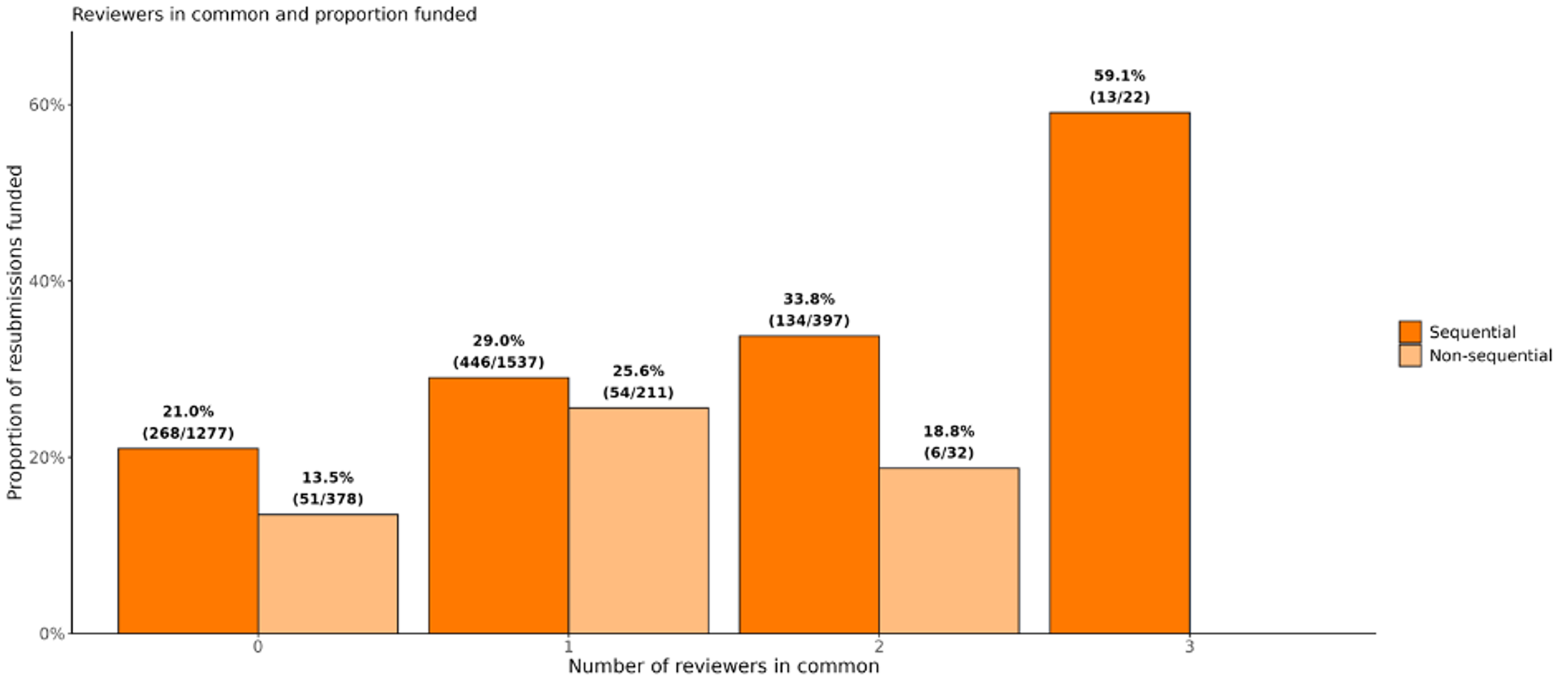
Figure 21 long description
| Proportion of resubmissions funded | Number of resubmissions funded | Total number of resubmissions | ||||
|---|---|---|---|---|---|---|
| Number of reviewers in common | Sequential | Non-sequential | Sequential | Non-sequential | Sequential | Non-sequential |
| 0 | 21.0% | 13.5% | 268 | 51 | 1277 | 378 |
| 1 | 29.0% | 25.6% | 446 | 54 | 1537 | 211 |
| 2 | 33.8% | 18.8% | 134 | 6 | 397 | 32 |
| 3 | 59.1% | 13 | 0 | 22 | 0 | |
Figure 22: Success rate of NPAs that submit single or multiple applications
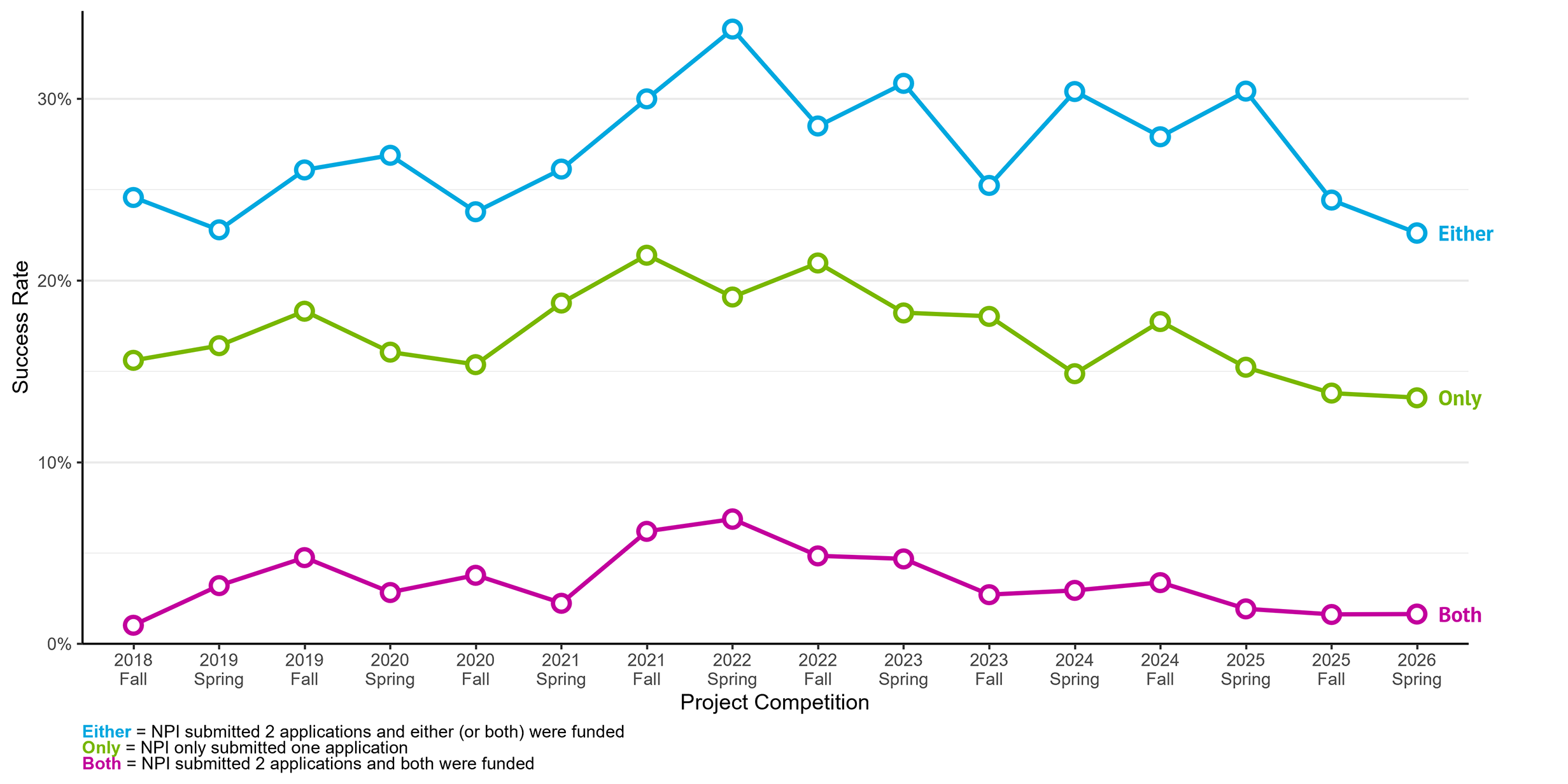
Figure 22 long description
| Project Competition | NPA Type | Success Rate |
|---|---|---|
| 2018 Fall | Only | 15.6% |
| 2018 Fall | Either | 24.6% |
| 2018 Fall | Both | 1.0% |
| 2019 Fall | Only | 18.3% |
| 2019 Fall | Either | 26.1% |
| 2019 Fall | Both | 4.7% |
| 2019 Spring | Only | 16.4% |
| 2019 Spring | Either | 22.8% |
| 2019 Spring | Both | 3.2% |
| 2020 Fall | Only | 15.4% |
| 2020 Fall | Either | 23.8% |
| 2020 Fall | Both | 3.8% |
| 2020 Spring | Only | 16.1% |
| 2020 Spring | Either | 26.9% |
| 2020 Spring | Both | 2.8% |
| 2021 Fall | Only | 21.4% |
| 2021 Fall | Either | 30.0% |
| 2021 Fall | Both | 6.2% |
| 2021 Spring | Only | 18.8% |
| 2021 Spring | Either | 26.1% |
| 2021 Spring | Both | 2.2% |
| 2022 Fall | Only | 21.0% |
| 2022 Fall | Either | 28.5% |
| 2022 Fall | Both | 4.8% |
| 2022 Spring | Only | 19.1% |
| 2022 Spring | Either | 33.8% |
| 2022 Spring | Both | 6.9% |
| 2023 Fall | Only | 18.0% |
| 2023 Fall | Either | 25.2% |
| 2023 Fall | Both | 2.7% |
| 2023 Spring | Only | 18.2% |
| 2023 Spring | Either | 30.8% |
| 2023 Spring | Both | 4.7% |
| 2024 Fall | Only | 17.7% |
| 2024 Fall | Either | 27.9% |
| 2024 Fall | Both | 3.4% |
| 2024 Spring | Only | 14.9% |
| 2024 Spring | Either | 30.4% |
| 2024 Spring | Both | 2.9% |
| 2025 Fall | Only | 13.8% |
| 2025 Fall | Either | 24.4% |
| 2025 Fall | Both | 1.6% |
| 2025 Spring | Only | 15.2% |
| 2025 Spring | Either | 30.4% |
| 2025 Spring | Both | 1.9% |
| 2026 Spring | Only | 13.5% |
| 2026 Spring | Either | 22.6% |
| 2026 Spring | Both | 1.6% |
Figure 23: Percent rank of previous application by the proportion of funded resubmissions
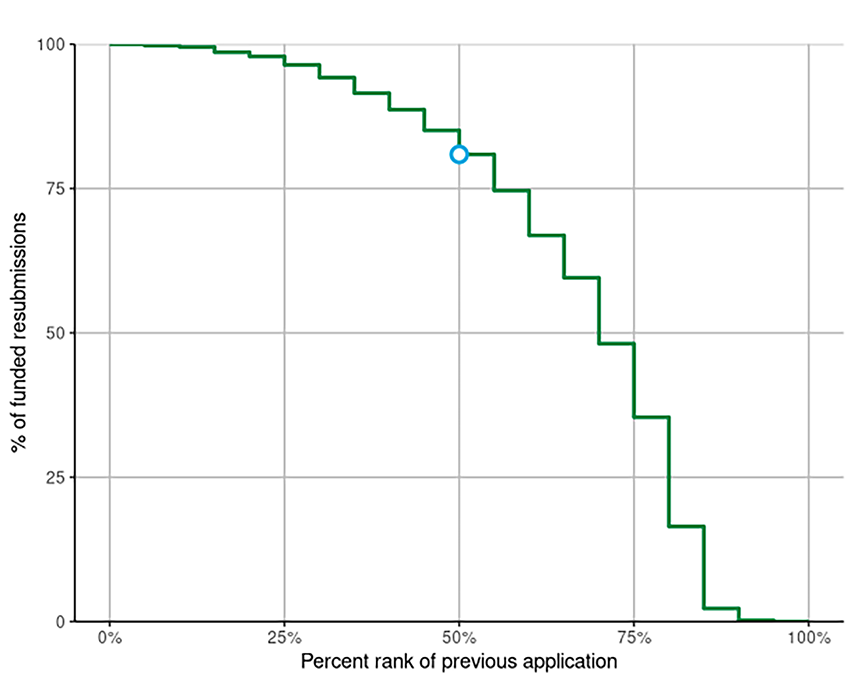
Figure 23 long description
| Percent rank of previous application | Number of grants funded | Total number of applications | Proportion |
|---|---|---|---|
| 0% | 1226 | 1226 | 100% |
| 5% | 1223 | 1226 | 99.8% |
| 10% | 1220 | 1226 | 99.5% |
| 15% | 1209 | 1226 | 98.6% |
| 20% | 1200 | 1226 | 97.9% |
| 25% | 1182 | 1226 | 96.4% |
| 30% | 1155 | 1226 | 94.2% |
| 35% | 1122 | 1226 | 91.5% |
| 40% | 1087 | 1226 | 88.7% |
| 45% | 1043 | 1226 | 85.1% |
| 50% | 992 | 1226 | 80.9% |
| 55% | 915 | 1226 | 74.6% |
| 60% | 820 | 1226 | 66.9% |
| 65% | 730 | 1226 | 59.5% |
| 70% | 590 | 1226 | 48.1% |
| 75% | 434 | 1226 | 35.4% |
| 80% | 202 | 1226 | 16.5% |
| 85% | 28 | 1226 | 2.28% |
| 90% | 3 | 1226 | 0.245% |
| 95% | 0 | 1226 | 0% |
| 100% | 0 | 1226 | 0% |
Figure 24: Percent rank of previous submissions by a) all or b) funded
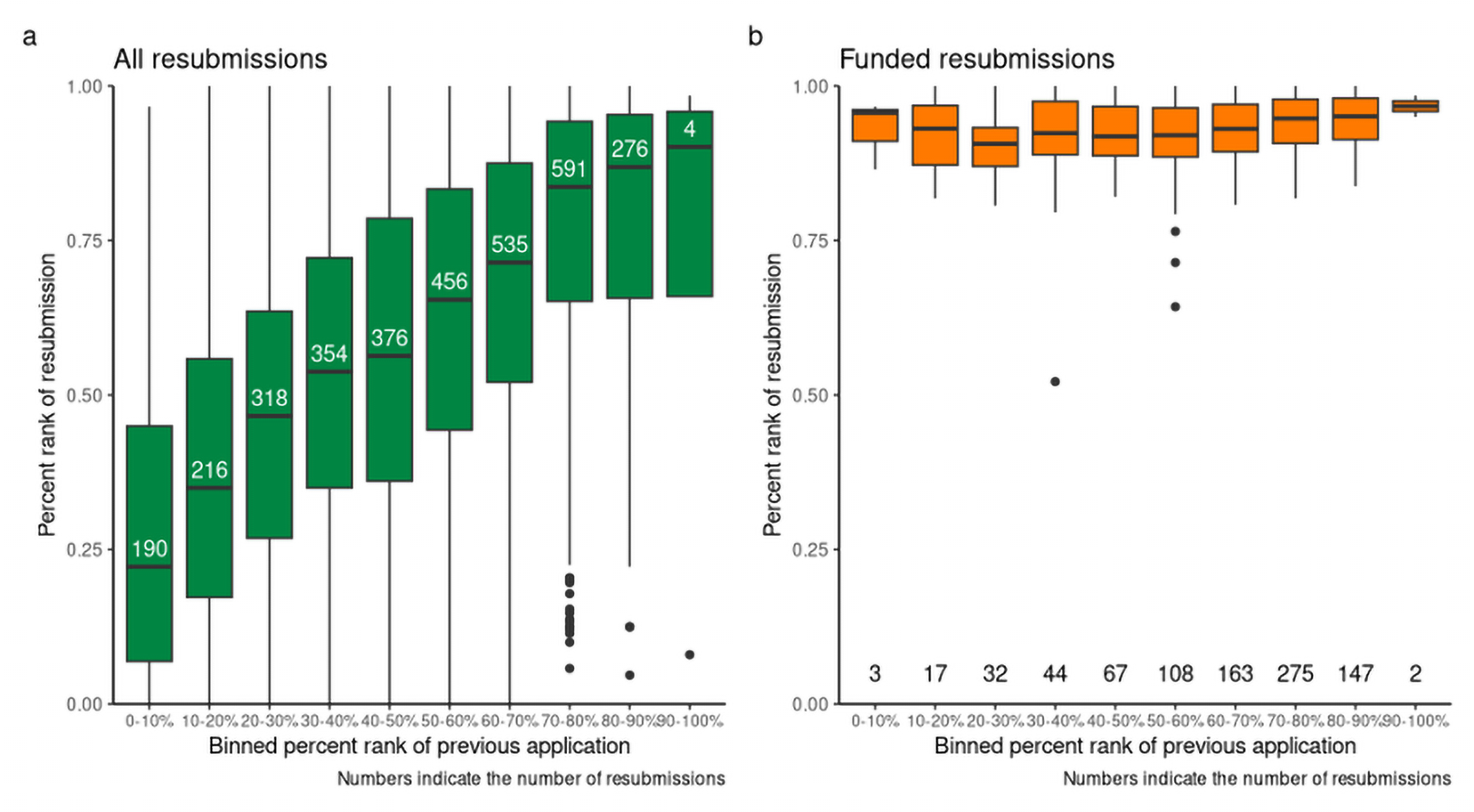
Figure 24 long description
| Binned percent rank of previous application | Group | Sample size | Median percent rank of resubmission | Minimum percent rank of resubmission | Maximum percent rank of resubmissions | Interquartile range of percent rank of resubmission |
|---|---|---|---|---|---|---|
| 10-20% | All resubmissions | 321 | 0.353 | 0 | 1 | 0.382 |
| 60-70% | All resubmissions | 774 | 0.717 | 0 | 1 | 0.351 |
| 50-60% | All resubmissions | 719 | 0.643 | 0 | 1 | 0.384 |
| 20-30% | All resubmissions | 465 | 0.454 | 0 | 1 | 0.384 |
| 40-50% | All resubmissions | 578 | 0.546 | 0 | 1 | 0.397 |
| 70-80% | All resubmissions | 845 | 0.837 | 0.0577 | 1 | 0.297 |
| 0-10% | All resubmissions | 280 | 0.261 | 0 | 1 | 0.394 |
| 30-40% | All resubmissions | 525 | 0.518 | 0 | 1 | 0.412 |
| 80-90% | All resubmissions | 398 | 0.864 | 0.0244 | 1 | 0.281 |
| 90-100% | All resubmissions | 14 | 0.643 | 0.08 | 1 | 0.356 |
| 50-60% | Funded resubmissions | 164 | 0.915 | 0.643 | 1 | 0.0728 |
| 70-80% | Funded resubmissions | 393 | 0.949 | 0.805 | 1 | 0.0701 |
| 30-40% | Funded resubmissions | 68 | 0.919 | 0.522 | 1 | 0.0872 |
| 20-30% | Funded resubmissions | 45 | 0.911 | 0.806 | 1 | 0.0662 |
| 10-20% | Funded resubmissions | 20 | 0.912 | 0.806 | 1 | 0.0964 |
| 60-70% | Funded resubmissions | 234 | 0.931 | 0.787 | 1 | 0.0757 |
| 80-90% | Funded resubmissions | 200 | 0.954 | 0.838 | 1 | 0.0683 |
| 40-50% | Funded resubmissions | 95 | 0.915 | 0.788 | 1 | 0.0847 |
| 0-10% | Funded resubmissions | 6 | 0.939 | 0.865 | 1 | 0.0731 |
| 90-100% | Funded resubmissions | 3 | 0.984 | 0.95 | 1 | 0.025 |
Figure 25: Proposed process and timeline for one intake per year
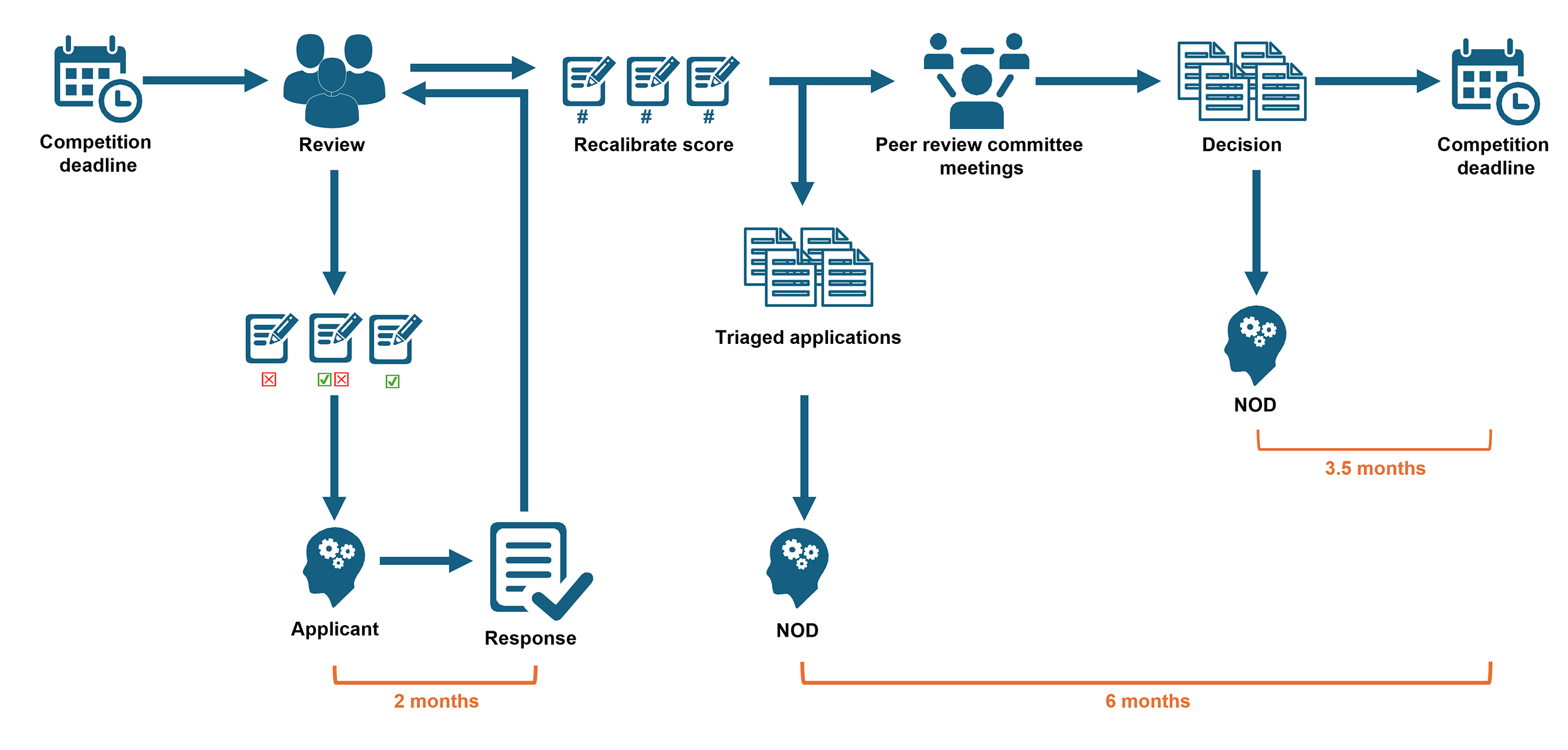
Figure 25 long description
This figure illustrates a proposed single annual intake model with an integrated feedback-and-response process. The figure is arranged from left to right and uses blue icons connected by arrows to demonstrate this proposed process.
The process begins on the far left with an icon labelled “Competition deadline.” An arrow points to a “Review” stage icon. From this stage, an arrow leads downward to reviewer assessment icons, and then to an “Applicant” icon. These icons depict how initial assessments could be provided to applicants. An arrow then points to a “Response” icon, with a return arrow to the review process to demonstrate how applicants would have an opportunity to submit a response to the reviewers.
An orange bracket beneath these icons indicates that this feedback-and-response phase would take 2 months.
From the “Review” icon, an arrow points to a “Recalibrate score” icon, showing how reviewers would recalibrate their scores based on applicants’ responses.
A downward arrow leads to a “Triaged applications” icon, illustrating the applications that will not be discussed in committee meetings. From there, an arrow points to a “Notice of Decision” icon.
From the “Recalibrate score” icon, an arrow points right to a “Peer review committee meetings” icon. An arrow then leads to a “Decision” icon. From the “Decision” icon, one arrow points downward to a “Notice of Decision” icon, while a separate arrow points to the right to a “Competition deadline” icon.
Orange brackets indicate that the time between Notices of Decision for triaged applications and the next competition deadline is 6 months, while the time between Notices of Decision for discussed applications and the next competition deadline is 3.5 months.
Figure 26: Number of competitions to first funded Project grant
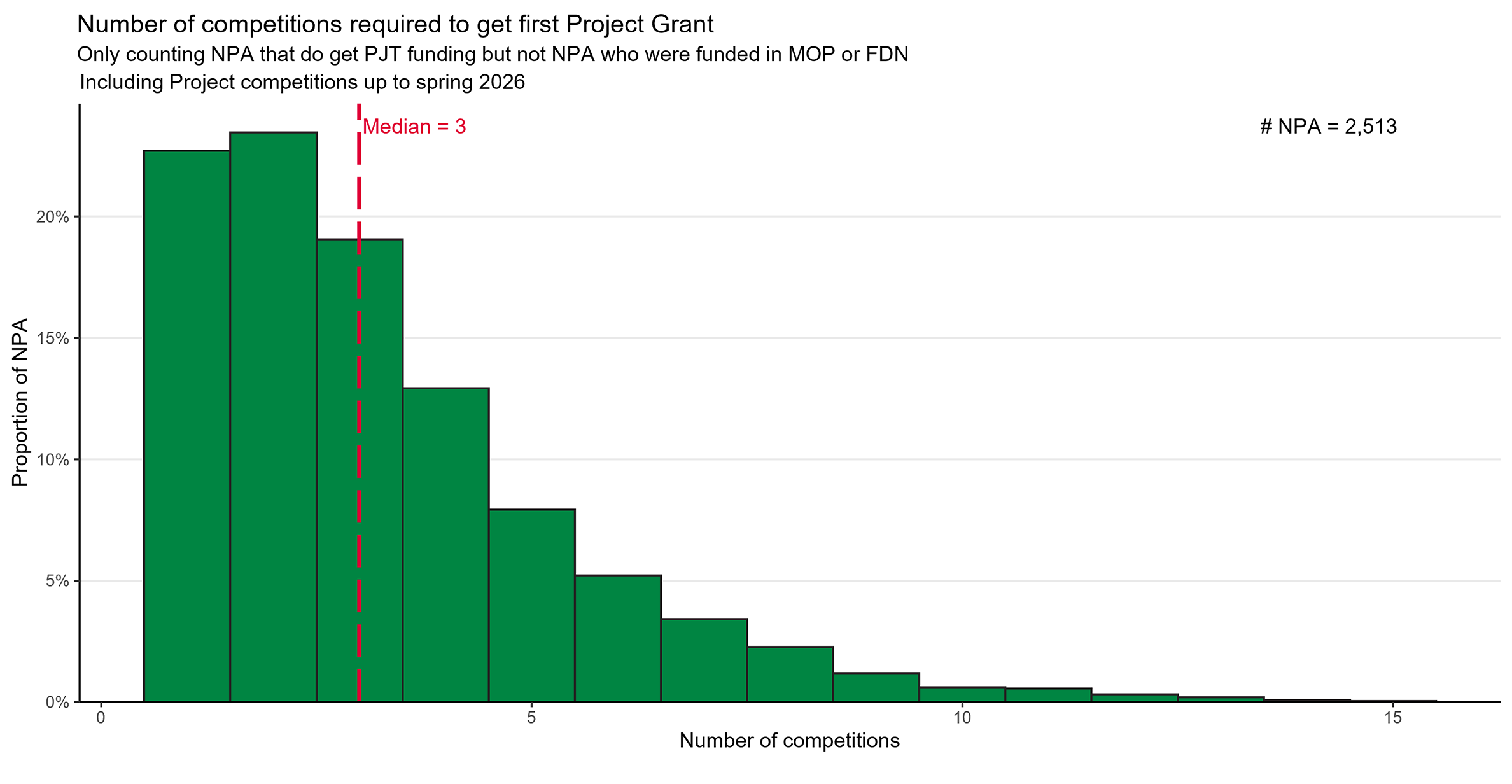
Figure 26 long description
| Number of competitions to first Project Grant | Number of NPA | Proportion of NPA |
|---|---|---|
| 1 | 571 | 22.7% |
| 2 | 590 | 23.5% |
| 3 | 479 | 19.1% |
| 4 | 325 | 12.9% |
| 5 | 199 | 7.9% |
| 6 | 131 | 5.2% |
| 7 | 86 | 3.4% |
| 8 | 57 | 2.3% |
| 9 | 30 | 1.2% |
| 10 | 15 | 0.6% |
| 11 | 14 | 0.6% |
| 12 | 8 | 0.3% |
| 13 | 5 | 0.2% |
| 14 | 2 | 0.1% |
| 15 | 1 | 0.0% |
Tables
| Activity | Description | Key Question |
|---|---|---|
Authoring |
Design of the funding opportunity (FO; program objectives, eligibility requirements, assessment criteria, funding parameters and reporting expectations |
Did we design the right program? |
Advertisement |
Communication and promotion of the FO to eligible applicants |
Did we reach the right audience? |
Application Intake |
Submission and receipt of applications (eligibility screening and collection of information for review and administration |
Did applicants submit complete applications? |
Assessment |
Evaluation of applications against established criteria through peer review to inform funding recommendations |
Was review fair and efficient? |
Approvals & Agreements |
Funding decisions are finalized, applicants are notified, and funding agreements and related documentation are completed |
Were decisions communicated promptly? |
Award & Manage |
Administration of funded grants, including release of funds, oversight of awards, and management of ongoing requirements |
Are grants being administered effectively? |
Analytics & Audit |
Collection and analysis of information related to funded projects to support accountability, performance monitoring, and auditing activities |
What do the data tell us? |
Achievement |
Assessment of research outputs, outcomes and impacts, generating evidence that informs future program improvements, Fos and funding decisions |
What impact was achieved? |
| Engagement Group | Organization/Entity | Estimated number of participants |
|---|---|---|
Advisory Boards |
Institute Advisory Boards (all 13 institutes); CIHR HIV/AIDS and STBBI Research Advisory Committee; Science Council; Investigator Initiated Research Working Group |
250 |
Networks |
University Delegates; Health Charities Coalition of Canada; Canadian Immunology Conference; III New Investigator Forum |
270 |
Institutions |
University of British Columbia; Université de Montréal; Université de Laval; University of Ottawa; Ottawa Hospital Research Institute; Université de Sherbrooke |
600 |
Peer Reviewers & Researchers |
Project Grant Chairs and Scientific Officers; Project Grant Reviewers (Spring 2024); National 'Ask Me Anything' webinars |
980 |
| Theme | Sentiment/Interpretation |
|---|---|
Root cause and core issue |
Strong consensus that system strain is real and driven by funding constraints and unsustainable application volume Strong alignment / consensus |
Clarity of framing and narrative |
Needs simpler, clearer and more compelling articulation of the problem and rationale for change Contentious / lack of consensus |
Strength of evidence |
Strong but gaps remain (disaggregated data, behaviour, perceptions and AI impacts) Concerns / important risks |
Competition structure (1 vs 2 annual intakes per year) |
Contentious with opposition due to risks to continuity of labs and impact on ECRs Contentious / lack of consensus |
Application volume management |
Broad support in principle but mixed views on mechanisms and impacts on fairness and excellence Support with important considerations |
Peer review system |
Support to preserve but need for improvements (quality, consistency, burden and incentives) Support with important considerations |
Funding decision phase |
Interest in partial randomization for funding decisions Support with important considerations |
AI and innovation |
Interest and necessity for adoption but should be exploratory with limitations and emphasis on privacy and data sovereignty Support with important considerations |
Implementation, trust and change management |
Requires strong communication, transparency, piloting and engagement Concerns / important risks |
| Intervention | Main estimated impact | Potential benefits | Potential risks |
|---|---|---|---|
One application per NPA |
Reduces application volume by 11-17% |
Applicants must prioritize their strongest proposal |
Limits flexibility Applicants may seek workarounds |
Post-grant pause |
Reduces application volume by up to 5-15% |
Broadened funding distribution Increases potential reviewer pool |
Restricts funded researchers from pursuing new opportunities immediately after receipt of funding |
Resubmission restrictions |
Reduces application volume by up to 30% |
Reduced reviewer burden Additional time for application revisions |
May prevent potentially fundable applications from returning Operationally challenging to implement Applicants may seek workarounds |
Single annual intake + feedback/response |
Improves review continuity |
Reduces application volume Better reviewer calibration Applicants can directly address concerns with the same set of reviewers |
More time between competition cycles Less flexibility on submission timing Risks funding gaps |
Biannual intake + feedback/response |
Improves review continuity |
Applicants can directly address concerns with the same set of reviewers Maintains flexibility of submission timing |
Requires more reviewers Requires substantial operational support Requires inclusion of other restriction measures |
Letter of Intent stage |
Concentrates effort to the most competitive applications |
Reduced applicant and reviewer burden |
Strong applications may be screened out early Reduced feedback for unsuccessful applicants at the LOI stage |
Rolling intake |
Increases flexibility of submission timing |
Applicants can submit when an application is ready Enhances responsivity of funding to emerging health research |
Challenges with program budget management High operational complexity Challenges with fairness, consistency, reviewer capacity, and equalization |
| Competitions/year | 2023 | 2024 | 2025 | |
|---|---|---|---|---|
# of applications |
1 |
3,285 |
3,749 |
4,390 |
2 |
4,288 |
5,074 |
5,916 |
|
Difference |
-1,003 |
-1,325 |
-1,526 |
|
# of fully funded grants |
1 |
760 |
838 |
876 |
2 |
754 |
826 |
856 |
|
Difference |
6 |
12 |
20 |
|
Success rate |
1 |
23.1% |
22.4% |
20.0% |
2 |
17.6% |
16.3% |
14.5% |
|
Difference |
5.6% |
6.1% |
5.5% |
|
% of grants equalized |
1 |
13.4% |
8.6% |
12.9% |
2 |
16.2% |
9.8% |
19.0% |
|
Difference |
-2.8% |
-1.2% |
-6.1% |
|
# of unique nominated principal applicants funded |
1 |
740 |
808 |
839 |
2 |
718 |
783 |
818 |
|
Difference |
22 |
25 |
21 |
| Intervention | Main impact | Potential benefits | Potential risks/trade-offs |
|---|---|---|---|
Mandatory peer review |
Expands reviewer pool |
Reduces recruitment challenges Reinforces reciprocity |
Additional burden to overtaxed research community |
Enhanced Chair and SO roles |
Improves review quality and consistency |
Stronger oversight, calibration, reviewer support, and deliberation |
Increased responsibilities for Chair and SOs |
Expanded in-person peer review |
Strengthens engagement and discussion quality |
Improved calibration, networking, and reviewer experience |
Significant cost and operational requirements Risks alienating reviewers unable to attend in-person meetings A seasonal risks inconsistencies in process across the virtual and in-person peer review meetings |
Partial randomization |
Addresses uncertainty among highly ranked applications |
Acknowledges limits of ranking similar proposals Improved perceived fairness and equity in funding outcomes |
Controversial among some applicants and reviewers |
Expanded Program Officer model |
Increases scientific and programmatic oversight |
Improved applicant support, portfolio management, and strategic guidance |
Significant new staffing and operational costs Recruitment and retention challenges |
Funding decisions beyond rank order |
Allows flexibility in funding decisions for equally meritorious applications |
Supports strategic priorities and/or specific underfunded groups |
Concerns about transparency, fairness and objectivity in peer review |
| Intervention | Main impact | Potential benefits | Potential risks/trade-offs |
|---|---|---|---|
Standalone programs |
Better aligns programs with distinct research niches |
Tailored review, oversight, and program objectives Greater flexibility |
Increased program complexity and fragmentation Additional operational complexity Risks fragmenting applicant and reviewer pools |
Alternative budget assessment approaches |
Improves alignment between requested and awarded budgets |
More transparent and consistent budget decisions Less gaming of budget requests Reduced applicant and reviewer burden |
Requires redesign of review processes Potential for fewer applications to be funded |
Revised application requirements and review criteria |
Better aligns assessment with program objectives |
Reduced applicant and reviewer burden Potential for increased support for innovation and high-risk research |
Potential uncertainty and variability in review |
- Date modified: